




Louisiana Celebrations Rooted in Tradition
By Jane Vidrine
Hopefully the first vent du nord will have arrived by the time of the 1988 Louisiana Folklife Festival. What a great time to pull out that okra which you put up on the hottest day of last summer and prepare the season's first gumbo!
The cool winds of a Louisiana fall and the rich aroma of gumbo fall are upon us. Lauren Post's Cajun Sketches describes it:
"The chinaberry trees . . . turn a beautiful yellow with the first frost, which is apt to come in November . . . Sugarcane holds its color longest . . . Although the winters are short they bring about a dullness in the landscape thought to be characteristic only of climates of far more northerly latitude . . . Between cold spells, the balmy winds the Gulf blow and ultimately bring rain" (Post 1974).
Preparation and anticipation. Whether it is in the making of a pot of gumbo or in advance of a holy day or celebration, process or ritual are repeated again and again, year after year, We look forward to the repetition. The yearly cycle of seasonal events and holidays serve as guideposts for our identity. Yet, the modern lifestyles led by most of us have caused the altering of our traditional behavior calendar. Many of the seasonal communal acts which were once essential and significant to the maintenance of familiar relations and community welfare are no longer relevant. Some of these are syrupmaking, hog boucheries, carding and weaving, and la veille (overnight visits among families).
All Saints Day
The day after Halloween, All Saints Day (La Toussaint), is more important in south Louisiana than in any other area of the country both as a Catholic Holy Day of Obligation and as a day of family unity. "According to the custom of the people, all crops had to be in, hogs were turned out to glean the cornfields and potato patches (Post 1974:18).
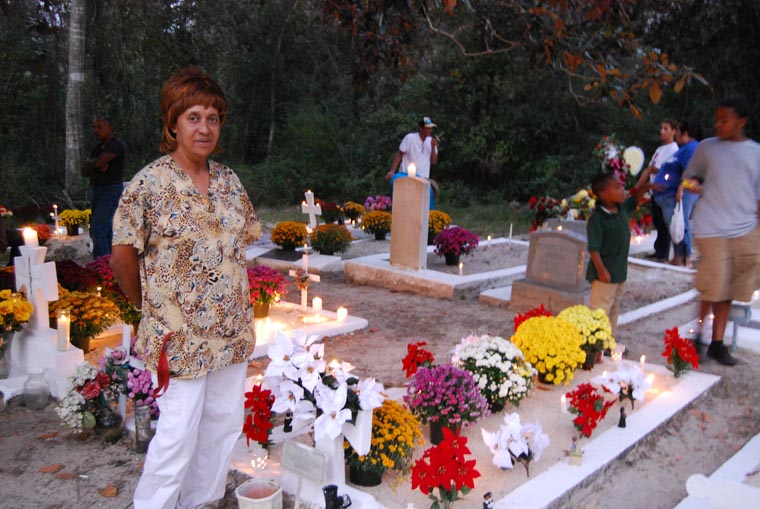
The day is one of elaborate ceremony closely aligned with Latin American celebrations on the "Day of the Dead." Many people recount that "families would gather all day to whitewash the graves and decorate them for All Saints." They would bring a picnic lunch and eat at the cemetery. Every tomb was adorned with a coronne de toussaints, a wreath of artificial or fresh flowers. Since the flowers of All Saints Day were to be everlasting through the year, the use of the waxed paper flower wreaths was popular. At one time, many women made the wreaths. One source said Black women would sell their wreaths on the steps of St. Martin de Tours Catholic Church in St. Martinville. Today, the use of crepe paper wreaths has been largely replaced by plastic flowers. In some French Catholic cemeteries in southeast Louisiana parishes, a late evening mass is followed by a candlelight ceremony in the graveyard and a blessing of the tombs. One gentleman remembers, "They would parade and parade . . . . Each one would put the candle on his [family's] tomb and kneel down and the priest would bless the dead." Most of the people interviewed have no recollection of this practice in Lafayette, St. Martin, St. Landry or Evangeline parishes, but many churches do conduct daytime mass followed by a blessing of the cemetery.
For more on All Saints Day waxed paper wreaths, obtain Craft Talk: Interviews with Five Traditional Louisiana Craftspeople, available from the Lafayette Natural History Museum bookstore.
Thanksgiving
Thanksgiving has always been celebrated the same as in other parts of the country with a gathering of family and friends for a bountiful meal. What distinguishes a Cajun Thanksgiving meal or any other meal, is the food preparation . . . particularly the dressing. Families traditions differed concerning the stuffing--whether oyster dressing, rice and meat dressing, or cornbread dressing was traditional or whether the turkey was to be stuffed or not. In the northern United States, pecan bread dressing may be made with the broth of the turkey giblets which was the piece-de-resistance of the Thanksgiving meal. In Louisiana, many people did not even have turkey until recent years, but pork which had been killed at a fall boucheries was the accepted are.
Christmas
In many parts of the northern United States, it is always freezing outside by Christmas time. That may be why the custom of shooting off firecrackers and guns on Christmas eve never caught on. Many people tell about staying up Christmas eve for midnight mass and coming home to a big pot of gumbo on the stove. One Creole gentlemen recalled "breakfast dances" which were held in some of the clubs after midnight mass until sunrise. Those stopped when closing laws made the clubs shut down by 2 am. Most people in South Louisiana relate that gift giving was modest in their childhood. The children's stocking were hung on Christmas eve and the next day contained a trinket and some fruit and sweets. Adults rarely exchanged gifts.
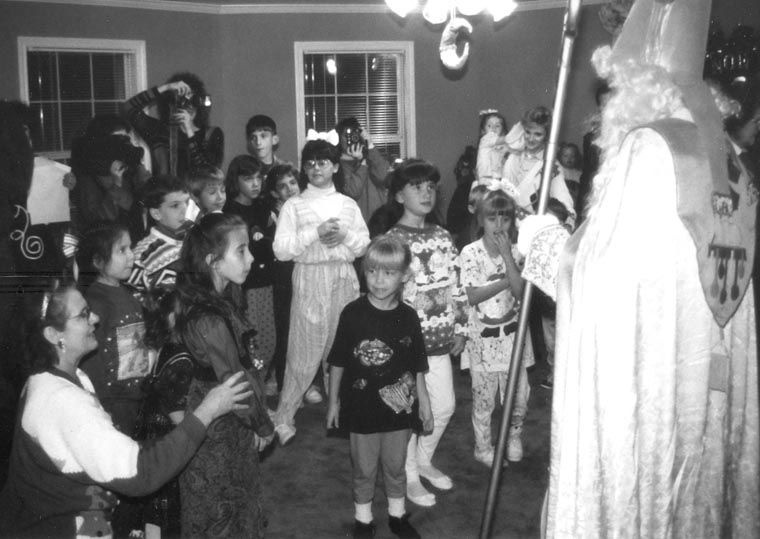
St. Nicholas Day (December 5) is an interesting tradition celebrated by the families of German descent in Robert's Cove in Acadia parish. For many generations, extended families have gathered at homes in the cove to await Kris Kringle (St. Nicholas) and Black Peter to bring treats for the good children. Several older people remember being afraid of this impressive bearded figure in white robes with a shepherd's staff, for he was said to punish the children who had not been good since last Christmas. Around the time of World War II, the St. Nicholas Day celebration was suspended but has seen a revival in recent years. The choir accompanied by St. Nicholas, Black Peter, and Santa Claus visit about ten homes in the cove. All the children are given treats, the choir sings German Christmas carols, and sweets and beverages are served. St. Nicholas Day continues to serve as an annual reminder of the Cove's German heritage.
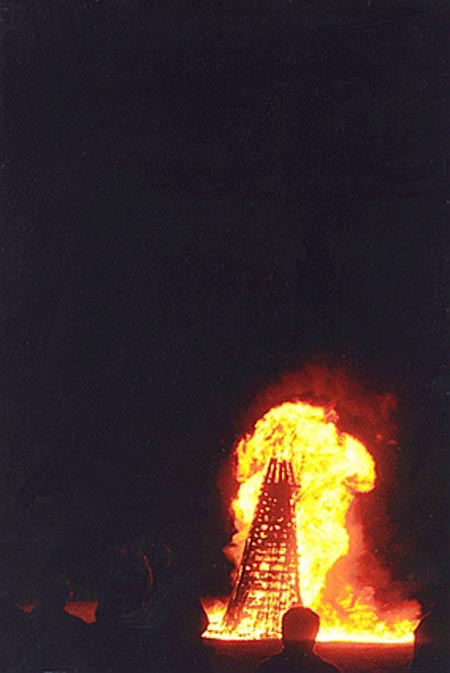
In the Mississippi River parishes of St. James and St. John the Baptist, bonfires have been lit on the levee since the mid-1800s. According to Marcia Gaudet's Tales from the Levee, the bonfires in Louisiana originated with the Marist priests at Jefferson College in Convent. "These French priests began building and lighting bonfires on the batture on New Years Eve, a tradition they had known in France. Years later, the tradition was moved to Christmas Eve and the fires were built on the levee." The fires were constructed as a tall four-sided pyre with timbers laid log-cabin style and fueled by any kind of trash which was stacked in the middle. Today, the building of fires is elaborate and very competitive. Teams of young men organize themselves year after year to build the biggest and most unique fire. The structures range from life-sized, fully equipped oil rigs to forts. Competition between the groups is so strong that often the teams post 24-hour guard during the week of construction so to guard against the possibility of arson or sabotage. To see the bonfires on the levee, drive along the Mississippi River levee south of Baton Rouge after dark on Christmas Eve.
New Year's Eve
In the countryside throughout the south, the New Year has traditionally been rung in by the sound of shotguns and firecrackers at midnight on New Year's Eve. Some Cajuns remember that Tit Homme Janvier (some call him Bonhomme Janvier), a snowy-bearded bearer of good tiding, would pass and leave fruit and nuts in the children's shoes and stockings. For many families New Year's was the time for trinket exchange, not Christmas.
An interesting French tradition is the running of La Guignolee (Gaie Annee). This is a long standing New Year's Eve custom in French communities of the mid-Mississippi Valley such as Old Mines (Les Vielles Mones), Missouri, and Prairie du Rocher, Illinois. Of note because it is closely related to the Cajun courir de Mardi Gras the intent of La Guignolee is to gather pledges of food and money for a king's ball held between Twelfth Night and Mardi Gras. On New Year's Eve, the men dress in disguise as Indians or in old clothes turned inside out. The gang of revelers travels afoot from house to house in the countryside with lanterns as their only light. Today, trucks provide the transportation. In the quiet of the night, they sneak up on the porch of each house and sing La Guignolee accompanied by a fiddle.
"Bon soir le maitre et maitresse et tous le monde du logis. Pour le dernier jour de l'annee, c'est la Guignolee vous nous devais. Si vous voulais rien a nos donnais, ditez nous le. On vous demandez seulement, la fille ainee..."
The song begs entry to the house, a 96-foot long sausage, and a dance with the eldest daughter, then apologizes to the inhabitants for any mischief caused and asks for an invitation next year.
For South Louisiana Cajuns, New Year's day used to be a time for visiting from house to house to wish bonne annee. A traditional French Creole song sung by Canray Fontenot wishes:
Bonjour bonne annee, belle heureuse annee.
Heureuse annee que je souaite a tous.
Bonjour bonne annee, madam.
In a recollection from the Anonymous Breaux Manuscript (1901), the author observes "people who have long been enemies seizing the opportunity which the day presents to be reconciled and to wish other good fortune and prosperity. A young man who wishes to marry often asks his sweetheart's parents for permission to marry."
A traditional New Year's dish, black-eyed peas and cabbage, symbolizes the promise of good luck and money in the coming year. It is still prepared and eaten diligently by many every year.
Today, recently created community festivals have become the calendrical markers of cultural identity. They have taken the place of many deeply rooted rituals which once served to reinforce the concepts of community and family.
Sources
Gaudet, Marcia. 1984. Tales from the Levee. Lafayette: University of Southwestern Louisiana.
Latimer, Beverly D. and Phoebe D. Vermillion. 1988. Crafts Talk: Visits with Five Traditional Louisiana Craftspeople. Lafayette, LA: Lafayette Natural History Museum.
Post, Lauren. 1974. Cajun Sketches from the Prairies of Southwest Louisiana. Baton Rouge: LSU Press.
Reinicke, George F. "Early Louisiana French Life and Folklore from the Anonymous Breaux Manuscript as Edited by Professor Jay K. Ditchy." Louisiana Folklore Miscellany, Vol. 2, May 1966, No. 3, p 1-56. Selected, arranged and translated by George F. Reinicke.
