




Oilfield Lore
By Ben Sandmel
Perhaps no industry has affected Louisiana so profoundly as the oil business. Besides providing jobs and filling the state's coffers (at least during boom times), oil production has spurred economic development and road building in many sections of Louisiana which were previously quite isolated—especially the south central and southwestern Cajun and Creole parishes. Such development, with its accompanying influx of mainstream American culture, increased pressures to assimilate and speak English that already existed in these areas. Fortunately, however, the past 15 years have seen such ethnocentric attitudes replaced by pride. Today, Cajun/Creole language, music and folklore are finally treated as cherished cultural resources, even as their home turf has been thoroughly modernized.
While the advent of the oil industry helped stimulate such modernization, and thus threatened the region's rich folk culture, the industry is rich in folklore in its own right. One aspect of oilfield lore consists of highly technical work jargon. A gauge of such complexity is the fact that an industry book entitled A Dictionary of Petroleum Terms (University of Texas, 1976) contains nearly 200 entries in its "A" section alone. Yet there is also a significant body of oilfield folklore which can be understood and appreciated by those who do not have oilfield experience. Some of this latter body of lore is oilfield-specific, while other terms and traditions may frequently be found outside of the industry as well.
Certain industry-specific terms such as job titles are often encountered by the public, in the course of reading or watching the news, or perusing classified employment ads. John Vidrine—a Mamou native who now resides in Lafayette, and works offshore in the dual capacity of medic and materials manager—explains the industry's various job descriptions, and the pecking order which accompanies them. "On the bottom of the ladder you have what you call a roustabout, who runs around and does everything that nobody else wants to do. He's a 'grunt.' He unloads and stacks pipe, mops, cleans, paints, that kind of thing." Crawford Vincent of Lake Charles, a former guitarist with the Cajun Swing band, the Hackberry Ramblers, worked as a roustabout in the 1940s, and describes it succinctly as "you do what you're told, and plus!"
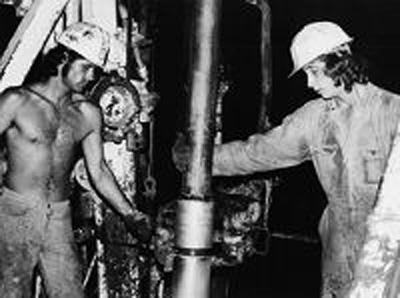
"After roustabouts," Vidrine continues, "you have the floorman, who is also known as a roughneck. They work the actual drilling floor on the rigs, and make up or break up the pipe. Their job is probably the most dangerous. There was, and still is, a macho stigma attached to that job—some of the old-timers especially might sort of be proud of having lost a finger or whatever. The description of a typical roughneck or roustabout used to be that he weighed 250 pounds or more, that at least three-quarters of that was located above his belt-line, and that he used a two-inch bull-plug for a hard-hat. In other words, he was a pin-head, and the job called for all brawn and no brains, which really isn't true."
"You can't go on to any promotion," Vidrine explains, "unless you work on the drilling floor. After floorman or roughneck, the next job would be a mud man. He follows the orders of the mud engineer in preparing the drilling mud—that's a fluid mixture which is used to equalize the pressure when you're drilling a well, so that it doesn't collapse. The next highest job is derrickman—and they work about 80 feet up in the air, too, standing on a small platform called the monkey board. Then the driller is above the derrickman—he operates the equipment and monitors everything that's going on. After the driller is the top job, toolpusher. The toolpusher is the overseer of the entire job. Sometimes he's called the rig manager, and he has the same authority as the master of the vessel on a boat. He has to work in cooperation with the company man, who represents whichever oil company has hired the rig to drill for them. There are other jobs, too, in maintenance, for instance, but those are the main ones."
Ken Hamlin, a Lafayette-based field engineer, comments that "out on the rig, the people whom I work with are always talking about their 'tool.' It's serious, important work talk, too—things like 'my tool is pulsing, my tool is rotating, my tool is on the bottom,' whatever. Everyone in the oil business knows that you're talking about drilling rather than sex, but if you say something like that when you get home, around people who don't know the business, you can tell from the look in their eye that they're taking it the other way. That's part of the transition process of coming home. Almost all the terminology can be taken two ways. Another thing is that I tend to change my speech patterns when I'm out on the rig. You get into a good old boy mode, with a lot of cursing and less proper English. My wife says it usually takes me two or three days to change back."
Hamlin goes on to explain that in addition to the job descriptions mentioned above, there's the unofficial title of a "bubba." "There's always a 'bubba' on a rig. He's usually a roughneck, and he can take anything off of anything. We couldn't get a plug off a pipe once, so we walked over to driller and asked for his "bubba." The driller knew right away that we needed one of the strongest and hard workers on his crew. He called a guy to come up, and this 'bubba' had the plug off in about three minutes."
Research in neighboring Texas reveals a wealth of informal oilfield jargon which in all likelihood is also heard in Louisiana. "He don't like to get dirty" is the negative assessment of a new hand who appears to be lazy. "Duck, or no dinner!" warns new workers to stay alert so that they'll live until their next meal. "Walk fast and look worried" is the recommended procedure if a company bigshot shows up unexpectedly. "Close-ology" refers to the art of drilling as close as legally possible to another company's well, in hopes of pumping from the same pool of oil. If a pipe connection loosens just a bit, ensuring that it can be eventually taken off, someone may comment "if they wink, they'll screw." "That'll drill" may be substituted for the ubiquitous "that'll work," while payment for travel to a job site is known as "windshield time." An expression popular on Louisiana rigs is "channel fever," which describes the excitement which prevails the night before a crew change, when everyone is about to go home. If things continually go wrong on a rig, it is said to be jinxed or "snake-bit."
Some of the richest and most broadly accessible forms of oilfield folklore can be found away from the drilling floor, in the off-duty social setting of the crew's quarters. As in many other jobs, there are unofficial initiation rites for new employees.
Many times," Ken Hamlin explains, "they'll tell a new guy to go get the key to the V door, which is something that doesn't exist. Everyone who he asks will send him to someone else. After a couple of hours, someone will finally tell him `there ain't no ___in' key to the V door.' Eventually, if he lasts, he'll lay it on someone else.
Nowadays the companies are really cracking down on horseplay," John Vidrine explains, "because everyone is more concerned with safety, but there used to be a lot of goosing going on out there, and they would try to catch people in the worst possible position. I've seen lots of guys get goosed. There were lots of practical jokes, too, like short-sheeting beds. And I knew a rig engineer who would stick raw eggs in people's work boots when they were sleeping, and then yell something like 'FIRE!,' and watch them jump into their boots and crunch those eggs.
During the oil industry's infancy in Louisiana, however, safety concerns often took a distant second to production quotas. Edwin Duhon, who co-founded The Hackberry Ramblers back in 1933, also spent years working in the oilfields, beginning in 1927. (Significantly enough, one of the group's favorite and most popular numbers is an oilfield-related song entitled "The Pipeliner's Blues".)
"I was on a land rig once with a driller named Bill Bolton," Duhon recalls, "and we had a roughneck named Vic Legendre working the tongs. We hit a floating rock, and the drill stem was very thin, and this sharp-edged pipe fell on Vic and slashed him open all the way to the bone—we could see his lung! And Bill Bolton said, 'Get him out of the way, we got to go into the hole and finish the pipe!' Some of the roughnecks put Vic in a car and took him to the hospital, and the rest of them damn near lynched Bill."
Such strong sentiments indicated the camaraderie which develops when a worker is accepted by his peers. (If not, he may be regarded as "a problem child" who must be "run off.") Nicknames serve as a symbol of insider status.
"I have a master's degree in geology," Ken Hamlin says, "but I started out working as a roustabout to pay my college tuition. They called me 'College Boy' as a test, in a way, to see if I could handle the hardest dirty jobs, and really work. But basically it is a sign of acceptance if you get a nickname. More recently I've been called 'Mr. Coffee,' since I work 20 or 30 hours straight, and drink a lot of it to stay awake. Sometimes the roustabouts refer to their supervisor as 'Daddy,' and he'll refer to them as his 'children.' Then there are always lots of guys called Slim, Chico, Skeeter, nicknames that you'd find in rural America. And people will write those names on their hard hats."
"Where I'm working now," John Vidrine says, "at first they'd just call me 'storekeeper'—not too friendly. I knew they were starting to like me when they called me 'Cousin John,' and when I moved up the family tree to 'Uncle John' then I was in. If you get the freeze out there, if you people decide you're not cool, then no one will talk to you except the galley hands, and you probably won't last long."
"Something that I find interesting," Vidrine continues, "is that every rig I've worked on out of Louisiana has had a majority percentage of non-Louisiana people in the crew. And there are definitely some cultural clashes, with a certain amount of animosity. People will ask me where I'm from and when I say 'Mamou' they'll say 'you're one of them coon-asses, ain't you?' and I'll say 'yeah, and you must be one of them stump jumpers.' Then they'll call all of us 'Boudreaux,' no matter what our names are. And if any of us Cajuns speak in French among ourselves, then these guys from Texas or Mississippi are convinced that we're talking about them—which we probably are."
Despite such cultural conflicts, and the massive environmental damage which oil production has caused, many Louisianans feel indebted to the oil industry. "A lot of Cajun people worked in the oilfields," Edwin Duhon says, "and it really came in handy for us. It beat picking cotton, I'll tell you that. It helped feed a lot of families, and I don't think it discouraged the French language or anything like that. The oilfield was a big bonus for the French people, we all know that. If it hadn't been for the oilfield, as of right now we might still be living like we were 50 or 60 years ago, just farming." While the oil industry is bound to keep causing both environmental and economic controversy, its importance in Louisiana folklore cannot be disputed.
