




Traditional Quiltmaking in Louisiana
By Susan Roach
Traditional quiltmaking, one of the most prevalent domestic folk crafts in Louisiana, is widely practiced by Anglo- and African-American women in the rural areas of the state and by some Native American women as well. Research on Louisiana quilters shows that their quilts are comparable to other American quilts, which is to be expected since the quiltmaking tradition traveled to Louisiana with settlers across the upland South. American quilts typically use one of three separate techniques, each having long histories. The typical quilt consists of three layers—a top of either solid fabric or patchwork; a filler or batting of cotton, wool, or blanket; and a lining or bottom usually of a solid fabric. The term patchwork generally applies to needlework which uses scraps of fabric either as pieces in a mosaic joined edge to edge by stitching (also called pieced work) or as decoration applied to the surface of a plain background fabric (called appliqué). Quilting itself is the process of sewing the layers together.
In any given region of the state, it is probably possible to find several women who have made and continue to make quilts. In urban areas, some younger women are learning quiltmaking in popular quilt classes taught by revivalist quilters; however, in more rural areas, traditional quiltmaking techniques practiced mainly by middle-aged or older women have been passed down from past generations.
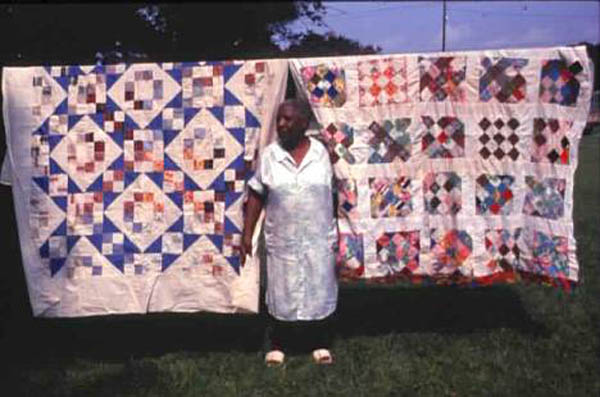
The learning process of traditional quiltmaking parallels that of other folk art in that a few directions are given now and then, but generally the pupil learns by watching and imitating. Quiltmaking, like any folk art or any art, requires a degree of technical ability. Competence in the craft involves not only the learning and practice of skills, such as color coordination, cutting patterns, piecing, and quilting but also the acquisition of knowledge of local standards and acceptable modes of creative expression. Most of the quilters learned quiltmaking basics between the ages of four and fifteen from mothers, grandmothers, and neighbors. Doris Nolen, of Vernon parish, typifies this early learning: "As far back as I can remember, I used to cut out scraps with Mama. Even before I started school, Mama and Granny used to quilt in front of the fireplace." Or as Nova Mercer, of Jackson Parish, jokingly puts it, "I was born with a needle and thread in my hand instead of a silver spoon," a statement which refers to a very early knowledge of sewing and also a life of work instead of leisure.
Usually girls began learning to piece by sewing pieces of cloth together. Cloaner Smith, of Claiborne Parish, tells of her early interest and her mother's support:
"I've been quilting since I was old enough to sew. My mother always done that, and I was a nosy, little old girl, and I always stood in the way. Every scrap she'd drop, why, I'd pick it up and sew. I kept sewing until I got where I could make a good block, and she put it in her quilt as encouragement."
Sometimes a young girl would learn the rudiments of making simple quilts for cover but would never master the finer points of making fancier quilts; others, such as Nova Mercer and Opal Madden, learned basics from their families, but learned to make fancy quilts after they were married.
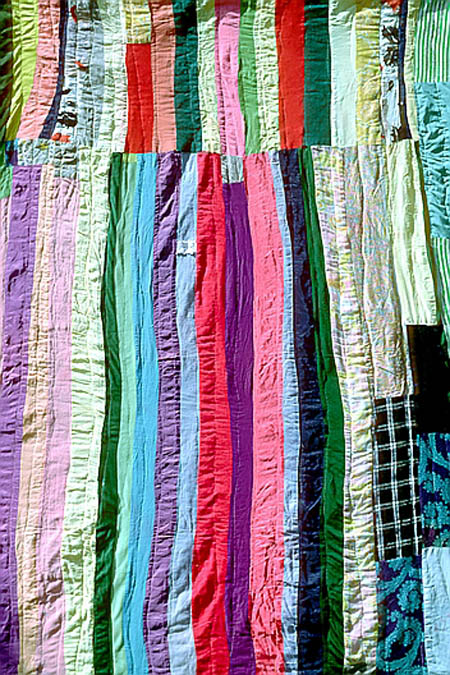
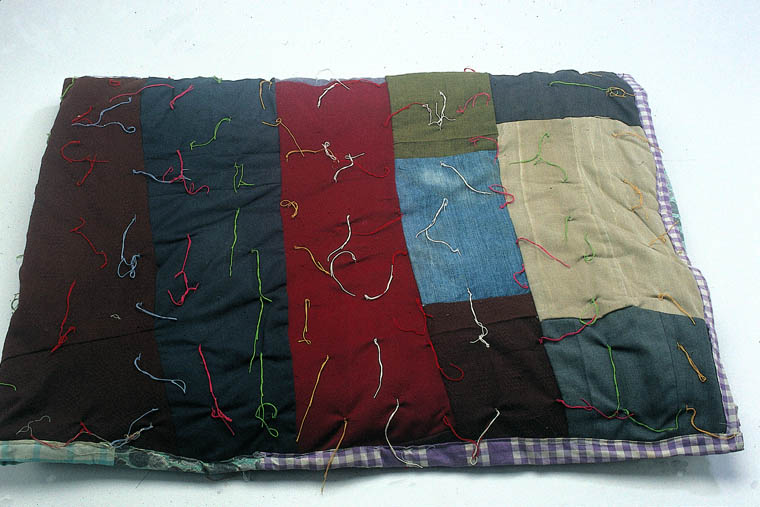
Louisiana quiltmakers' skills and experience and their quilt types have a wide range. Their quilts range from utilitarian quilts (termed "common or everyday") used for simple bedcovers to decorative ones ("fancy"), used for special occasions, gifts, competitions, or heirlooms. These labels originate in the quilter's degree of skill, her intended use of the quilt, and the amount of care and work put into a specific quilt. Some women have made only one or two quilts which may be of excellent or mediocre quality depending on their sewing skills; some make only "common" (or "everyday") quilts for cover; some make both "common" quilts and "fancy" quilts; and still others spend their time only on "fancy" quilts.
Generally, all these quilters prefer to do most of their piecing of patchwork tops, especially their fancy patterns, by hand. Nova Mercer, of Jackson Parish, and Rosie Allen, of Claiborne Parish, take pride that all their piecing is done by hand so that each corner of each piece is aligned carefully. The favorite fancy quilt patterns, such as the "Double Wedding Ring" or the "Flower Garden," call for more careful color coordination, piecing, and hand work; everyday quilts, such as the strip quilt, "Ni ne Patch," or "Trip around the World" patterns, may be carefully pieced or hurriedly sewn together by machine depending on the personality of the maker.
While piecing techniques for the quilt top are more universal, choices for the batting, lining, and quilting techniques vary more with socio-economic situations and ethnicity. Reusing old blankets or quilts for batting and pieced lining or cotton/polyester sheets are cheaper than commercial cotton or polyester batting and color-coordinated linings. British American quilters are more likely to quilt on four-sided frames either suspended from the ceiling or set up on "horses" or chairs; African-American quilters, also use these frames, but others, such as Alice Thomas, of Shreveport, quilt their quilts on the bed. In this convenient method of quilting, the lining is spread out over the bed, the batting is laid on top of the lining, and the top placed over the batting just as it would be if done in frames. However, the bed method does not attach the edges of the fabric to any edge. Instead the edges are rolled under on one side until the quilter is ready for them. Although the bed method cannot stretch the quilt tightly like the frame can and results in a less smooth top, this method is often used when space will not permit the use of frames.

Traditional quiltmaking has often been stereotyped as a communal activity centered around the quilting bee. Given the fact that quiltmaking is a long, complex task, group quilting can shorten the length of time needed to complete a quilt. Generally, most group work is done in the last stage of quiltmaking in which the layers of the quilt are stitched (quilted) together. In the past most Louisiana women participated in group quilting on occasion although today they usually make their quilts alone according to what women such as Mary Anderson report:
"No, we don't get together and quilt. You know, people used to do that. We used to do that years ago, you know, put in a quilt and give a quilting and have coffee and teacakes and something or other to serve. People don't do that no more. Everybody just quilts their ownself."
There are many possible reasons for the decline in group quilting over the years. Today, most of the women do not have to have quilts for cover even though they may use quilts in this manner. Therefore, there is usually no hurry to finish them. Probably, most significant is simply the change in lifestyle. Television and convenient transportation offer other means of entertainment and socializing. Even so, there is a trend toward more organized group quilting, which is probably the result of the recent revival of interest in quilting. Such organized groups include community groups, homemaker clubs, churches, and senior citizen centers, many of which quilt for charity. If there are no charitable causes apparent to a group, it may quilt tops for members, or to raise money for the group, the group may make quilts to raffle or may quilt tops for the public, usually for a fee ranging from $40-100.
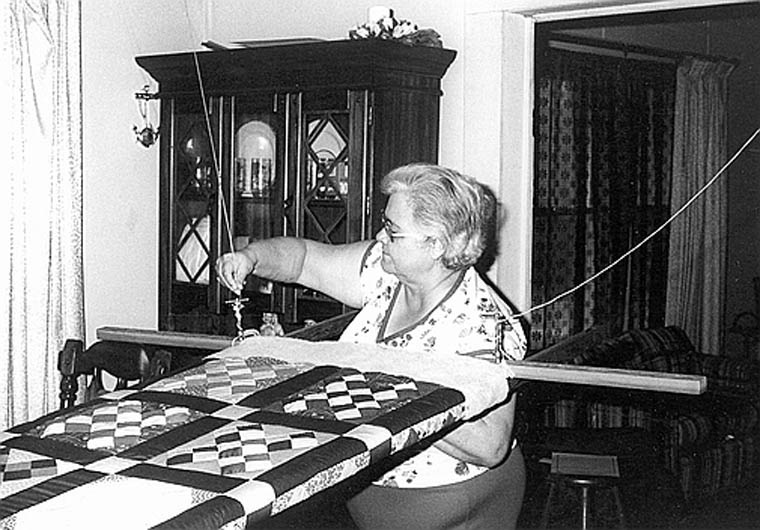
Frequently, older expert quilters also "quilt for the public." Some women who offer this service do not want anyone else to quilt on their quilts because as one woman put it: "Some quilts good, and some don't." Some quilters, more concerned than others with having consistent, small stitches on the quilts they quilt, have different aesthetic standards for quilt production, which keep them from asking others to help with quilting. For the most part then, quilters are aware of the value of their time and their products, but also know that it is difficult to get that full value in cash and do not feel it proper to sell their skills to neighbors and friends. This concern for the local low market value of quilts keeps some women from selling their quilts.
Since the income from quilting is so small, it seems unlikely that economics is a prime reason for quiltmaking. Nor is it the totally rewarding nature of the task. Women frequently metaphorically express the difficulties in making quilts. Quilting can, according to Mary Anderson, cause you to "worry your brains out." Making fancy quilts requires "taking pains" according to Mozelle Durrett, or "worry[ing] yourself to death" according to Cloaner Smith, and "yards and yards and yards of patience" according to Opal Madden. Yet "It's a pleasure if you've got time to do it, and it's pretty," says Cloaner Smith, noting the rewards of both the process—quiltmaking and the product—the quilt.
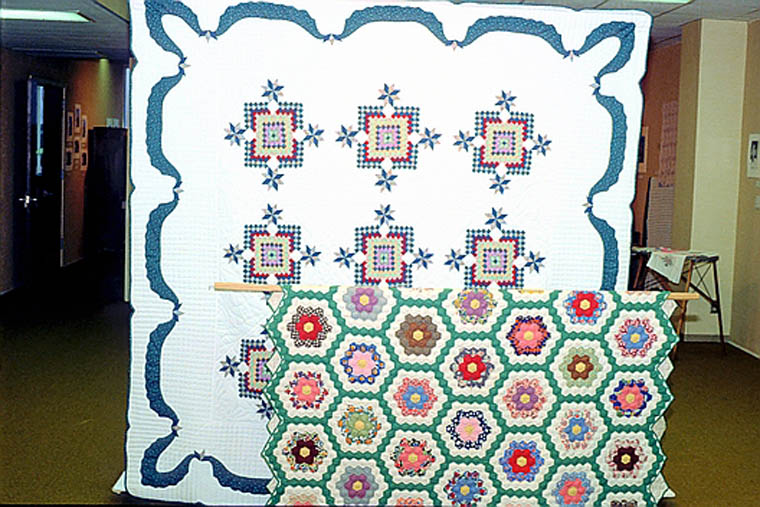
Quiltmaking, then, is also therapeutic and enjoyable because of its creative function. Artie Lindsey, of Bienville Parish, marvels at her own productions: "It just fascinates me that you can take those scraps and put them together and make something beautiful. Now that's me. I've created something."
Quiltmaking has appeal not only because it upholds the custom of recycling all possible materials, but also because it magically transforms rubbish into something valuable. However, as Mozelle Durrett explains, not all types of rubbish are worth transforming, and not all resulting objects are of equal value:
"I just like to create things, to make something worthwhile. A lot of people take these detergent bottles and cut out and make something. Well, really, I don't feel like I've done anything [when I do] such as that [laughing]. What I want to do is something that is worthwhile to show for what I've done, I guess. There's a woman lives here that takes clocks, and she takes these egg cartons, and she cuts them up and puts them around them [the clock]. When she gets through, it's big, and she uses clothes pins and all [encircling the clock]. Well, I really don't feel like you have much when you done that because it's not something that will last on, and, of course, it's showy, maybe. But it's just not my type, I'll say. The quilts, the [hooked] rugs, the crochet [are] the same way. When you've done this, you've got something to show for it, but these other things—it does show right now, but it's not lasting."
Unlike the popular fad crafts, quilts are lasting and will often outlast their maker to become heirlooms which must be carefully divided among survivors. Thus quilts bind their makers with future generations and the past, but more importantly, quilts offer a creative outlet to express feelings and an aesthetic vision.
