




Shrimping in Louisiana: Overview of a Tradition
By Laura Landry
Shrimp, shrimp, shrimp! They are boiled, fried, stewed, in a Creole sauce, an etouffee, stuffed with breadcrumbs and rice, and found in the gumbos and jambalayas of South Louisiana. Shrimping has a long history in Louisiana. Fishermen have taken advantage of Louisiana's marshes and estuaries of our coastline since earliest settlement. In 1774, an early traveler in Louisiana, Le Page du Pratz, noted that shrimp were being fished in the lakes south of New Orleans with large nets brought from France. Using small skiffs or wading in shallow waters, shrimp were caught with seine nets in the shallow coastal lakes and bays and along the beach. In the early years, shrimp was largely a product sold fresh in local markets. After Chinese immigrants introduced drying platforms for small shrimp in the last quarter of the 1800s, shrimp exportation to markets in the Orient began. The development of can liners improved canning techniques, and by 1880 the market distribution was greatly expanded. As the size of the catch increased to meet a growing consumer demand, shrimping emerged as an important folk occupation in Louisiana during the twentieth century.

Two types of fishermen shrimp in coastal Louisiana; those who shrimp with the smaller vessels in the inland bays and shallow water zones and those with larger vessels which shrimp offshore in federal waters. The inland fishermen operate during seasons regulated by the Louisiana Department of Wildlife and Fisheries. Often, their crews are family members, and the shrimping trip may last for one to several days. Larger vessels, sometimes also operated as family ventures, are outfitted to pursue offshore shrimp for extended periods of time and are able to work year round.
Many of the shrimpers who fish seasonally live in settlements along the bayous of south Louisiana and along the lower Mississippi River. Many come from a tradition of fishing and shrimping during the spring, summer and fall months, then oystering and trapping during the winter months. The ranks of shrimpers have increased as others have entered the shrimping industry. Many left city and industrial work, preferring to be their own boss. While traditionally many shrimpers in Louisiana come from a French-speaking background, Chinese, Filipino, Croatian, and Vietnamese immigrants have also entered the South Louisiana fishing industry for their livelihoods.
The earliest boats used for shrimping in Louisiana were built on the lines of traditional Mediterranean fishing vessels. Referred to as canots, these sailing boats were fitted with a centerboard, or hinged keel, and could operate in shallow waters. Boats commonly used today for shrimping the inland waters of the coast evolved from these early lugger-style boats. The term lugger comes from the boat's original sailing rig that consisted of a single large lugsail. The modern day lugger commonly seen along the bayous, lakes and bays of Louisiana is a flat-bottomed, shallow draft vessel, which varies in length from 20 to over 40 feet. The engine and wheelhouse, which replaced the centerboard casing of the earlier sailing vessel are set to the stern, with the fish hold located in the forward section of the boat. Questions remain about when and by whom this boat style was first introduced to Louisiana. But it is known that Dalmatian (Croatian) oystermen who settled in the freshwater marsh of southeastern Louisiana in the late 19th century popularized it and adapted it modern shrimping.
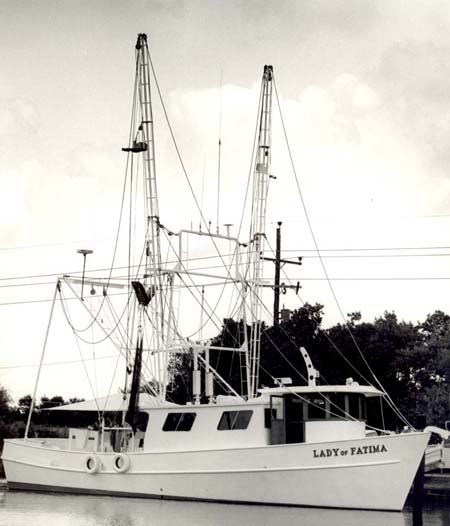
The larger offshore shrimp boats used today were introduced in 1938 by Florida fishermen, who helped to develop the state's offshore shrimping industry. These South Atlantic type vessels, typically 50 to 65 feet long, have deep drafts and refrigeration. Steel hulled vessels powered by larger diesel-fueled engines are now common. These large shrimp boats are frequently rigged to tow two nets.
A third boat-type, the Lafitte skiff, is also used for shrimping on the Louisiana coast. Inspired by the World War II P.T. boats built in Louisiana, the Lafitte skiff is an adaptation of the basic skiff design. Traditionally built of marine plywood or cypress planks, they are now common in fiberglass and aluminum. These vessels incorporate a semi-V hull with more sheer and flare in the bow section than is characteristic of traditional, smaller skiffs. Used primarily as shrimping vessels between 18 and 45 feet long, they are commonly built in small shipyards by specialists as well as individual fishermen. Emile Dufrene of Lafitte, Louisiana, was a builder of some of the first Lafitte skiffs. They have a sleek, shallow-draft design and are powered by automobile engines converted to inboard marine use. This enables them to work efficiently in the lakes and bays of the inland coastal waters and the shallow waters along the coast. They are rigged with either small otter trawls or with wing nets, commonly called "butterfly nets".
In the late 1800s, the haul seine net was commonly used along the Louisiana coast. Crews of eight to twenty men manned the larger sailing luggers and rowed small skiffs to set the nets, some of which had dimensions as great as 1800 feet. While a crew sailed the lugger, men in the small skiffs played out the net by rowing away from the lugger, then circling back. The lead, or weighted, edge of the net dragged along the bottom, forcing the shrimp and fish to collect in the wider, pouch-like central area of the seine. The shrimp were then dipped out of the net, placed in the boat's holds and kept cool with dampened palmetto leaves. Use of the haul seine continued until about 1930 for several reasons. It was well suited to the mud-bottomed shallow bays of the inshore waters and the nets themselves represented considerable investments of the shrimpers.
In 1917, the otter trawl, still in use today, was introduced to the Gulf Coast region from the Atlantic fisheries which first tested it in the early decades of this century along the Carolina coast. Although the adoption of the trawl represented a considerable investment requiring modification of the lugger to gasoline or diesel power, the rewards were great. Its use expanded the fisherman's range by opening new fishing grounds in deeper waters, and increased the per-man production by cutting the necessary manpower to two or three.
The trawl net is a conical bag-like net with two "boards" or "doors" connected by lines to the mouth of the net. The angle of the boards, controlled by "chain bridles", regulates the spread of the net mouth and keeps the trawl on the bottom. "Trawl bridles" are the independently operated towlines connecting the net to the boat. Other lines at the mouth of the net function to weight the bottom of the net to the sea floor, maintain the floats attached to the top of the net for buoyancy, and "tickle" t he shrimp from the seafloor into the net.
After a "drag" of about two hours, the otter trawl is hauled in with a power winch, brought to the side of the boat, and hoisted onto the deck where the contents are then emptied, sorted, and stored in the hold. In the early days of shrimping, the shrimp were then transferred to ice boats that checked the shrimpers' progress and carried the shrimp to the shoreline platforms for sale and processing. Some shrimp were sold by the shrimpers directly to the drying platforms.
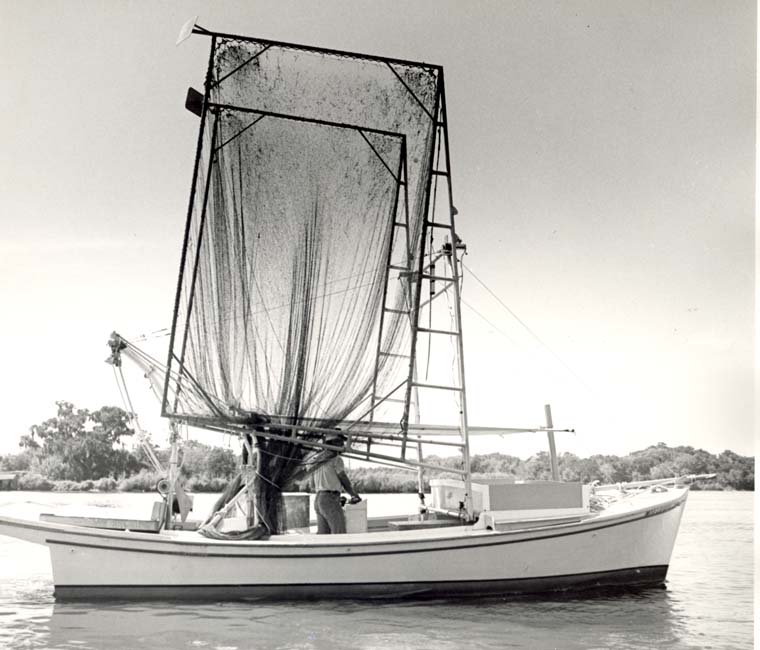
About 1933, in the bayous of Terrebonne Parish, another type of trawling rig came into use. Referred to as the "night trawl" or "butterfly" (wing) net, it is used in shallow water at night when the shrimp are near the surface of the water. The rigging consists of two rectangular wing nets, or frames, with 3/4 inch mesh netting. These nets are hinged to the bow of the boat so that the nets can be lowered perpendicularly or raised horizontally to the vessel. Some of the early frames for the butterfly nets came from the barrel rims used in the sugar factories. This type of net is generally used on small, fast luggers, and Lafitte skiffs, or is mounted to docks or platforms along the bank of the waterway.
While shrimping continues as a way of life for many folks in South Louisiana, changes are occurring which will affect the continuity of the shrimping tradition and the availability of shrimp. As a business, shrimping has become much more competitive, with more licenses granted now than ten years ago. As a result, shrimp catches per individual have dropped. Federal regulations requiring the use of turtle excluder devices on vessels fishing offshore and increasing costs for nets, fuel and ice further complicate the issue. When the shrimp numbers are up, the price per pound drops. A steady increase in cheaper, imported shrimp from South America and Southeast Asia has greatly cut into the local fishermen's market, causing resentment among Louisiana fishermen. Pollution in the waterways and a rapidly disappearing marsh are also taking their toll.
So while shrimping as a way of life and a family tradition is still present in Louisiana, many fishermen are having to relinquish this heritage because of so many adverse conditions. Their children will not learn to work the trawls and boats or share in the conviviality of a net repair session. The community spirit of the fishermen along the bayous and the shared experience of a family working together will be lost to the changes brought about by government, industry, and development of a foreign market. Shrimping as a way of life may live on only in the stories of the fishermen.
