




Clapping On Two and Four
By Kalamu ya Salaam
African American approach to performance has many aspects, some of which, such as improvisation and emotional intensity, are frequently cited. This essay will address two seminal, albeit frequently overlooked, characteristics of public performance in the Black cultural context. The first aspect is the use of the music as a language and the second is the function of performance as a means of achieving social stability and cohesion.
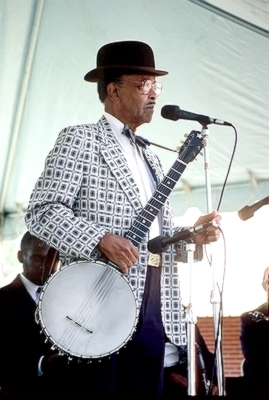
A Black, or more precisely, African-heritage, approach to public performance necessarily includes music. Even with the visual arts, masks and costumes dance, i.e. they are made to move rhythmically. Indeed, Black music is often characterized as rhythm-driven.
I believe this rhythm emphasis is both contextual and inherent. Contextual in that Black music came of age contemporaneously with modern industrial developments in America. The recording industry; electricity (plus electronic amplification and alteration); radio; cars, trains and planes; all of these were born and developed during the same epoch. This industrializing and speeding up of daily life produced a major change in the psyche and emotional desires of Americans.
The last of the pre-industrial (and simultaneously, the first of the industrial) music forms was "ragtime"—a piano music that through the use of "piano rolls" (a way to mechanically reproduce the literal "sound" of the music without the musician having to be present) ushered in the industrial era of music making. In many, many obvious ways ragtime bridges music performance as it was traditionally done for centuries with the literally new noise of 20th century sounds. Although ragtime sounds stilted and "mechanical" to those of us weaned on modern music, at the time of its inception and development ragtime was a wild, boisterous, and seemingly explosive music.

With its pronounced employment of syncopation, ragtime mirrored the new ways a-coming and suggested a completely new way to make music. Syncopation (and emphasis on the weak beats juxtaposed against a de-emphasis of the strong beats, particularly in the bass line) is ragtime's most easily identifiable characteristic.
Ragtime peaked in the decades of the 1880s and 1890s, and was quickly replaced by a music called jazz as the most popular expression of Black music specifically and American music in general. In fact, by the 1920s, jazz was so popular that that decade became known as the jazz age. Jazz as both a music form and an approach to playing pre-existing music forms, introduced not just rhythm innovations, but also harmonic innovations, chiefly through the use of what is often called "the blue-note." Jazz is famously an amalgamation of many ingredients; however, jazz is chiefly a mixture of blues and ragtime devices commingled with a multitude of melodic sources (folk songs from diverse ethnic sources including English, German, Scottish on the Euro-side and field hollers, chants, reels, arhoolies, line songs, ring shouts, and other Negro strains—I specifically identify these as "Negro" because these forms are not simply African retentions, but more precisely are African American extensions).
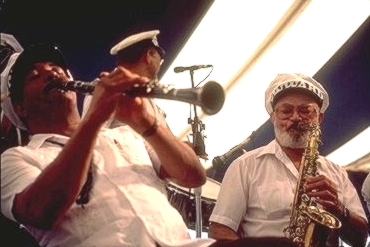
Jazz, blues, and their sacred cousin, gospel music, all have a rhythm-device in common: the back-beat. Indeed, the back-beat, a heavy emphasis on two and four, is a hallmark of African American music and remains dominant as a rhythmic device into the 21st century. An interesting note about the back-beat with respect to gospel music is the flipping of rhythmic emphasis. In the then-popular waltz form, the emphasis was usually ONE-two-three, ONE-two-three. But in gospel, when three-four time is used, as it frequently is, the practictioners usually clap on two and three, thus getting a one-TWO-THREE, one-TWO-THREE rhythm. The back-beat.
None of the other popular musics of the African diaspora (whether from the Caribbean, Central America, or South America) employs a heavy back-beat unless the particular form in question, such as salsa, reggae, or soca, is a form that was significantly influenced by Black music from America. This absence of the back-beat is distinctive especially given that most African diaspora music heavily uses drums, or quasi-drum instruments (steel pans for example). This is a curious development that is made even more curious by the fact that for the most part the drums of the diaspora remained hand-drums and it was in the United States that the mechanical drum, or the drum kit, commonly called the trap drum or traps, was developed. So the place where the drum had the least continuity in terms of usage and the direct retention of African poly-rhythms is the place where the back-beat was emphasized and the drum kit was developed!
So then the cultural context of industrialization and the specificities of Black musical development within the United States are the general cultural context that sits atop the inherent African aesthetics of music. One particular aspect of the African aesthetic in music is the use of music to achieve trance, or a state of altered consciousness usually induced with the aid of dance. This quality, which goes by numerous names including "getting the spirit," "spacing out," and "being possessed" is a desired effect and not an accidental by-product of Black musical production. In other words, the music is designed to alter the consciousness of the audience. Moreover, the audience is never seen as a voyeur, who silently looks on, but as a participant, whose physical interaction with the musicians is necessary in order for the music to achieve its purpose of elevating, or transforming, both audience and musician.
From this perspective it is easy to understand Black music as a social force. I propose we take this understanding a step further. First, let us look at the music as language and second as a social stabilizer.
The majority of African Americans are descended from peoples of West and Central Africa, from peoples whose spoken language was often tonal and for whom singing accompanied nearly every aspect of daily life—particularly work and ritual activity. The American insistence that the Negro speak English and the American prohibition against the use of African languages would seem to mitigate the retention of tonality as a part of language, but again, similar to the emphasis of the back-beat in a culture where the drum was outlawed, tonality is asserted as a prominent feature of Black music. Specifically, instrumentalists developed techniques to make their horns sound like they were talking, singing, or laughing while simultaneously singers developed techniques to make their voices sound like instruments. In essence, that which was suppressed reappears as a dominant characteristic.
Moreover, in terms of representing the attitudes and psychological state of its makers, Black music carries an emotional breadth and depth rarely found in written literature, whether that literature be text or composed music.
Black music is a language of the lived experience, a way to communicate to the world and with each other, how it feels to be so Black (and blue). What is important to realize is that the very style and structure, the "how" the language sounds is an inseparable part of the content, or meaning, of the language. Or, to quote a folk saying: it ain't what you say, it's the way that you say it. This emphasis on process is not simply an emphasis on stylization, but is rather a clear prioritizing of the concrete lived experienced. In this context, the whole self is celebrated, not just ideas, but body and soul, ideas, and emotions.
But beyond, this emotional wealth, there is the greater truth, Black forms of making music are not an end in themselves, but a means toward the end of achieving social cohesion. Under the influence of the music, all the participants are first brought to a state of unity via the rhythm—or as they say in church, if you can't sing, at least pat your foot and keep time. While some may minimize or ignore this attribute, every body literally moving (clapping, foot-patting, etc.) on the one is a sine qua non.
To listen to music without moving is not to be involved in the music. Even the most avant garde of free jazz generally invoked a physical response if no more than swaying to the underlying pulse of the music. I suggest that this attribute of collective movement, the individual getting in tune with the group, is a significant characteristic; and, of course, the use of poly-rhythms and poly-phonics allows the individual to make a unique contribution to the collective, thereby achieving both unity and individuality. Indeed, Black music is the most democratic American artform in that it successfully stresses both the collective and the individual at the same time.
From a psychological standpoint the music offers one the opportunity to identify oneself as a part of a larger social grouping and simultaneously to distinguish oneself as a particular individual within that group. Thus, Black music is the perfect embodiment of American social values most often thought of in political (democracy) or economic (free market) terms, but values which also have aesthetic corollaries.
The embodiment of democratic ideals along with technological progressiveness—Black music has always been at the forefront of using and creating technological innovation in terms of "how" to make music, whether one wants to talk about instrumental techniques and innovative approaches to playing an instrument, or talk about the use of machines (from the levers and pulleys of the trap drum kit, to the computers and midi-based equipment of rap and popular music production)—is precisely what has made Black performance in music the most popular and most influential performance style worldwide.
Why do so many people like Black music? Because it is hip! Why is Black music so hip? Because it simultaneously draws on the most ancient of traditions while utilizing the latest technological advances available, and all while emphasizing both social cohesion as well as individual development-which, not surprisingly, is basically a working definition of hipness.
