




African American Oral Traditions in Louisiana
By Mona Lisa Saloy
Since Africans were transported as slaves to America, Black Americans have nurtured and created a dynamic culture within a climate of intense racial, social, and economic exploitation and injustice. They developed kinship networks, religious beliefs, and families infused with their values and race knowledge. This rich expressive culture articulates their deepest feelings, aspirations, and wishes.
In both urban and rural communities, Black Americans have maintained a lively and widespread verbal art tradition in spite of urbanization, industrial growth, education, and mass communications. This has been possible because Blacks—for their own survival and sanity—formed a separate culture within the dominant culture, one which remains predominantly oral.
In New Orleans, as in other urban centers where Blacks live apart yet as a part of the larger city, stories, songs, and other kinds of folklore continue to develop. The wealth of oral lore includes many traditional forms such as children's sidewalk and jump rope rhymes, handclap songs, and rap, as well as toasts and tales recited by adults. Although each genre has its own concerns and norms, all represent a unique cultural response to a difficult historical and economic climate.
Storytelling has always been important in African–American culture. In Africa, people sang or chanted long oral narratives concerning gods, heroes, and demons. In Louisiana, adults spin their own heroic tales about characters ranging from Marie Laveau to Stackolee. These tales are often known, sung and recited by everyone in the community, with each person adding his or her own versions. Because these songs or stories are not written, the words vary among versions, but the basic content remains essentially the same.
Ahmos Zu–Bolton's storytelling is one example of Louisiana's rich Black oral tradition. Zu–Bolton inherited his storytelling honestly, growing up in a front–porch storytelling arena and learning to tell stories from his family in the small rural town of DeRidder, Louisiana. He was especially influenced by the "lies" told by his father, who competed with Zu–Bolton's uncles to be the biggest "teacher" in their front porch storytelling sessions.
At home, his illiterate great–grandmother, Mama Easter, fashioned tall tales. She also kept family history alive with her stories about the family's ancestors, including one about the origin of Zu–Bolton's name. An ancestor who had escaped from a Mississippi plantation was branded with the German owners' name so that people would know who owned him if he escaped again. Some of Ahmos' people during Reconstruction "decided to keep the name Zu–Bolton in his honor because they were really proud that he was man enough and arrogant enough and freedom lovin' enough to try to snatch his own liberty and not wait for someone else's emancipation."
Today, Zu–Bolton's storytelling reflects his front porch introduction to the tradition. He has enjoyed a successful writing career while holding onto his oral roots.
Toasting, a modern and primarily urban form of Black oral lore, has its roots in older traditions like signifying and playing the dozens. A toast is a lengthy, recited narrative or poem describing a series of exploits by a central character. Focusing on the main character's heroic acts and exercises of wit, the toast presents values through actions.
Toast characters include recognizable and popular figures like Shine, Stackolee and the Signifying Monkey. Many are Black entrepreneurs pursuing the American Dream and its promise of plenty for those who can achieve entry into mainstream American society—an entry which in reality is denied them. Willing to grab or take their success into their own hands, these characters announce their intentions to survive in style, which can mean "heroic masculinity" or conspicuous consumption.
Toasts are commonly recited on street corners, front porches, prisons, or wherever men and groups of Blacks get together. In the performance of a toast, the "toaster" seems to become the toast character or "big man" and to take on his "style". Listeners can celebrate their existence through identifying with the success of the hero, whose actions stand in contrast to the reality of their own oppressed circumstances.
The toast is heroic because the chief character will accept death in the face of danger and therefore subjugates himself or herself to the group. In fighting to the point of death or the possibility of dying, the hero ennobles the group.
For Arthur Pfister, New Orleans poet and grand voice in the toast tradition, hearing or performing the winning ways of the central character becomes as creative a release as Black music. Growing up in the Sixth Ward, he learned toasts from old Black men—chocolate to vanilla—sitting together for days on the steps or front porch or standing near a lamp post.
Pfister affectionately recalls many of the "bull sessions" that became performer–audience events in the community, with one or more participants reciting heroic tales such as "Shine and the Titanic" or the hilarious antics of "The Signifying Monkey." These boasting narrative tales of bad guys who confront and vanquish any adversary instantly and guiltlessly are not drinking speeches but adventures of Black verbal prowess. In the toast, a mix of the dozens and rapping, the power of "talk" overcomes all conflicts in society.
Unlike the typical neighborhood toaster, Arthur Pfister is a working professional, an educator, published novelist, and poet. His performances include his own New Orleans version of the traditional toast "Shine and the Titanic" along with other completely original toasts such as "The Ballad of Billy Bob" and its X–rated counterpart "The Ballad of Nigger Bob."
Although toasting is primarily an unwritten literary tradition, many toasters today work from written texts. The ability to improvise is highly valued, though, and performers can adapt their toasts to different audiences. Creative tradition–bearers like Arthur Pfister continue to contribute to the development and vitality of the toasting tradition.
The African American tradition of dueling rhymes is evident in many oral art forms. Toasting, rapping, signifying and playing the dozens are all demonstrations of verbal skill. Today's rapping is closely related to toasting, which in turn has much in common with signifying, an exhibition of aggressive wit and indirect verbal assault on a victim. Signifying and toasting also share elements of the dozens.
"The Dozens" are an elaborate insult contest. Rather than insulting an opponent directly, a contestant derides members of the opponent's family, usually his mother. The dozens has its origins in the slave trade of New Orleans where deformed slaves—generally slaves punished with dismemberment for disobedience—were grouped in lots of a "cheap dozen" for sale to slave owners. For a Black to be sold as part of the "dozens" was the lowest blow possible.
In an effort to toughen their hearts against the continual verbal assault inflicted on them as part of the "dozens," Blacks practiced insulting each other indirectly by attacking the most sacred "mother" of the other. The person who loses his "cool" and comes to blows loses the contest. The person who outwits and out–insults the other while keeping a "cool" head is the winner. Elements of both signifying and the dozens appear in the toasts tradition.
Toaster Arthur Pfister and storyteller Ahmos "Dr. Zulu" Zu–Bolton deliver important essences of the Black oral tradition. They both share professional lives. They are both committed tradition bearers. They belong to that special griot–type African American Louisiana lore. Their audiences love them. They enjoy performing stories and toasts.
Children's Lore
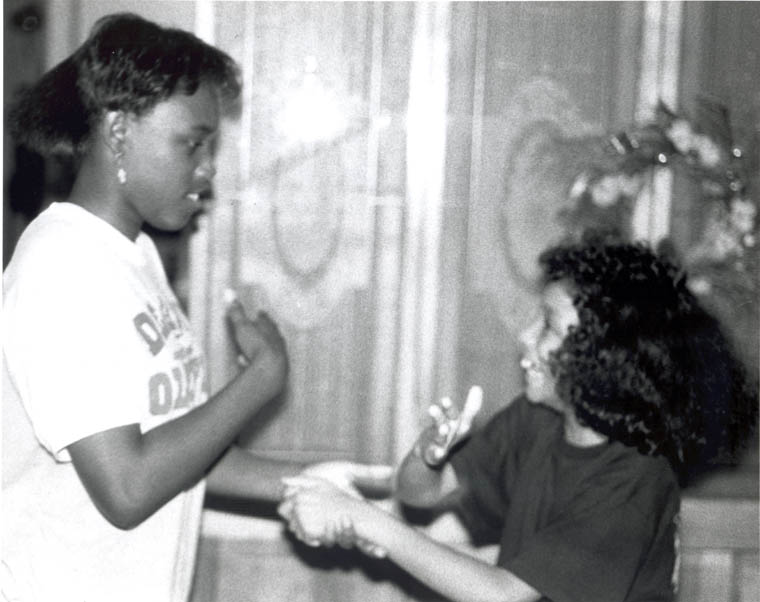
Verbal artistry among African American children is equally expressive and creative, although the forms are different. Children's lore in New Orleans Black neighborhoods bears a necessary developmental function. Sidewalk songs pass on attitudes and knowledge of self, imitations of adult life and values, and distinct criticisms of adult life and societal norms.
At its core, children's folklore is play as well as a comment on the world. Some attitudes are imposed by race and sex, and family, ethnic and economic situations. New Orleans itself, with its Black majority, imposes a dominant and varied set of adult examples, values, barriers, and opportunities.
The oral songs and rhymes of these sidewalk games are a special part of children's folklife. Black youth typically learn sidewalk songs from other children. But they also learn them from their parents often before they can talk. Once in the children's repertoire, sidewalk songs take the place of nursery rhymes and reflect pre–adult concerns. Children then learn them from each other in the street, on the front porch, on the sidewalk, or in the park.
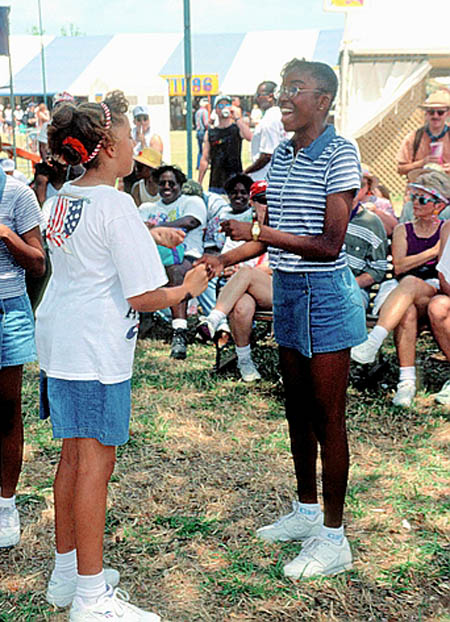
Children's folklore, in general, fulfills certain functions; it reflects and criticizes society and transmits values. For most kids, their lore entertains them, teaches them how to manipulate words, helps to develop their group identity, and creates a bond. It also provides the opportunity to practice "handling" authority and informs them of their sexual roles.
The sidewalk–song of children's folklore performs a particularly important role in African American culture. When Black youth perform these sidewalk songs, they practice and learn to contribute to their rich African American verbal culture. By puberty if not earlier, the Black child must learn to "hold their own" for protection, that is, from verbal or physical abuse. It is a common Black custom to be able to "rap" oneself out of a street fight or "jive" your parents out of a deserved whipping. Therefore, this early verbal play becomes a vital link to what will later become "jiving," "sounding," "woofing," "the dozens," and eventually "rapping," all of which are common African American verbal–dueling traditions. The dueling dozens and rapping have been incorrectly attributed only to Black male culture. Girls also participate in these early raps and frequently with boys. Boys participate with girls to varying degrees depending on their exposure to sisters, girl cousins, and neighbors.

Black children perform the songs and rhymes in a family and extended–family environment. The youth are sometimes left attended by elder brothers and sisters, cousins, or neighbors who may get them started and urge them to continue, especially in New Orleans—a city of families where it is common for several generations to live in the same neighborhood where they were born, on the same street or within blocks of one another. This does not mean that all is love and kindness. Many families retain that geographical closeness and do not speak because of old grudges. Yet, for the sake of the children, a nurturing and extensive children's society continues.
The existence of children's sidewalk culture depends on adults who believe that children should socialize separately. Even though they consider their children to be blessings from God, they believe that children should not be a part of adult talk and that children should play with children. Many hot Louisiana evenings are spent in this way. As a result, children talk about "grown things" with their siblings and friends in a way they can get away with, in a song.
Each youth is expected to contribute. If one doesn't know a rhyme, he is expected to make one up or learn one from someone else. No one wants to be known as not able to "talk stuff." These unspoken rules have existed for generations. In some cases, the environment creates a healthy competitive spirit, the kind that will produce a "jam" session as in jazz where no one wins but everyone contributes. In other cases, kids can be cruel and taunt the person into producing, or the person will not be in the game—a fate considered worse than death. Nevertheless, the product is children's lore.
The neighborhoods of New Orleans Seventh Ward between St. Bernard and Elysian Fields combine various classes of Blacks: poor, working classes, and some upper lower–middle class families. Many families have lived there for generations, but some have moved to an area nearby called The Paris Oaks—the area east of St. Bernard and Broad, curving down along Paris Avenue and behind the St. Bernard project. Perlita is a street with a sea of kids—tall kids, babies, kids on scooters, skates, and tricycles. On Perlita, the Fitch household is a representative, medium–sized family where the parents allow their kids' friends to frequent. This creates the needed environment for a free exchange to take place between youth.
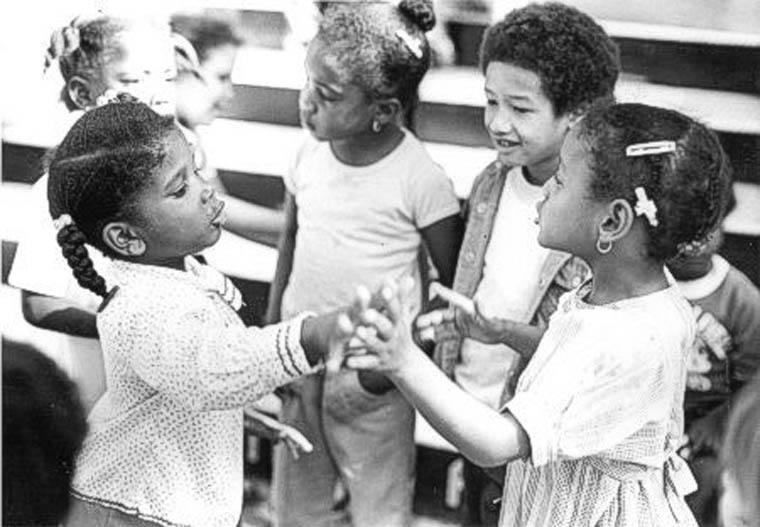
Nine–year–old Sunni Maria Fitch frequently plays outside with her friend Treshon Turner (eleven). Fourteen–year–old Natasha Montgomery occasionally joins the younger girls but more frequently plays with older girls. At times, Cory Fitch (age fourteen), his younger brother John, and their friend Jason Bernard join in and play all of the games the girls play but they also rap. Rapping tends to happen when the girls go inside.
The topics range from familiar rhymes and songs to adult–style "bragging" strategies. These songs are much more relevant to their day—such as the existence of crack in following example that is sung to a sidewalk dance or stomp (a group line dance).
Yo' momma, yo' daddy, they betta leave that pipe alone
Yo' sista, yo' brotha, they betta leave that crack alone
Yo' antee, yo' uncle, they betta leave that pipe alone
Yo' family, yo' friends, they betta leave that crack aloneDo wha'cha wanna, Do wha'cha wanna
Do wha'cha wanna, Do wha'cha wannaYo' momma, yo' daddy, they betta leave that pipe alone
Yo' sista, yo' brotha, they betta leave that crack alone—John, Sunni, Treshon, Natasha, Corey, Jason
2 June 1990
It is clear in this sidewalk song that the children are aware of the impending fate of "crack" cocaine addicts. It is something to avoid firmly. Here they perform a prophetic service to each other, reminding themselves of the boundaries they must face to achieve in life.
Sunni and John together perform the following long narrative which is a hand clap and rope song. This one reflects the dominant racial theme of the time as well as taboo topics like pre–marital sex.
I like ice cream
I like cake
I like a colored boy
And he don't fake
So step back white boy
You don't shine
I'll get another colored boy
to beat yo' behind
Last night,
the night before
I met my boyfriend at the candy store
He bought me ice cream
He bought me cake
He sent me home with a stomach ache
Mommie, Mommie, I feel sick
Call the doctor, quick, quick, quick
Doctor, Doctor, before I die
Close my eyes one to five
I said a one, a two, a three, a four, a five
See that house
On top of that hill
That's where me and my boyfriend live
Cookin' that chicken and cookin' that rice
Come on baby, let's shoot some dice!—Sunni Maria Fitch, age 6, with John Anthony Fitch, 4
New Orleans, 1987
From these brief examples, it is clear that at an early age, African American children actively participate in their verbal development. They brag, they duel, they dance, they sing. These rhymes and raps serve to define group identity, address adults on adult concerns, learn verbal prowess, and entertain one another. Sidewalk songs, toasts, and stories are traditions particularly strong on the streets of the Seventh Ward in New Orleans.
Update, May 1998
By Mona Lisa Saloy
After documenting, interviewing, presenting and writing about the Perlita Street Kids for the past ten or so years, many things have happened besides their ages. Sunni Maria, the key girl and center of this sidewalk culture, made her debut at the St. Mary's Cotillion, April 22, 1998, because she and her friends came to learn from my articles and presentation that they were contributing to their culture in a much larger way, they performed as a group long after the core girl friends would have normally. As a a result, I witnessed them pass on these traditions for years. Sunni Maria's little brother John Anthony—who was five years old—became the darling for the New Orleans Jazz & Heritage Festival performances, and who with his older bother Cory Michael Fitch choreographed dances and moved into rap, so much so that music critic Michael Tisserand of Off Beat magazine, a monthly tabloid in New Orleans, voted them "the best hope of the next music generation" in June, 1994. But 1997s end, John Anthony Fitch is a member of the new youth group Imajin, doing R&B, has been touring the east coast for Jive Records and is about to embark on tour to London followed by Japan. Cory Michael performs as a jazz singer locally with his group Vizio.
