




Still Laughing to Keep from Crying: Black Humor
By Mona Lisa Saloy
Humor has sustained Africans in America since first delivered to these shores. Black humor is now mainstreamed into popular commercial culture with the advent of the Kings of Comedy tour, now available on film, and its companion the Queens of Comedy. Anyone who owns cable television or satellite access can catch such shows as "Comedy Central" and others where Black comedians are featured. Of course, such popularity evolved from the one-man shows of greats such as Moms Mabley, Redd Foxx, Flip Wilson, Bill Cosby, later the great Richard Prior, Rudy Ray Moore, Eddy Murphy, Whoopi Goldberg, more recently Chris Rock, Chris Tucker, and a host of many others. These accomplished comedians are the result of a culture whose humor rose out of a bitter, often harsh and dangerous racial climate; the result is the common adage that Blacks laughed to keep from crying, giving fuel to Langston Hughes's admonition that laughter is the best medicine. Black humor sustained Africans in America from the earliest use of parody, to animal tales, the dozens, in proverbs, to the urban narratives such as toasts, and many other forms such as jokes, the foundation for these contemporary practitioners. Considering the proliferation of professional Black comedians, male and female, rest assured that Black humor exists in pure folk form orally, on the block, in families, neighborhoods, at churches, and still on front porches or street corners wherever Black folks congregate.
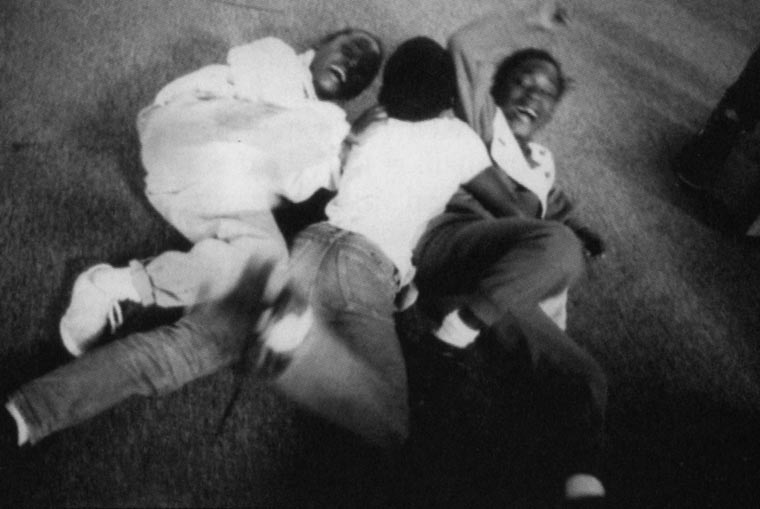
Is the current Black folk humor still indirect, filled with desperate or absurd attacks on racism? Is it hilarious, in-your-face bold, sexist, stereotypical, or refined and subtle?
In the Crescent City, the variety of styles and modes of humor are staggering, and most of it spontaneous except in a few instances where the tradition bearer recalls a humorous moment. The sampling of sources here are recent, living Black folks, old and young, men and women, and their humor is a natural eruption and response to life such as the following church example. This one is from Frank Davis, IV, a PK or Preacher's Kid, who is himself gifted with gab, a great voice for singing and speaking, and insightfully observant. Frank calls this one "Hebrews."
The old preacher got up to read the text of the sermon on third Sunday morning. "Hebrews, chapter 1:3," he said. "Now women, you know it's a sin for you to make coffee." All of the church went to mumbling. "Yes, the Bible says he brews, not she brews." (July 9, 2001)
Of course, this humorous anecdote belongs to the malapropism, and the smiles it brought at the time and still brings are not lost.
The origins of Black American verbal prowess historically gave rise to ritual insult, a game to toughen Black hearts from the abuse of society, specifically on the auction block, in the form of the "dozens." The insults fly back and forth between "contestants," and the loser is the one who gets angry, or literally loses their cool. Although often denigrating, sexist, stereotypical, self-mocking, and boastful, the dozens are alive and going strong. Today, just as after the turn of the twentieth century, any heartfelt mention of someone's mother are fighting words. The following ones were recalled by Chad Jordan from friends and relatives.
Your momma's a St. Bernard.
You're so ugly. When you worked at the bakery, they dipped your face in the batter to make animal crackers.
Your momma's cooking is so bad, your family prays after you eat.
Your breath is so nasty; when you burp, your teeth have to duck.
Your momma's like a big Mac, full of fat and only worth a buck.
Your house is so dirty, the roaches ride around in dune buggies.
Your house is so small, I threw a rock in the window, and it hit everyone in the house.(July 7, 2001)
There are Black elders such as Clifford Fitch, Warren "Mush" Whitfield, Velma Cerre, who are literally fountains of folk tales, jokes, proverbs that are too numerous and varied to provide adequate attention here. But like those mentioned above, one, Mr. Northern Stoval, is particularly full of wisdom and uncommon common sense. He is the dear friend of my neighbor and known widely for his talkative nature. Now deceased, Mr. Charles Barnes dubbed him "Mr. Loquacious." Mr. Stoval tells everyone that he was married three times. He was born in New Orleans, and is now retired. Long ago, he was a longshoreman. He drove a taxi for many years, worked at UPS, and drove a bus until he retired. Mr. Stoval is an avid reader and debater of current events. Sometimes, I am blessed to become his audience. One morning in late spring, we spoke across the fence.
A bit of an anomaly in my working-class neighborhood, 77-year-old Mr. Stoval marveled at the fact that I work at home writing in the mornings, especially since as a Black, he knew my Dad was schooled to the third grade and my Mom to the eighth grade. Shaking his head he said, "if you use these, pointing to his hands, you might not stand. But if you use this, pointing to his head, you're in demand."
Then he looks at me and asks:
Do you know why kids have so much energy?
Why?
They don't have to fight gravity.
It is one of those days when he is on a role, and one has to catch as
much as possible, because he can go on like this for hours. He became perplexed, looking about. I asked,
"What's wrong, you look so sad?"
He grabs his chest as though he may be having an attack, indigestion I'm hoping.
"Can I help you?" I ask.
"No indeed. You see, I'm having a CRS moment."
"What is that?"
"Can't remember stuff."
This back-yard philosopher also visits on the porch to cool off. This
particular late spring during the excruciating dry spell, Mr. Stoval attacked
my neighbor's overgrown lawn. After hours of pulling weeds, cutting grass, he
sat on my front porch for a breather.
"How're you doing, Mr. Stoval?"
"Well," he said. "I'm minimum wage."
"Hush now, Mr. Retired."
"You see. Sometimes I get paid; and sometimes, I don't."
In this next anecdote, Mr. Stoval expressed another spring day, it falls into the classification of what humor critic John Lowe and other humor theorists call in-group techniques "corrective comedy" (370). This type, Hughes labeled "Jokes Negroes Tell on Themselves" (Lowe 370). Here, Mr. Stoval admits to being able to close the gap between Black men and Black women with this understanding. He said that he "knows what the problem is between Black men and Black women."
"You see," he says. "The Black man selects a wife by what is below the waist. The white man takes a wife by what's above the waist. Now, the Black man, who takes a wife by what's in the basement, ignores what's in the attic. Soon as the Black man figures there's nothing in her attic, he wants to toss her aside like an old carpet bag."
In this example, the telling "functions as a crooked stick used to lick home a point of comic correction" (Lowe 370). Mr. Stoval's reflection is less the frustration Langston Hughes suggests as an origin (Lowe 370) and more a reflection for better understanding. As in all of Mr. Stoval's examples, they occur spontaneously.
To include Mr. Stoval on himself, he provided the following information, again, spontaneously; but this time, over the phone.
I was born in a lil' shotgun house. Had a mother and a father who had no scholastic background. Not to make a braggadocio's nature, but it's a matter of fact about this. I only have a seventh-grade school background. My biggest difficulty is that I'm self-educated. I'm thankful to God for all blessings, and to myself for my determinations. I try to offer to younger generations that come behind me something, and the reason is that I've seen so many incidents. You see, people want to give glory but cannot substantiate the glory they want to give. See, you have to have a challenge. Without a challenge, you do not develop. Me, I'm not an innovator, but one who meets his challenges. A challenge brings out the best in me. Just last night at church (Franklin Avenue Baptist), the minister asked a young man that if he could answer his questions, he would give the young man $100.00. The young man rattled on about the first question on Rap and Rap stars and styles and successes. He was excellent. The second question was to name ten presidents. The boy couldn't do it. He was 13 or 14. See. Black people mature early in negatives. We think we are smart; but when you really come down to it, without competition, how do you know? That's what's wrong with Black people. Take one young woman in my family. She had the opportunity to attend college; she went to Dillard University. She says is so proudly. Well, she dropped out after one year, one year she quit. It's not about how long you are in the world, but what you do in the world. So I tell her I went to Dillard University too. Sure did; I went on my bicycle picking up cans! See. We are proud of things we should be ashamed of, and ashamed of things we should be proud of. Things of value should be the goal for young people not peer pressure for things of no value. In the long run, the rate of progress depends on our values (23 August 2001).
For some, Mr. Stoval may sound negative, but his analysis has sound merit. Mr. Stoval represents that cadre of Black people referred to by Harold Cruse in The Crises of the Negro Intellectual when he refers to the social outlook of "a broad strain of Negro social opinion in America that is strikingly cogent and cuts through class lines". For Cruse, this stratum of Blacks perceive a collective mind that is agitated by modern dilemmas but whose answers are not found in any organization said to represent it. It is this section of the Black population, the folk, who produce the folk culture, the food, the music, and much of the art, certainly the language, the soul of the people, though unschooled perhaps but creative, spontaneous, innovative, and collective in spirit.
Finally, for now, Mr. Stoval represents the many Blacks whose voices are not heard enough but possess social enlightenment; call it uncommon common sense, la joi de vivre or the joy of life, the soul of Black life and humor, because he is Black life, lives to laugh about it daily and spreads it free of charge. When not helping friends or neighbors, he might be found among one of his many young disciples who label him genius, profound. Black life is complicated still; no easy answers exist, but Black culture and humor keep erupting, continuing to create in all its complexity. Mr. Stoval says that he's glad God made him Black.
"You see," he says, "when John the Baptist poured the water over Jesus, he thanked God proclaiming that Jesus was the one who would save us all from sin."
And Jesus replied, "I am that I am."
"And I'm made in his image, the image of God, a Black Man!
"Well, I don't know if I'm a son of Ham, Siam, or Ms. Anne, but I'm glad God made me Black. Thank you. Amen."
Sources
Cruse, Harold. The Crises of the Negro Intellectual: A Historical Analysis of the Failure of Black Leadership. New York: Quill, 1984.
Lowe, John. "Humor," The Oxford Companion to African American Literature. William L. Andrews, Frances Smith Foster, & Trudier Harris, eds. New York: Oxford University Press, 1997.
