




Cajun Music: Alive and Well in Louisiana
By Ann Savoy
One of French Louisiana's most vital attractions is its music. Acadian music has undergone vast changes since arriving in Louisiana, to a large extent because those who play it today live so differently from earlier residents.
Understanding Cajun music in all its variety is a large undertaking but an important one. Today, we in Louisiana are fortunate to have living representatives of many of its various styles and stages. A look at Cajun music and its development offers a glimpse into Louisiana's different cultures, its fascinating history, and the variety which exists within a traditional culture. The scheduled musical performances at the Louisiana Folklife Festival give the visitor the opportunity to trace the historical development of Cajun music styles.
One of the earliest forms of music in Louisiana was the unaccompanied ballad. All of Louisiana's immigrants brought ballads with them, but perhaps the traditions most resistant to innovation or change were those of Acadian, French, and Spanish settlers. These narrative songs provided a means to share love stories and humorous tales. Ballads were ritually sung at weddings and funerals, and sung informally for small groups of people at house parties as the food cooked and young children played. Families who had certain songs associated with their name were asked to sing their songs on special occasions.
Although today television, radio and air conditioners have lured people off their porches and made gatherings of friends less frequent, some of the older people still remember the days when neighbors sat together and shared songs. Ask a gathering of elderly people of French heritage if they know any ballads or ballad singers and most will give say yes.
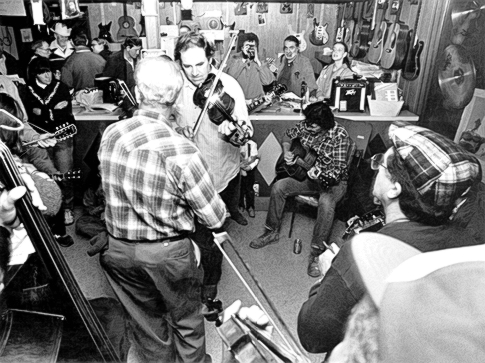
The ballad workshop at the Louisiana Folklife Festival will feature ballad singers from Oberlin, Kaplin, Welsh, Crowley, Basile, and Mamou. Many share knowledge of the same songs with only slight variations, but all know rare songs long forgotten by most living Louisianians. The beauty of the ballad component of Louisiana's musical heritage lies not only in their haunting melodies but also in the early French history often revealed in the story lines and the rich vocabulary of the songs.
The fiddle was the first instrument commonly used in French Louisiana music, and the tradition of twin fiddles was a predecessor of the Cajun music heard today. Early music was usually played by two fiddles, one playing the melody while the other provided the segoner, or back-up part. Twin fiddling traditions represent the music in its purest form, as it was brought to Louisiana with the early immigrants and before popular American tunes mingled with it. Early fiddlers' repertoires included old French and Canadian fiddle tunes, delicate reels, and mazurkas.
This year's festival is dedicated to Dennis McGee, who until October 3 was our last living link with the earliest Acadian fiddle tunes. Fortunately, many musicians learned and were influenced by the tunes he played. To illustrate his tremendous influence on today's musicians, several young musicians have been asked to perform the intricate melodies they learned from him.
Over time, the music changed as other instruments came to the prairie and were incorporated into its music. The diatonic accordion became enormously popular at the turn of the twentieth century, creating a stylistic change in the rhythm and chording of Cajun tunes and in repertoire as well.
The accordion was attractive to prairie Cajun musicians for many reasons: it had a powerful sound, was almost indestructible, and could be played at a basic level fairly easily. Because of the diatonic accordion's limited chord capacities, however, it was not always suited to the Acadian tunes, as it could play few very complex or minor key tunes. It did prove very adaptable to the popular American tunes that were coming to the southwestern prairie, and as early as 1920, Joe and Cleoma Falcon were translating country and western tunes into French and playing them on accordion and guitar.
In time, the settings in which much of the music was played changed, too. Music was a central part of the social life of the early Cajuns, and music was played mainly in people's homes, at small gatherings and fais do-dos. A few dancehalls began appearing in the late 1920s, and soon the dancehall was the primary place for hearing Cajun music.
As radio came into the prairies of Louisiana, outside or mainstream American influences were heard more and more frequently in the Cajun dancehalls. In this time period of roughly 1900-1928, dancehall bands were usually centered on the accordion, either alone or accompanied by one rhythm instrument, usually a fiddle or triangle. Beginning around 1928, Cajun bands began using the guitar as an accompaniment as well. This was a period of beautiful, heartfelt music, really the basis of Cajun music as it is known today.
In the early to mid-1930s, the accordion itself was pushed into the background by the popular string bands of the time. Fiddles were joined by mandolins, pianos, banjos, playing a variety of music with a snappy swing beat strongly influenced by Western Swing of neighboring Texas.
Other changes came to the Cajun music scene with the string bands. Luderin Darbonne was a founding member of the Hackberry Ramblers, one of the earliest string bands. He recalls that they were the first band to perform standing up and the first band to amplify their music. Amplification alone was a big step into the modern world. Cajuns came to the unelectrified dancehalls to hear loud music from amplifiers powered by Model T Ford batteries! Today, the Hackberry Ramblers still perform with several of the original members and they will play Cajun music of the string band era for this festival on Saturday.
After World War II, the accordion regained its popularity in Cajun music, in what could be called the second golden age of Cajun music. This era included accordionists like Iry LeJeune, Lawrence Walker, and Aldus Roger, who filled the dancehalls with their beautiful and expressive songs of lonely sorrows.
In the 1950s, one band, the Pine Grove Boys, became especially popular for the fundamentally human quality and soul of its heartfelt music. Its leader, Nathan Abshire, one of Louisiana's great accordion players, is no longer with us, but the other original Pinegrove Boys have reassembled to give insight into what it was like in those wooden dancehalls of the 1950s. Fiddler Harry Lafleur, guitarist Ernest Thibodeaux, bassist "Big Jim" Baker, drummer Shelton Manuel, and Nathan Abshire's young friend and student, Robert Jardell, will recreate this country dance band and its unique sound.
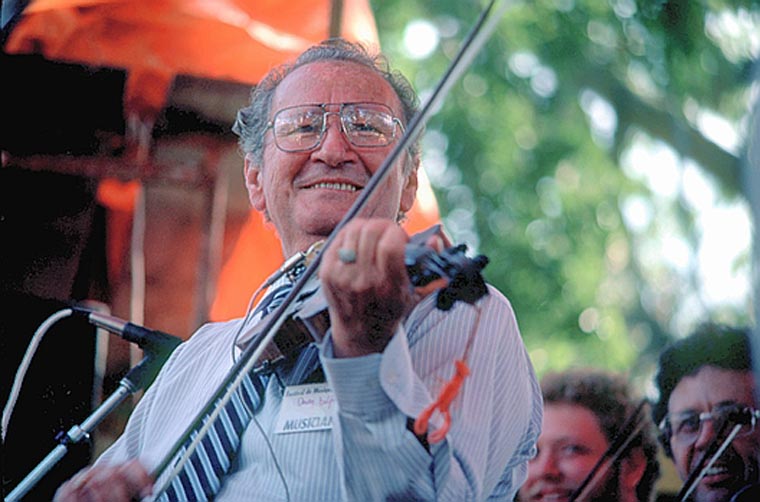
Cajun fiddler Dewey Balfa has been an ambassador of traditional Cajun music to those outside Louisiana since the 1960s, and a role model for many young musicians. His style of playing, with its emphasis on the double string fiddle sound, has become his trademark throughout the world. The ballads-turned-dance-tunes made popular by Dewey and his brothers in the late 1950s to early 1960s are classics among Cajun songs. Throughout his years of playing music, Dewey has maintained a very high standard for the quality of sound in his bands. Balfa's performances are always something to look forward to for their beautiful songs and strong musicianship which stand without artifice.
For Cajuns in 1989, the modern equivalent of a dancehall can be a church hall, a lounge, a dancehall, or a restaurant. Musicians playing Cajun music range from small, primarily young acoustic bands to full electric bands.
Since the 1940s, the standard band of the Cajun honky-tonks has consisted of an electric guitar and bass, an amplified accordion, an amplified fiddle, an electric steel guitar, and a set of drums. This year, the festival is proud to present Belton Richard, who heads one of the best such dancehall bands.
Belton Richard shook up the dancehall scene when he put out his first 45 rpm recording of "La Valse d'Ennui/Just un Reve." He was perhaps the first "rocker" of his time, full of new ideas for his band, as he popularized the sound of two fiddles played in close harmony and was the first to use an electric bass in a band. He also wrote some beautiful songs, singing them in a style that has been copied extensively by other Cajun performers. Belton's singing is exceptional and his vocal style has been compared to country singer George Jones in his prime. For the festival's Saturday night street dance party, Belton has reassembled the original members of his band, the Musical Aces, and they will play from 8-9:30 pm.
In the past decade, many young bands have begun playing Cajun music in a wide range of styles. Some have blended the sounds of modern popular music into their music, just as Joe and Cleoma Falcon introduced popular songs into the Cajun music of the 1920s.
Among some of the other younger musicians, there has been a movement to bring back the old songs and the acoustic small band sound, proving that the more traditional styles are still vital. One such band which is gaining a large and varied following is Steve Riley and the Mamou Playboys. Steve has studied the styles of his mentors, accordionist Marc Savoy and fiddler Dewey Balfa. He maintains the traditional style of playing accordion and fiddle which he loves and appreciates. Always joined by a top notch band that shares his belief that "quality plus tradition can't be improved upon," Steve Riley is a good example of the future of Cajun music.
There are many fine musicians in this state, musicians of all kinds who demonstrate the great variety of styles and influences within Cajun music. They can be heard throughout the year on many occasions, in many settings. Perhaps some of the older musicians need to be remembered, as they tell their listeners about their times, and teach them through the example of their lives. So let's listen, learn, and have a good time!
