




Dance for a Chicken: The Cajun Mardi Gras
By Pat Mire
Mardi Gras celebrations assume the shape of a community and immediately reflect the strong conservative and innovative spirit needed for a healthy society. One Mardi Gras tradition which is often misunderstood and usually profoundly affects the sensibilities of outsiders is the rural Mardi Gras run of Southwest Louisiana prairies and bordering woodlands. The Mamou run has been extensively documented and reported to the public which has created the false impression that all runs are similar. Recent research has revealed that while there are similarities, in reality Mardi Gras traditions vary from community to community.
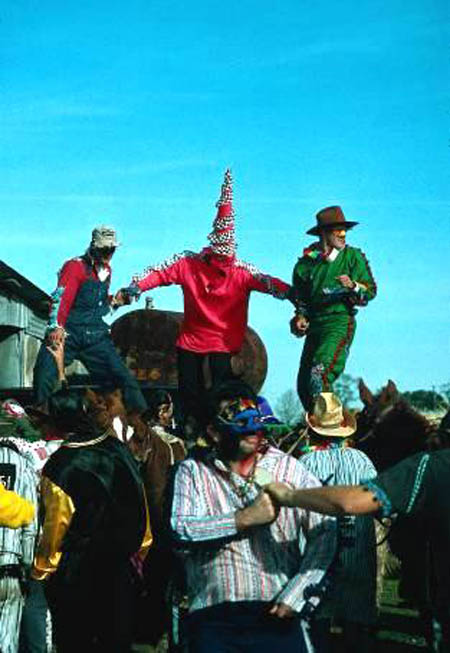
Many aspects of the Mardi Gras celebration in L'Anse Maigre, a community north of Eunice are typical of other communities. Cultural Catholicism still binds the community together, and collecting ingredients for a communal gumbo remains central to their run. They work hard all year, but they also celebrate life abundantly because their faith teaches them that life has been redeemed and Mardi Gras day provides the opportunity to embrace the totality of human life. Led by a flag-bearing capitaine, this colorful and noisy procession of masked and costumed men on horses and wagons go from house to house in the countryside asking for charity in return for a performance of dancing and buffoonery. The participants are earnestly employed chasing chickens, the most valued offering, and they pride themselves on their ability to collect enough "live chickens" to feed the entire community "free of charge."
At an organizational meeting before Mardi Gras, Wendell Manuel instructs the group, "when you get to a man's house . . . get off that horse and dance for him and beg to him . . . . Do whatever you have to do to get his chickens or his sausage or his rice or his money . . . . Anything we can do to get the goods for the supper." Mardi Gras is after all a redistribution of wealth and beneath its many layers of exotic behavior lies a serious message of survival which goes back to pre-Christian festivals and ancient rites of passage.
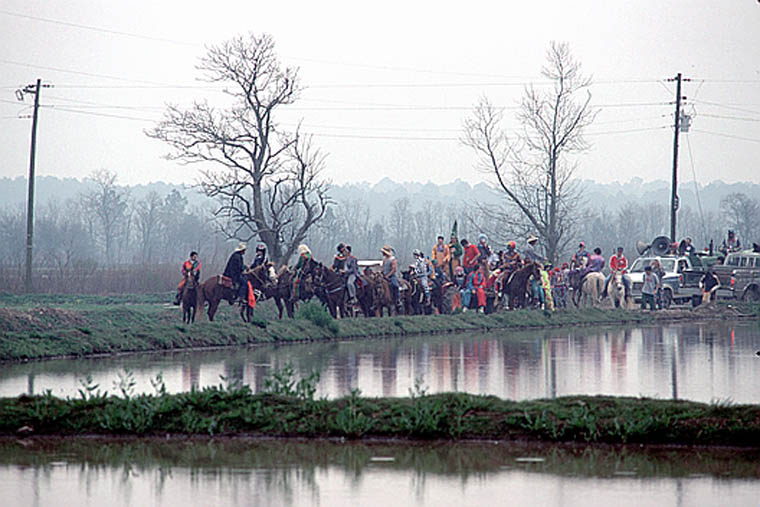
During this festival where everyone gives and everyone receives, which supports the egalitarian values of Cajun culture, humanity's story of sharing is told over and over in the course of the day. In one of mankind's oldest games of trying to fool your closest neighbors and best friends, these masked beggars symbolize anyone who may be hungry. The idea is that when they visit someone, those visited should share. Theft is part of the tension in the drama of this ritual play, but has no problem turning into "enforced charity" when the runners feel that the homeowner is not giving enough.
Like many other small communities on the prairie, L'Anse Maigre is for the most part socially unpretentious and its members do not indulge in conspicuous consumption. They dress and talk alike, live in modest dwellings, most drive pick-up trucks, and all know each other and treat each other the same, regardless of economic circumstances. Thus, it is difficult for an outsider to recognize who is expected to give more or less on Mardi Gras day. It is no wonder why outside image makers, journalists, and even some researchers-who lack evidence about how the community functions the rest of the year and are invading insider ritual space-have blurred vision and miss important details. They are often not well acquainted with the larger culture's subtleties and survival strategies much less the varying degrees of interdependence from one neighborhood to the next, so they misinform the public by consistently reporting on the crust while missing the pie filling completely.
Two distinctly different questing songs exist with numerous variations. Some communities require the runners to sing their version of the song in French, which discourages outsider participation. But other runs encourage outsider participation. It is amusing to watch an outsider wearing a mask imitating locals trying to conceal their identity when no one would recognize them if they participated without masks.

All successful runs have a core group of key players who have internalized the game's rules and know instinctively what to do and how far they can push the boundaries that create the tension necessary to propel this disorderly contrivance towards its appeal for communal equity. A couple of runs have almost turned into trail rides and seem more interested in returning to town on time for scheduled parades than fulfilling the event's original mission. One run in particular lost its meaning when their culturally dysfunctional capitaine passed up a homeowner standing in his yard with chicken in hand which is an inconceivable act to most communities.
The Tee Mamou's run was not interrupted during World War II as it was in most other communities and Mamou has been credited with the first revived run, but actually six Eunice men and capitaine Tobert Frugé reassembled in 1946. Recently it has been found that other communities, Oberlin for example, began running again after a short hiatus of only two or three years which hardly constitutes a revival. Women in Eunice had their own separate Mardi Gras run throughout the 1950s and elders in several communities recount stories of children's runs as far back as memory goes.
The Tee Mamou group has maintained aspects of a very old begging tradition and uses a gesture of pointing to the open palm, which centuries ago may have distinguished carnival beggars in Western Europe from another group of beggars known as the "bashful poor." Recent discovery and observation of the Hathaway Mardi Gras reveals similar and possibly older traditions. They have what they refer to as "our beggars" who wield rolled burlap whips leading the procession with the capitaine. The whipping traditions have been preserved along isolated pockets of the Cajun prairie's cultural edge west of Highway 13. Whipping has its origins in the pre-Christian festival of the Lupercalia or the wolf festival which was thought to promote fertility. Hathaway's ritual beggars are blackfaced and are the first to approach a house where they dismount from their horses and confront the homeowners on their knees with their hats in their hands and genuinely petition resident members for charity. This appears to be a vestige of the poor man's carnival of the Middle Ages and may even have roots in the most widely celebrated festival of the Roman Calendar, the Saturnalia, where people masqueraded and blackened their faces.
Outside reporters invariably focus on the issues of racism, sexuality, and alcohol. It is important that people not misunderstand this as a racial issue. Reversing social order and pretending to be someone else go much farther back than our immediate roots of racism in the south. Still today, Black Creoles frequently whiten their faces and the earliest illustrations of African and Caribbean carnival include Blacks in white face. Related to this is the fact that most older Cajun runners identify themselves with the sauvage, which is the Cajun French term for Native American. This is their version of l'homme sauvage or the wildman in European tradition. Evidence includes the traditional Cajun costume which from shoulder to ankle is clearly Native American and the many masks that bear a striking resemblance to illustrations of the wildman. Concerning alcohol, many people forget that Mardi Gras is based on rites of passage that have for centuries used mind-altering drugs which loosens inhibitions and allows participants to "play the other."
Communities preoccupied with preserving cultural continuity in costume provide the opportunity to walk back in time, but have eliminated to some measure a core part of Mardi Gras: its ability to respond to current issues. In Eunice and Basile, parodying contemporary events is important and the separation of sexes is not. The social upheaval nature of Mardi Gras has always presented powerful commentary from the populace. There were effigies of Saddam Hussein and George Bush along the side of modern versions of old themes like the French paillasse (strawman) and the vieille femme (old woman) on the 1991 Eunice run. Two strong statements indicated the frustration local people felt during the Gulf War. A life-size dummy of Hussein entitled "So Damn Insane" hung by the neck with a can of Bush beer in his back pocket and was repeatedly assaulted. Another truck displayed Hussein's decapitated head with a rooster (an old Carnival symbol of bravery and male sexuality) standing over him in triumph.
One of the best visual examples of the death and regeneration factor associated with Mardi Gras is the enacting of a birth complete with a midwife by men dressed as women, particularly the vieille femme. Another one is the "Dead Man Revived" of the Tee-Mamou run in which the homeowner shoots (with blanks) a participant out of a tree. The "dead man" is then revived by pouring beer into his mouth. Something very similar to this occurred on the steps of the cathedral during Medieval times.
But possibly the most astounding folk drama happens in Hathaway. Here participant bonding and brotherhood is eminently exhibited when they are unsympathetically flogged by the beggars. Flogging is precipitated by their skipping a verse in the song, acting mischievously (which is expected of them), or when the homeowner pays to have them whipped. This forces the capitaine to bring false charges on his troop and to order them punished. This is reminiscent of Saturnalia's burlesque king who gave inane orders to his court of noblemen. Loud cries of "I'm looking for some help" and "Where's my brother?" from the accused as they are ordered to lay face down and take lashings, prompt innocent participants to crawl over them and relieve their comrades' sufferances by receiving the lashes themselves. This calls to mind the flagellations during Medieval times used for the atonement of sins and to purify the community.
The Eunice and Tee-Mamou Iota Mardi Gras celebrations are both excellent examples of their respective towns coming together to demonstrate community pride and vitality in their traditions. Both have planned brilliant strategies to accommodate the flood of tourists and neighbors which they have courted. The grand procession returns to spirited crowds of revelers to celebrate until midnight when Lent begins and many of Mardi Gras' most audacious participants valiantly turn and follow Christ.
