




The Varieties of Mardi Gras
By Frank de Caro
The existence of Mardi Gras in Louisiana is sometimes dated to 1699 when the explorer Iberville and his men rested that day by a stream they named Bayou Mardi Gras. That hardly resulted in implanting the holiday in the fledgling French colony, but after New Orleans was established, the holiday did become part of local life, though its precise history in colonial times is unclear. Probably it was celebrated intermittently at best (this was, after all, a tiny, precarious outpost whose colonists had more to worry about than putting on festivities), and probably its early evolution owed much to Caribbean influences. But by the time Louisiana became American territory in 1803, Mardi Gras was certainly an established custom for many Louisianans. By the second half of the 19th century visitors in great numbers were being drawn to Louisiana for Mardi Gras festivities, and they have continued to come. Although almost invariably visitors have found their trips worthwhile and have appreciated the spectacle, the gaiety, and the communal good feelings of the celebration, often they have not appreciated the complexity. Indeed, many Louisianans themselves have very incomplete knowledge of the intricacies of this great festival event (or, really, series of events)—of how different people celebrate it differently, of how the madness is organized, of how it plays so many roles on the stage of Louisiana society.
To begin with, Mardi Gras has—broadly speaking—three rather different manifestations. There is the great, world-famous city Carnival of New Orleans. There is the courir du Mardi Gras of rural French Louisiana, sometimes referred to as the Cajun Mardi Gras though it is celebrated also in Creole communities (Creole here meaning people of mixed French and African descent and cultural heritage). And there are numerous Mardi Gras celebrations in other cities and in small towns which pattern themselves on the model of New Orleans celebration but which are also shaped by local forces and which may incorporate elements of the small-town civic festival. What they have in common, of course, is there being forms of pre-Lenten carnival, celebrations which emphasize feasting and excess (hence "Mardi Gras," French for "Fat Tuesday") just before the fasting of the solemn Christian season of Lent. Thus they are part of a larger festival system—known to Iberville in the 17th century—found in many parts of the world where Catholic (especially Latin Catholic) cultures emphasize, or at least allow for, the celebrating of the flesh prior to honoring the spiritual during Lent. Mardi Gras has had little place in Protestant North Louisiana, though in recent years the festival has expanded its traditional boundaries.
To many, both outside and inside Louisiana, New Orleans Mardi Gras is the Mardi Gras, perhaps the only one of which they have much knowledge. Indeed, not only is it a socially important event for local residents, but for many years it has been promoted to outsiders, and it is very important to the Crescent City economy, both in terms of tourist dollars and local spending, as well as to the city's sense of itself. The celebration is, in fact, not a day but a season which stretches from Twelfth Night (January 6, the Epiphany) to Mardi Gras, the Tuesday before Ash Wednesday (when Lent begins). Celebration in the early days of this season (which purists insist should be referred to as "Carnival," reserving the term "Mardi Gras" specifically for Fat Tuesday itself) are mostly limited to private ones such as parties and balls. As the season advances, the events become more public and emphasis shifts especially to parades. The number of parades increases at Mardi Gras day gets closer and the day itself is full of parading and "masking," that is, the wearing of costumes. Mardi Gras is the only day when large numbers of people costume in the streets, and, indeed, the streets fill up with elaborately dressed people, especially in the French Quarter.

New Orleans Mardi Gras parades—there are many on Mardi Gras day and on the days just preceding it—are very lavish, featuring opulent floats designed to tie in with parade themes. They are built to accommodate numerous masked riders, who are the members of the private organizations generally called "krewes" which each sponsor a parade. In addition, marching bands intersperse with the floats to provide music. Some krewe officials may ride horses or in cars. Night parades feature impressively lit floats and may include flambeaux carriers, torch bearers who walk. Each krewe has a king and queen who ride their own floats or vehicles. And as the parade "rolls," the riders toss to the watching crowds what are called "throws"—strings of beads, specially-made cups, specially-minted aluminum coins called "doubloons," and other trinkets. These throws are avidly sought by the crowd and process of throwing gives these parades a particular interactive quality, the parade attendees becoming participants rather than mere spectators.
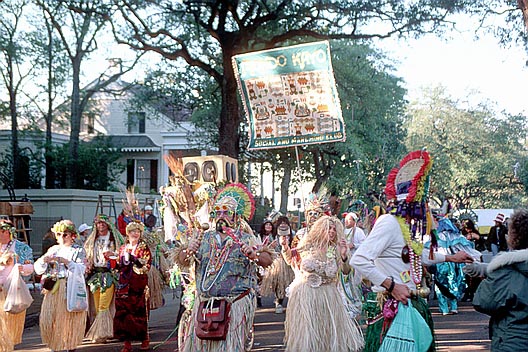
Although parades in general were popular in New Orleans from early days, the present-day pattern of parading and its organization stems only from the 1850s. At that time, many felt that the older forms of Mardi Gras had deteriorated into chaotic street violence, and the festival might have died out. However, some recent American arrivals in the city, who were familiar with holiday parading traditions in Mobile, founded the first krewe, Comus, and focused Mardi Gras energies into more orderly, organized events. This pattern was widely accepted, additional krewes came into existence, and the festival grew as the years have passed. Today organizing a parade and other krewe activities is very complicated and the captain and other officials of a krewe work virtually year round; numerous artists and craftspeople are employed in float building.
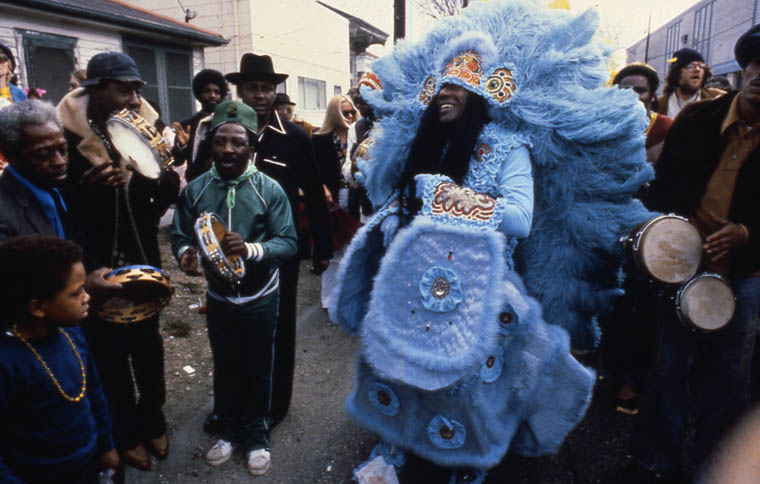
New Orleans Carnival, however, is not merely a grand display of street revelry. It also helps to structure the social season of the city's elite through balls and other social events, tying in with the custom of presenting debutantes. Mardi Gras balls put on by the krewes are very formal, sometimes following the group's parade. And, though New Orleanians probably think little of this in their general enjoyment of the celebration, Carnival also ties into the social structure of the city, krewe membership (or non-membership) relating to social prestige and social connections and to class and ethnic identity. Indeed, the city's racial divisions particularly have been mirrored in Carnival, with black participation (through, for example, the organization which produces the Zulu parade and through the Mardi Gras Indian "tribes," who costume as Native Americans and troop around the city on Fat Tuesday) historically having been quite separate from white participation. These racial differences came to a dramatic head in 1992 when the city council passed a controversial ordinance which in effect barred parades by segregated organizations. Several of the "old line" white krewes ceased parading at that time rather than change their traditions of exclusivity (thus joining some other Carnival organizations which had never paraded), and a major new krewe, Orpheus, came into existence. The end result seems to have been greater openness and democracy in the celebration of Mardi Gras. In 1999 on Lundi Gras (the day before Mardi Gras) the king of the Zulu organization and Rex, the white titular king of Carnival, saluted each other, an event which many saw as a significant expression of racial rapprochement for New Orleans.

The courir du Mardi Gras is found on the prairies of Southwest Louisiana where people of French heritage have long had farms and cattle and where a tradition of horsemanship has been well established. This form of Mardi Gras is community-based and involves (historically on Mardi Gras itself but now also on preceding days) a costumed group of people (traditionally men but now women "run" their own courirs) on horseback or in wagons who make a circuit of farmsteads and other points to request contributions for a communal meal to be enjoyed at the end of the day. They may seek money or contributions of food with the donation of a live chicken, which les Mardi Gras must run after to catch, being a prized trophy. The participants are expected to dance for or with donors (and an accompanying band plays a traditional Mardi Gras song). The participants may come as humble supplicants or may swagger on their horses and play pranks as an unmasked capitaine and his assistants attempt to control the group and its alcohol-stimulated celebrated advance.
The history of this form of Mardi Gras in Louisiana is not well documented in written sources but probably it stems from medieval European celebrations which involved license, parody, and role reversal. Some types of costume still used, such as the capuchon—a pointed hat which resembles medieval clerical garb—may come down from ancient attempts of the celebrants to poke fun at their social betters. Mardi Gras, of course, falls toward the end of winter, a time when—historically—stored food might be running short. The gathering of food for a communal meal served the practical purpose of providing a fine feast for the whole community at this time by the ritual pooling of resources. Whereas the structure of New Orleans Carnival suggests the social diversity an division of the metropolis, the communal gatherings in rural French places suggest the social solidarity and unity of smaller, country communities. Taking part in the run for the first time also serves as a rite of passage for young men.
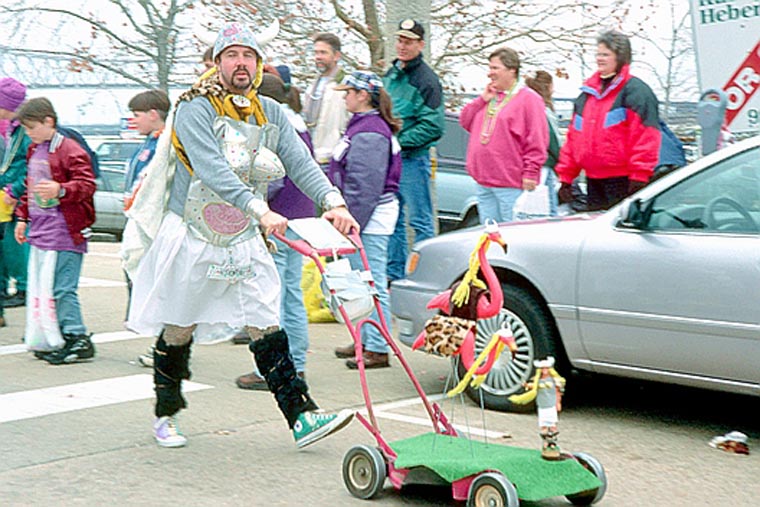
In places like Lafayette, New Road, and Monroe, parades which imitate the grander ones of New Orleans mark the festival. In such places there may also be krewes with balls and royalty, although in some places the organization of activity may be less formal than that. Although parade throws are popular here too, the floats are apt to be home-made and fairly simple, and the intense interaction between riders and spectators more personal. Like harvest festivals and other small-town fests, Mardi Gras can be a focus for local pride and cooperative endeavor (though there may also be a satirical edge to some parades, such as the Spanish Town parade in Baton Rouge).
The fortunes of Mardi Gras have waned and waxed over the years. The celebration might have died out in New Orleans in the 19th century had it not been resuscitated by the founder of Comus, and the rural running Mardi Gras had become moribund by the 1950s only to rebound in a burst of general French cultural revival. In recent years, Mardi Gras has reached new levels of energy and participation with the explosion of parades in suburban New Orleans, the great appeal of the running Mardi Gras, the expansion of parades and other Mardi Gras events in a number of towns, even the throwing of a Mardi Gras ball in Washington, DC, by the Louisiana Congressional delegation. At this point in time, the great festival seems well established for the coming new millennium.
