




If Your Eggs Are Cracked, Please Step Down: Easter Egg Knocking in Marksville
By Sheri Lane Dunbar
It's Easter Sunday morning in Marksville, Louisiana. Many of the townspeople are attending services at the various local churches. Meanwhile, Brent Scallan and Mike Bordelon hurry to set up tables and chairs for registration and a loud speaker system they will use in the big egg knocking contest that will begin soon, after the church crowd arrives. Brent will be the Master of Ceremonies, a capacity in which he has served for the past thirteen years, since he was eighteen years old. Mike, as his assistant, will be in charge of registration, as well as helping to keep everyone organized, and checking eggs at knocking time (to make sure that each contestant is using only the three eggs he or she has had registered, stamped and numbered). Years ago, Mike, now age forty five, was the announcer. Now he leaves that task to Brent.
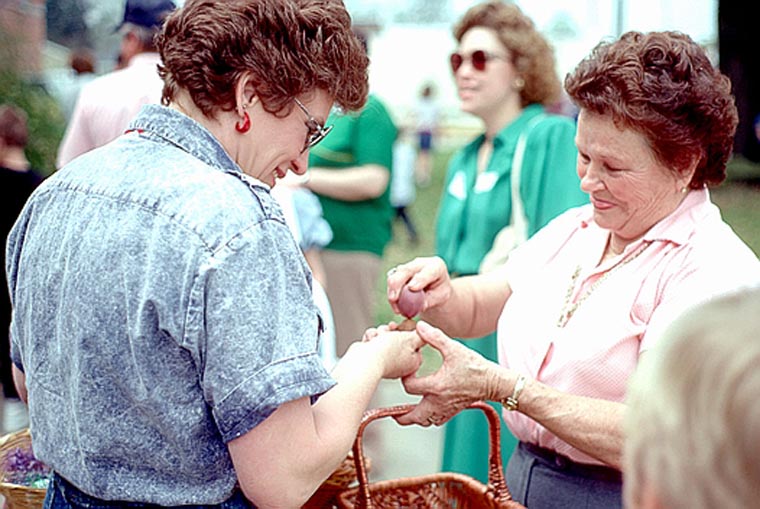
As the first few townspeople begin to arrive and register their eggs, Brent and Mike are hurrying to select the eggs they wish to enter in the contest. The Master of Ceremonies and his assistant are not content to simply officiate—that's only part of the fun. They would not think of not taking the opportunity to knock eggs themselves. For months, they have been collecting the hardest eggs they could find, in hopes that this year they or one of their family members will be the winners. Mike and Brent have both confessed to going through hundreds of dozens. They have each selected fifteen or twenty dozen that are boiled and dyed very carefully in preparation for this big event. At this time, they are knocking most of the eggs they have prepared in order to find the hardest ones of all and the (hopefully) winning eggs that will enter the contest. In order to "knock eggs" two people will agree to knock, then one will hold a boiled egg with the small end up while the other taps on it with the small en d of his egg. One egg will crack. The person whose egg has cracked will then have to forfeit his egg to the winner. This custom is carried out in several Cajun communities throughout South Louisiana. In some areas the practice is referred to as "Pacques Pacques", which simply means "Easter Easter" in French, but is also a play on words because the sound of an egg tapping on another egg makes a sound like "poc"
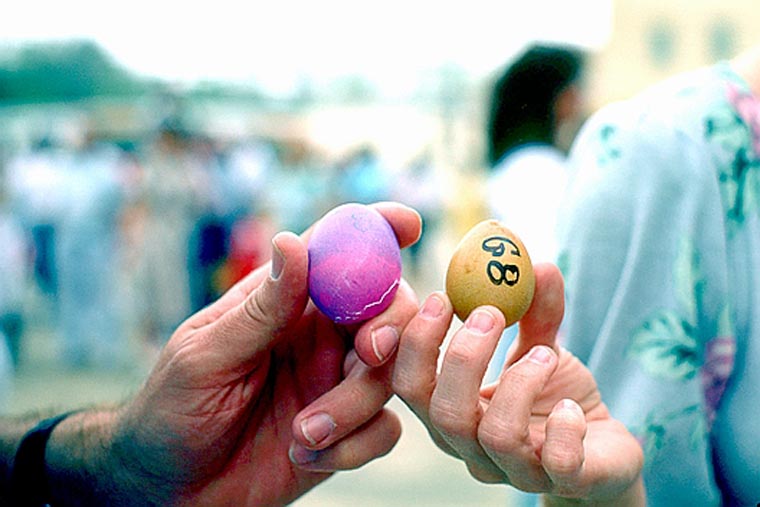
The town of Marksville and the neighboring town of Cottonport are unique in that they have organized contests for egg knocking. Marksville was the pioneer in establishing the formalized event in 1956. It was during the term of office of Mayor Edgar Coco, at the mayor's suggestion, that a city ordinance concerning the event was passed. In the early 1970s, Cottonport followed suit and also organized a community-wide contest. The citizens of Marksville are quick to point out that they started it first, but Cottonport does lay claim to its own unique customs surrounding egg knocking. For several weeks prior to Easter Sunday various bars in Cottonport hold egg knocking contests which involve some wagering on the hardest eggs. This makes the contest rather exciting! The biggest pre-Easter Sunday event is held on Saturday night at Scotty's Bar.
There are some differences between Marksville and Cottonport's Easter Sunday contests. The one in Marksville is quite a bit larger, requiring that groups of people, paired off and lined up on the courthouse steps knock at the same time. As one person in each pair is eliminated by having all his or her eggs cracked they must step down and the winner of each pair goes on to knock with someone else who still has intact eggs. This continues until there is only one person left from that entire group. The n another group is called to line up on the steps. Finally the winners of each group are paired off and out of that round will come the winner.
After the chicken egg category is the guinea egg contest. Guinea eggs are quite a bit smaller than chicken eggs and very hard. Guinea eggs are not available in as such abundant supply as chicken eggs. This makes them highly valued, selling for anywhere from $6.00 to $20.00 per dozen in the Marksville/Cottonport area at Easter time. Not only do guineas lay fewer eggs overall than chickens, but they only lay during the spring. When Easter falls early in the spring, there are fewer guinea eggs to be found—that is when they can be sold for higher prices. Even when Easter comes later, getting those hard little eggs is a challenge because guineas tend to hide their nests and one has to walk through fields looking for them, hidden under bushes or in tall grass. Also, fewer people keep guinea hens than chickens. The tiny guinea eggs are so hard that they make a much louder pock-pock sound than chicken eggs. They also take longer to crack. During the guinea egg contest, there is more intensity in the air—those eggs cost more to get and the suspense of waiting for one egg to crack brings the excitement up. There is definitely a payoff for the winners. In addition to the prestige, cash prizes are donated by local civic organizations. The first prize winner in each category is awarded $100.00. Each second place contest winner takes home $50.00. $25.00 goes to the third and fourth place winners.
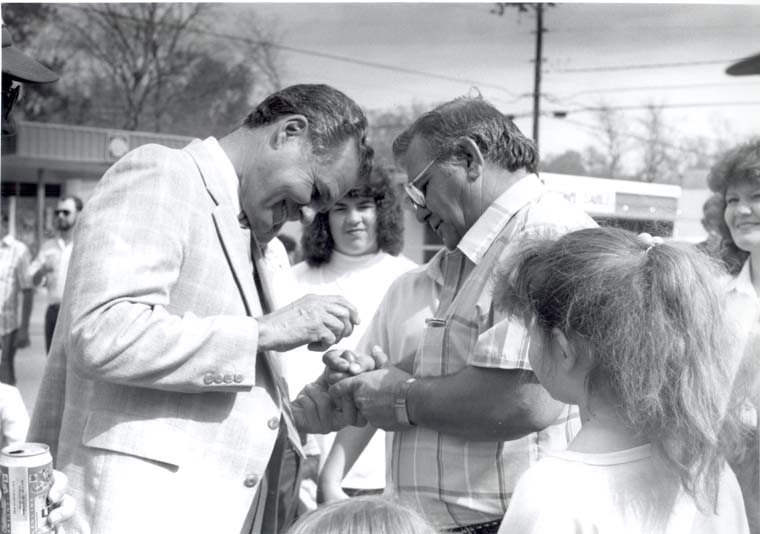
Most people in Marksville get their eggs, (both guinea and chicken), locally. If they do not keep hens themselves, they have friends who do. However, some people will go a little further from home to search for the perfect eggs. Mike Bordelon, who does not raise his own hens, works as a traveling salesman. His territory covers various parts of central and North Louisiana, and he has the opportunity to drive around in the rural areas of these regions in quest of eggs. Many people have signs out advertising that they sell yard eggs and Mike does not hesitate to stop. Egg knocking is not a part of Easter tradition in North Louisiana and people there may find Mike's enthusiasm for hard-shelled eggs a little unusual at first. However, once Mike has clued them in on how much fun the people in Marksville have at the contest, they are generally quite eager to help him. Mike says he has made a number of friends while on the road looking for eggs. As it is at home in Marksville, the guinea eggs are harder to locate. Asked how he would know who had guineas, Mike replied, "If I see a guinea on the side of the road or in someone's yard, I just stop and ask." Stopping and asking has been worthwhile—Mike's daughter-in-law won the guinea egg category in 1989 with an egg he gotten for her.
In Cottonport, the contest is still small enough that each pair is called up to knock individually. This is referred to as a "round-robin". The two towns come together on Easter Sunday afternoon at the Marksville radio station for the big "knock-off" which will determine the grand champions in chicken and guinea eggs.
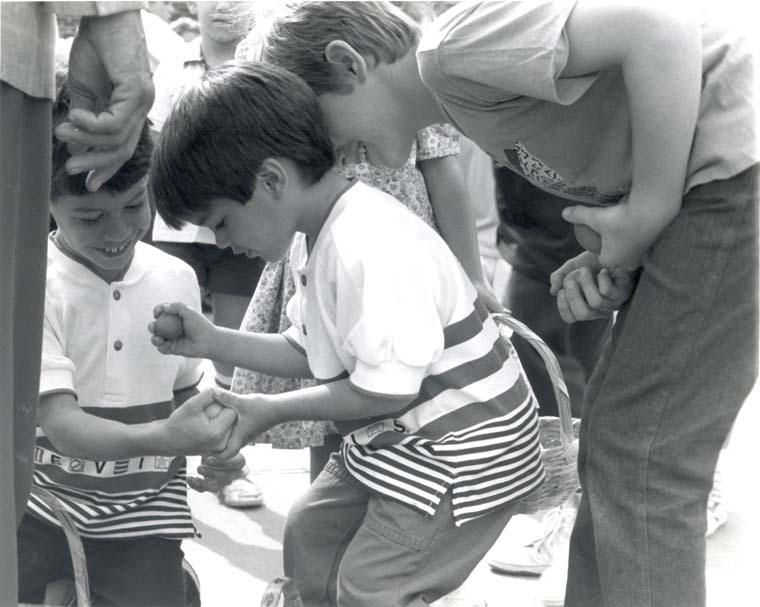
Prior to these organized contests and today, in addition to the formalized events, egg knocking or "pocking" occurs informally among groups of family and friends. This custom has always been a lot of fun and that is the purpose of the competition at the courthouse as well. Some people do not actually register eggs in the contest, but will knock with their family and friends, while they socialize. When all the eggs are cracked on their small end, the children usually continue with the game by knocking the "butts" or the large ends. Then they knock the sides. If they have an Easter egg hunt at home later, all the eggs will already be cracked all over! Hiding eggs for the children to find is a relatively new custom in Marksville, compared with knocking, and it is definitely not the major event.
The preparations begin several months in advance of Easter. Yard chickens lay fewer, but harder eggs in the early spring compared with some other times of the year, notably summer, when the eggs are abundant, but thin shelled. Supermarket eggs are always less hard than the smaller, brown, country eggs and the citizens of Marksville would not be caught dead on the courthouse steps with anything but yard eggs. There are certain breeds of chickens that are known to lay harder eggs. However, regardless of the breed, the hardest eggs are produced by well fed, active chickens. It is particularly important that the hens get adequate calcium. Some people see to it that their laying hens are fed bits of oyster shell as a calcium source; others give their brood calcium supplements or commercial food that has been fortified with vitamins and minerals.
The method generally used by the serious knockers for finding those hard eggs is to lightly tap them on their front teeth. According to Brent Scallan, the harder eggs will make a light high pitched ping, while the softer eggs will make a blunt, dull sound.
After several dozen hard eggs are selected, they must be very carefully prepared for the contest. They are boiled slowly, so that they will not jump around and hit the sides of the pan or other eggs. Many people in Marksville cushion the eggs by placing old rags on the bottom and sides of the pan. According to Brent, the eggs must also be boiled point down. This is to insure that the air pocket, something found in all eggs, will not be at the small end. There must be something solid behind the hard shell in order to keep it from cracking quickly. One method for keeping the eggs point down in the pan is to fill the pan, packing the eggs in so close together that they cannot turn around. However, both Brent and Mike actually boil their best eggs inside a cardboard carton. They will not take any chances!
After the eggs are boiled, they are dyed and decorated. Today, most families use commercial egg dyes or bottled food coloring. However, the citizens of Marksville and Cottonport recall the stories their parents and grandparents have told of the days when eggs were colored with juice from wildflowers, roots, berries, chimney soot, and coffee grounds. The old-timers believed that boiling the eggs in coffee grounds made them stronger. Some people still do it. As Judy Bordelon, Mike's wife said, "We boil our best eggs in coffee grounds, just in case. . . ."
The entire tradition of egg knocking is something passed on by the old-timers. Mike and Brent and many other people in Marksville and Cajun communities throughout South Louisiana learned the tradition from their grandparents. Easter was the favorite holiday of Mike's grandmother, and she delighted in the sport of egg knocking. Brent also has fond recollections of going to his grandparent's house to knock eggs on Easter Sunday.
Back at the courthouse square in Marksville, more and more people arrive with baskets of eggs in hand. A large group is gathered around the registration table. Many of the people here were born and reared in Marksville, but have moved away-to Baton Rouge, Alexandria, Lafayette, and some out-of-state, but they make it back every year at Easter and gravitate to the courthouse lawn for fun, socializing and of course the contest. Groups of family and friends are talking, laughing, catching up on the latest news, and knocking eggs.
When it is time to begin, Brent calls out, "Last call to register your eggs." Then starts the T-toddler contest for children under eight. Their prizes will be baskets of Easter candy. A few adults are still scrambling to get their eggs registered.
Brent calls out for numbers one through forty to line up on the steps. Mike is checking the eggs, making sure everyone is there, helping people find the knocking partners. And the big moment is here! "Ready! Knock!" Brent continues, reminding the contestants, "If all your eggs are cracked, please step down. If your eggs are not cracked, pair up with the next person in line and continue knocking. If you are finished knocking, please move off the steps." Soon there will be a winner, and a great, fun tradition continues in Marksville.
