




Music and Dance in South Louisiana's Cuban Community
By Tomás Montoya González with contributions from T. Ariana Hall. Translations by Lori N. Tyler, Guillermo Cabrera Rojo, and T. Ariana Hall
Introduction
Without a doubt, Cuban music has made its mark on the North American and international musical landscapes. The fusion of diverse cultural elements in Cuban music, most notably of Spanish and African origins, gave rise to a rich array of music and dance genres, rhythms, and styles that can be found in Louisiana, especially in the greater New Orleans area.
When the Spaniards arrived in Cuba in 1492, they practically annihilated the indigenous population through their abuses. Later they began one of the most brutal episodes of human history with the establishment of the trans-Atlantic slave trade, trafficking human slaves from Africa to the Americas.
The trans-Atlantic slave trade brought a second set of African cultural influences to the New World, since Christopher Columbus' ships carried with them age-old historical and cultural ties between Spain and its neighbor, Africa. At the time of Spain's colonization of the New World, Spanish society, culture, and, especially, music already incorporated centuries of African influences. Another distinguishing factor in the development of Cuban music and dance are the French and distinct African influences that were brought to Cuba by French-Haitian immigrants in the early 19th century. These French-Haitian immigrants also played an important role in the history of Louisiana.
During the Spanish colonization of the New World, Cuba served as a geographic bridge to the Americas, linking all the routes in and out of the Caribbean. This inevitably made Cuba a multicultural bridge that transcended the physical realm and penetrated the complex social and historical fabric of many New World communities, including Louisiana. Louisiana developed under Spanish, French, and, finally, American rule, while always maintaining a special relationship with the Caribbean.
Cuban Migration To Louisiana: Race, Identity, And Generation
The music and dance expressions of the Cuban immigrant community in the greater New Orleans area can be better understood in the context of the waves of Cuban migration to Louisiana. Since 1959 there have been several waves of Cuban migration into the United States, which were unprecedented in terms of their size and circumstances. The socio-political changes that occurred in Cuba after the 1959 revolution and the resulting changes that they created in U.S.-Cuba relations were the principal causes of these migrations. For many of these Cuban immigrants, the only possession they could bring, like a precious gem, was their culture and music.
Cuban immigrants arrived with the ever-evolving traditions from the period when they departed Cuba. These immigrants had infrequent and conflicted contact with Cuba after leaving the island. Each migratory wave has unique issues surrounding their musical preferences, which cannot be understood without looking at the distinguishing factors of class, race, generation, ethnicity, religion, and ideology for each group.
Three groups of Cubans have come to the United States, and Louisiana, since the 1960s. The 1960s group was the first to leave Cuba as an immediate result of the socio-economic changes of the Cuban Revolution. The Marielitos left Cuba in 1980, and are often referred to as Marielitos because they left the island through Mariel Bay in the northwestern part of Havana Province. The Balseros, or Rafters left Cuba in all kinds of small boats and rafts throughout the mid 1990s.
Each group of immigrants has been a product of the culture and times that caused them to leave Cuba. The immigration of the 1960s was mostly composed of different levels of the Cuban middle and upper classes. Even though they came from diverse origins, the majority were white Cubans.
In contrast, many of the 1980s Marielitos were black. They are often ostracized from the established Cuban community of the 1960s due to a complex set of social factors including class prejudice, racism, educational differences, differences in fundamental cultural values and tastes, etc. A certain number of Marielitos were released from jails in Cuba to leave for the United States, which has created a widespread prejudice against the entire Marielito group. Many Marielitos have also assimilated into black communities of South Louisiana.
The Balseros from the 1990s have internal conflicts in how much to assimilate and how to define themselves as a group and as individuals. They are torn among their mythical preconceptions of life in the United States, the reality of life in the United States, and their more recent memories of Cuba. They came to the United States because of the economic crisis in Cuba during the 1990s.
Cubans have settled in South Louisiana as a direct result of these three main migrations and a wide variety of other isolated cases. Upon their arrival, they were not only welcome in the United States, but they also felt at home in the friendly Louisiana environment. According to the 2000 United States Census, 5460 foreign-born Cubans were living in Louisiana. The Cuban population in South Louisiana has made a notable social impact on the area, despite their relatively small numbers.
Several Cubans immigrants, who came at different times, shared their stories about how they arrived in Louisiana and why they decided to stay in Louisiana.
Vilma Longoria, who arrived in the U. S. in 1962, explains how other family members and friendliness kept her here in New Orleans:
When I first arrived in the States with my husband and children, we spent a week in Miami, and since one of my uncles was living in New Orleans, we decided to move here. We stayed here because people were very friendly and helpful. However, I did not speak English and it wasn't easy for me at first. . . . Most of my husband's and my own relatives have migrated to the States and are living currently in New Orleans.
Family members already in Louisiana also brought Carlos Manuel Padial to the state in 1961:
I came here trying to escape communism. The Cuban government put me in jail the day before the invasion for a while because they thought I was a threat to the regime. At that time, I had a six-month-old baby. I did not want my child to grow up under the system. After I got out of jail, I came to the States. When I left Cuba, . . . my brother was living in Baton Rouge and my parents in Mobile, Alabama, so I moved there with them. After two months, I got a job in Baton Rouge, in which I worked for just three months. The company was moving out of town and I did not want to move again. I stayed in Baton Rouge and went to night school to get my Ph.D. At that time, I made a living as a door-to-door salesman. I sold an Italian coffee (Aroma Di Oro), Cuban cookies, and guava jelly. After five months, I got a job in New Orleans as a chemical engineer. I worked there for twenty years. Basically, my job, the Spanish-French culture, the type of food, and the music made me like this place so much that I wanted to stay.
At the age of 16, Francisco Thompson arrived in Louisiana in the early 1970s:
The reason that I wanted to come here is because I did not like the Cuban system. Well, when I arrived in Miami, they gave me two options: Nebraska or Louisiana, and since Louisiana was closer to Cuba, I chose Louisiana. Plus, there were some acquaintances here, too (my younger brother and some friends) and the very next year my older brother came, too. Then I petitioned for my father, who lived with me for a while before moving down to Florida.
Ailene Cabrera, a Balsera (rafter), says, "I left Cuba in 1994. I sold my gold and came here in a raft that I built with a bunch of people. We were rescued and taken to Guantanamo Naval Base, in which I stayed for a year. I arrived on August 11, 1995."
Cuban immigrants established social networks necessary to preserve their culture, with music and dance as the basis for collective community expressions. Music and dance are at the center of celebrations that, in turn, bind the Cuban community together, and inject the Cuban social psychology with a "Carnival attitude" that is an elemental characteristic of Cuban culture.
The Cuban community shares many cultural parallels to Louisiana like the importance of festivity, the use of time, and the relationship between public and private spaces. In both Cuba and Louisiana, there is a direct, informal nature to creating interpersonal relationships, with parties as important spaces for establishing social connections. A joviality affects ordinary everyday actions, a "Caribbean humor" that shows up in many cultural expressions.
Both places have a strong Spanish and French heritage, which can be seen in the music, architecture, and economic backgrounds in trading sugar, coffee, and wood. However, there are differences between the symbolic structures of Cuba and South Louisiana, so the sounds, dances, imagery, language, foodways, and other identifying traits of Cuban culture encountered obstacles to their development and acceptance. The Cuban traditions arriving from the Caribbean Sea had to survive culturally in this new context.
Creating Cuba In New Orleans
Cubans who came to Louisiana in the 1960s found no Cuban culture or music scene, so they created their own gathering spaces, musical groups, and institutions that consolidated their social networks and allowed for cultural expression. These institutions were primarily for civic and cultural purposes.
Undeniably, this first wave of immigrants breathed new creative life into Louisiana. Major achievements from the 1960s and later left a Cuban imprint on the South Louisiana cultural landscape. These achievements reveal some of the strategies by Cubans in the greater New Orleans area to collectively represent themselves through music and festivity.
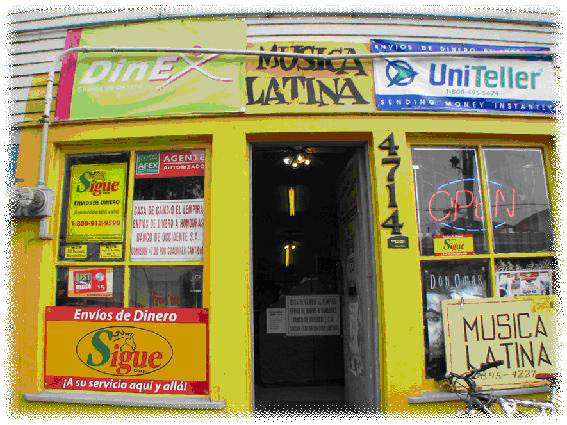
Several organizations have played important roles in Louisiana's Cuban community. In 1954, Liceo Cubano José Martí was created to present music for its members every Sunday as part of its mission to preserve Cuban culture. In the 1960s, Club Cubano de Profesionales was founded, which sponsored a multitude of social gatherings and concerts. The club still exists, but is not as active as it was throughout the 1960s-1990s since the founding members are growing older. In 1973, Comité Organizador del Festival Latinoamericano (COFLA: Latin-American Festival Organizing Committee) was created. COFLA existed for ten years, and some of its principal producers included TV commentator Julio Guichard and music shop owner Juan Suaréz. COFLA produced many music festivals and concerts during its tenure. In 1969, La Tienda Música Latina was opened on Magazine Street by the influential Suaréz family who played an important role in supporting Cuban culture in South Louisiana. The shop, which is still open, features an extensive collection of Cuban music. The owner, Juan M. Suaréz, arrived in the United States with his family in the 1960s and has been involved in many high-profile Cuban public events. His wife, Yolanda Estrada, is from Honduras and has a radio program on WWOZ-FM 90.7 that features traditional and contemporary Cuban music.
In 1980, the Cervantes Fundación Hispano-Americana de Arte (Cervantes Hispanic-American Arts Foundation) opened in Kenner, Louisiana. The Foundation's mission is to teach modern and classical Hispanic arts and cultural traditions. The founder, Guillermo de Bango, is an artist, intellectual, and cultural producer. Born in Havana, Cuba, de Bango was a political prisoner in Cuba, serving ten years in prison and seven under house arrest after the Cuban Revolution. He arrived in the United States in 1979, joining his wife and children in Kenner. Eager to be active in the local cultural scene, he founded the Fundación Hispano-Americana de Arte Cervantes. The school teaches classical and modern Latin American art, music, dance and culture and has had a major impact in the Cuban community, for both its teachers and students.
Carnaval Latino was a large Latin music festival throughout the 1980s and 1990s produced by Carlos Estévez and Romi González. Romi González recently resurrected the festival in 2006. ?Qué pasa New Orleans? and Aquí New Orleans, the Spanish-language magazines from that time frequently feature references to Carnaval Latino and the general Cuban and Latino cultural scene.
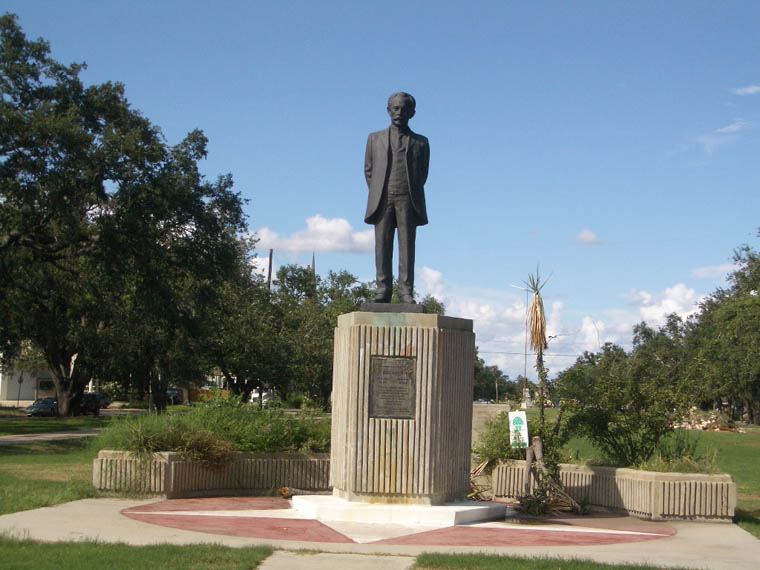
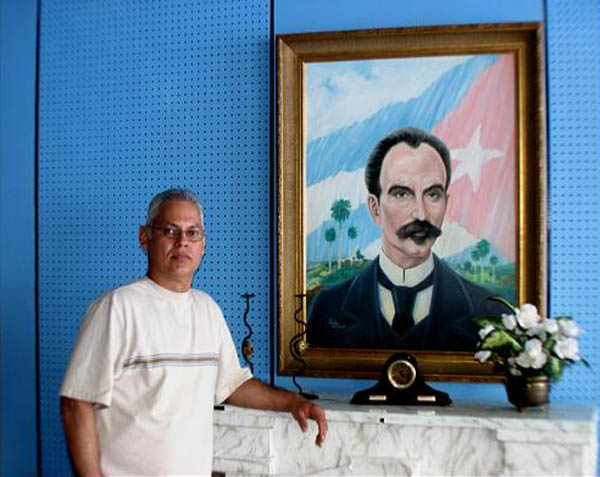
In 1996, the José Martí Monument was placed on the neutral ground at the intersection of Jefferson Davis Parkway and Banks Street by the organization Pro Monumento José Martí, formed specifically to create and erect the monument. This monument celebrates Cuba's national hero, José Martí, who was instrumental in Cuba's independence from Spain. Community organizer Bethsy Pizarro recalls that Cuban singer Celia Cruz contributed to the cause. The Pro Monumento José Martí group also placed a commemorative plaque at the corner of Poydras and Camp Streets in the New Orleans Central Business District, where the Cuban patriot Narciso López raised the Cuban flag for the very first time in 1850 before his expedition to liberate Cuba from Spanish rule.
Most recently, in 1999, artists, cultural promoters, and intellectuals formed the CubaNOLA Arts Collective, an organization led by Tasha Ariana Hall that seeks to explore and promote the historic and cultural connections between Cuba and New Orleans, Louisiana.
Cuban Music And Dance Styles And Instruments
Cubans incorporate music and dance into everyday life, domestic celebrations, and public celebrations. The Cuban love of a good party has helped them assimilate into the larger culture of south Louisiana. These celebrations have made Cubans a part of the south Louisiana landscape. Of the surprising variety of Cuban musical genres, rhythms, and tradition, four influential genres are discussed here: son cubano, conga, rumba, and cha cha cha. These are just a few of the music and dances styles, that exemplify the close relationship between music and dance in popular Cuban culture. Some of these dance styles are partner dances and some are collective dances like choreographed Carnival groups, un-choreographed street parades, block parties, etcetera, where tens, hundreds, or thousands of dancers participate in the overall dance. In Cuba collective dance is an important part of many Carnival traditions.
Son is a particular style of singing, a style of instrumental music, and a style of dance. It has Spanish and African elements, but it is one of the quintessential genres of Cuban music. Son dancing is a partner dance that has greatly influenced the Latin dance style of salsa. Son music incorporates a wide variety of instruments, which has helped the music spread, evolve, and penetrate Cuban cultural identity. The first forms of son included singers, guitar, tres, maracas, bongo, claves, and trumpet. Over time other instruments have been inserted into the traditional Son configuration including upright bass, piano, tumbadores (conga hand drums), etc. Son music has a syncopated rhythm that is faster than its predecessor the danzón, which sounds similar, in some ways, to the North American ragtime. Son is primarily dance music and many of the song lyrics are directed to the dancers.
Conga is a style of music and dance that has African origins, including its rhythms and the percussion instruments used to play those rhythms. During the Spanish colonial period, plantation owners allowed enslaved Africans to play and dance their traditional music, which later developed into several distinctly Cuban styles of music including conga. At the beginning of the 20th century conga groups began incorporating brass and woodwind instruments including trombones, trumpets, and saxophones in western Cuba, and the Chinese cornet in eastern Cuba. These conga processions and Carnival parades, which brought together hundreds or even thousands of participants, originated in public spaces as neighborhood parades. The traditional conga parade dance step is a very simple slow moving shuffle with a constant swaying back and forth with the hips. Conga even made a world-wide impact in the 1930s with a stylized theatrical version for international audiences, where the basic parade shuffle transformed into a long line of dancers each holding the waist of the person in front of them.
Rumba is one of the best-known music and dance styles in Cuba. Its origins are in the urban spaces of western Cuba, primarily Havana and Matanzas, where there were large numbers of free and enslaved Blacks during the Spanish colonial period. The use of tumbadoras or conga drums, wooden boxes, and a wide range of percussion instruments, often found objects, made rumba an essential element in the cohesion of those original Afro-Cuban communities. Several percussionists, dancers, and singers are necessary to perform a rumba. They can be performed at house parties or in public neighborhood spaces. Rumbas are not parades. They are gatherings that are more akin to drum circles, with a dance contest, of sorts, between a man and a woman or between two men. The collective group recognizes and praises the best dancers. Rumba songs can be traditional verses or chronicles of current events. A stylized ballroom dance, loosely based on traditional rumba but with many essential differences, was popularized around the world in the 1920s and 1930s.
Cha cha cha is a style of music and a style of dance. The music is based on a distinct rhythm and it incorporates elaborate vocals. Cha cha cha evolved out of two older Cuban music/dance genres: danzón and son. Created by Enrique Jorrín in the 1940s, this partner dance was incredibly popular in Cuba and around the world. The rhythm is broken into two parts, the first part is "1 - 2", and the second part is "1 - 2 - 3". The name cha cha cha corresponds to the "1 - 2 - 3" since the dancers would count "1 - 2", "cha - cha - cha." For more details on the history of cha cha cha, consult the Diccionario de la música cubana. Biográfico y técnico by Helio Orovio.
These styles and others heavily influenced what came to be known as salsa, a style of Latin dance music created in New York City by Latino musicians in the early 1970s. Many of the partner dance movements and musical elements that became part of the salsa style of music and dance were based on music and dance styles that originated in Cuba and spread throughout the Caribbean. Independently, a parallel, but distinct, popular music and dance style called timba cubana, evolved in Cuba in the 1980s. Timba incorporates elements from many popular Cuban genres including rumba, son, conga, and cha cha cha. Different generations of Cuban immigrants have been influenced in very different ways by the evolution of salsa and timba, depending on if the person was living in Cuba or in the United States during the 1970s, 1980s, or 1990s.
To the untrained eye and ear, salsa and timba music and dance styles may sound and look similar but there are many key differences. They are both partner dances with complicated turns and movements superficially similar to Swing, Jitterbug, and other modern partner dances. Musically, salsa is focused on the melodic aspects of the music, while timba is faster and more focused on highly syncopated, layered, complex rhythmic structures. The lyrics of salsa often concentrate on longer narratives while timba lyrics are infused with many punchy almost spoken choruses that are imbued with multiple meanings and interpretations. Both are partner dances where the two dancers repeat a foot pattern within the 4/4 beat, that stays in time with the music while they do various turns. The salsa foot pattern usually "breaks" (the part of the pattern when each dancer steps back) on the 2nd beat, while the timba foot pattern always "breaks" on the 1st beat, with a syncopated pause before that 1st beat. This is a huge distinction for dancers.
Clave, güiros, maracas, and tres guitar are some of the musical instruments that create the particular Cuban sounds of Cuban music, and that Cubans relate to their national identity. The clave is a wooden percussion instrument that originated in Cuba. There are two wooden cylindrical pieces of wood that the musician puts into each hand and strikes together to create the sound. Claves seem to have originated in poor neighborhoods of colonial Havana as an African retention. Over time claves have become ubiquitous throughout almost all Cuban music styles. Güiros are made from the gourds from the güira tree in Cuba. The ideal gourd is longer and larger, between 30 to 50 centimeters. The güiro as a percussion instrument has African roots. The sound is produced by running a stick along one side of the gourd that has a series of cut ridges. The gourd is held in one hand and the stick is held in the other hand. The güiro is widely used in popular Cuban music with large format orchestras or big bands (cha cha cha, mambo, etc.). It creates a raspy percussion sound similar to that of the washboard in South Louisiana music. Maracas are usually made from two güira tree gourds, but they may be made from the rounder smaller gourds. They have pre-Columbian origins and they are used throughout Latin America. Other kinds of gourds and fruits can be used to make maracas. The fruit or gourd is hollowed and dried out, leaving the hard outer shell. Then small seeds are put inside the shell. The hole that has been used to extract the insides and to insert the seeds is then covered up with a wooden handle, which is used to move the instrument up and down. Maracas are used in traditional Cuban styles like son. Tres guitar is a uniquely Cuban three-stringed guitar. The strings, which are usually metal, are stretched across the neck and body of the instrument, like a typical guitar. The tres guitar distinguishes the sound of son cubana and of Cuban music from the countryside.
Nightclubs, Music, And Dancing
Over time different nightclubs that featured Cuban music and dancing came and went in New Orleans. Clubs during the 1970s and 1980s include Guantánamo's Rum Club, the Latin bar rooms on Magazine Street, and the Latin bar rooms on St. Claude Avenue like the Blue Light and Café Olé. Francisco Thompson describes the Latin and Cuban club scene on Magazine Street during the late 1970s:
We would also run into each other on Magazine St., which was full of Cuban venues such as El Latin American, owned by Mario Zandoman, as well as El Loco, El Tranvia, Los Mayas, etc. There was even a Latin movie theater. There was also a very popular restaurant called La Clazoneta de Guanabo. In addition to that, there used to be a very popular night club called Guantanamo Room, owned by Benito Borges, in which many Cuban artists would perform.
He goes onto the describe the scene in the Gentilly neighborhood in New Orleans:
There used to be about thirty Cuban families living in the neighborhoods in between Broad and Gentilly. The group from the 1980s settled by Elysian Fields all the way from the railroad tracks to Interstate 610. There was a barber shop, a bakery, two bars, and a restaurant called San Lázaro.
In the same period of time, music bands such as Cubanola, founded by Jose D'Páez, Los Sagitarios, and Los Catrachos Boys became popular. José D' Páez came to Louisiana from Cuba in 1982 after living in New York and Miami. He says, "I decided to stay here because there was an interesting and very active music scene. Consequently, I formed a band named Cubanola. Rolando Castro helped me to form the band by giving me the instruments we needed. After playing with Cubanola until 1985, we split up and I started playing with Rítmo Caribeño."
Other noteworthy singers from this time include Tito Albizur, Rubén Gonzáles, and Rafael Hernán. Not all the musicians in these bands were Cubans, but the basic Latin music repertoire was based on Cuban genres. Some more recent New Orleans Latin bands with Cuban members and influences include Abatar, directed by Geovanis "Dongo" Palacios, Fredy Omar y su Orquesta with Geovanis Palacios and other Cuban musicians, AshéSon, directed by Javier Olondo and Dongo and Los Pingus directed by Alejandro Bernabeu. There are also local musicians, like Michael Skinkus, who have gone to Cuba to study Cuban music in-depth.
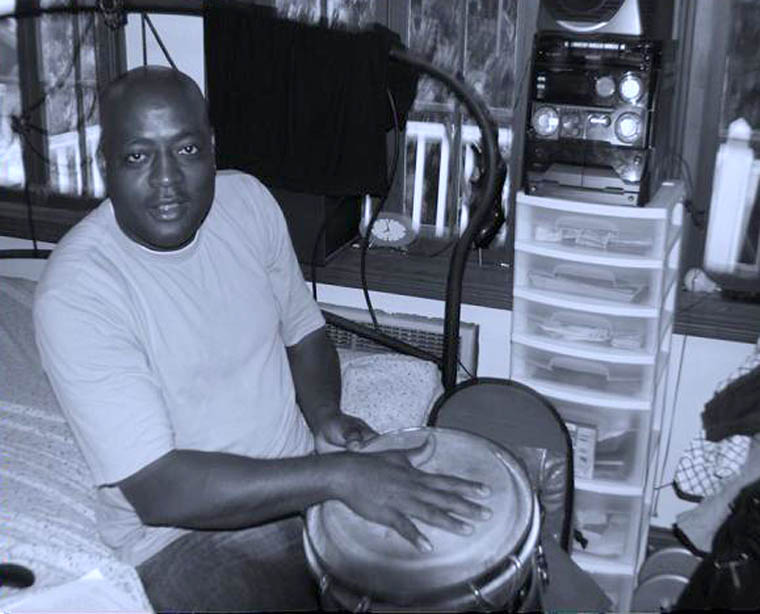
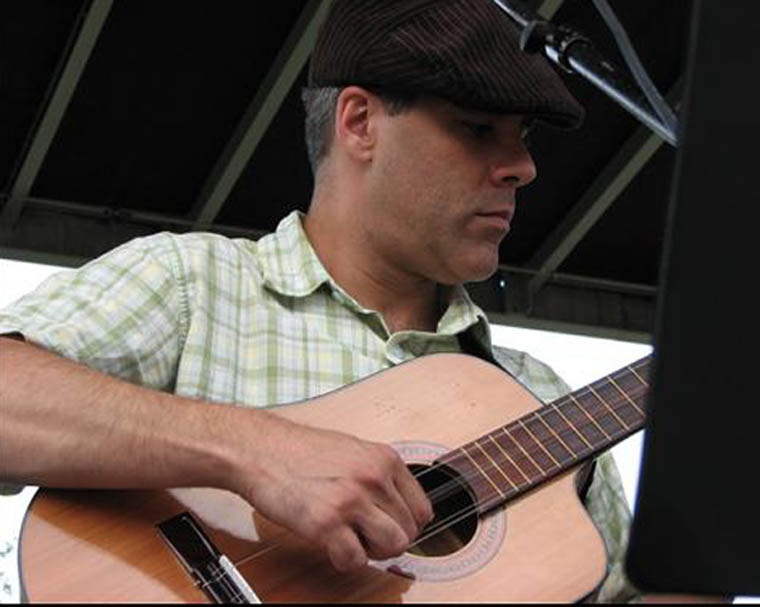
Geovanis Palacios, better known by his nickname Dongo, was raised within Afro-Cuban folkloric traditions. Arriving in the United States as a Balsero in the 1990s, he lived in several cities within the United States and finally settled in New Orleans, where the weather and music scene are more like what he left in Cuba. Javier Olondo had a very different path to New Orleans. He was born in Houston, Texas. Even though it was very unusual for the period, he and his Cuban family decided to go back to Cuba, reversing the immigration process. When Javier arrived in Cuba as a child, he embraced Cuban culture immediately. He earned a graduate degree in classical guitar. In the early 1990s, he moved to Europe to continue his musical studies. In 2000, he returned to the United States and settled in Louisiana, where he teaches guitar, gives salsa lessons, and leads the band AshéSon with Geovanis Palacios.
Over the last few years, a loose network of public gathering spaces for Cubans in the greater New Orleans area has included certain nights like Copacabana, Tomatillo's, Ray's Boom Boom Room, Blue Nile, Café East, Ray's Over the River, Banks St Bar, Lazzizas and Ray's Boom Boom Room, but this network is unstable and always shifting. Cubans also come together at larger Latino events. Among the currently active Latin music bands, only AshéSon and Los Pingus have exclusively Cuban repertoires. The rest of the active Latin bands incorporate Cuban music into their repertoires to varying degrees.
Additionally, there are some New Orleans English and Spanish language radio stations that feature some Cuban music in their Latin music programs like WWOZ 90.7 FM's Saturday morning program with Yolanda Estrada and WFNO 830 AM La Fabulosa's weekend traditional Latin music program.
Dance is an important component of Cuban culture. There are a few Cuban Salsa dance instructors that live in the greater New Orleans area. People from different origins and nationalities have established an active Latin dance network. Two Cuban dance instructors include Javier Olondo, a classically trained guitarist, and Aurelio A. González, a trained dancer and the current coordinator of cultural activities for the Cervantes Hispanic-American Art Foundation. Aurelio has formed a core group of Salsa students that serves as a social network for Cuban music and culture. This network of Salsa dancers is an important channel for spreading Cuban cultural influences throughout present day South Louisiana. Over the last two decades the movements of Cuban casino, known as salsa outside of Cuba, have evolved in response to the emergence of a new style of Cuban dance music called timba. Javier Olondo and Aurelio González incorporate some Cuban timba dance movements into their repertoire.
While the musical differences between salsa and timba have been described, it will be helpful to explore the differences of their dance movements. Timba movements have more of an emphasis on upper body and torso movements than salsa. This is attributed to the strong Afro-Cuban rumba dance influences in timba. The multiple layers of percussion patterns characteristic of timba also comes from rumba. In timba the male dancer takes a stronger lead than in Salsa and the couple tends to mark the basic step from side to side, with less autonomous movement for the female dancer. In salsa the couple tends to mark the basic step back and forth and the female dancer has more opportunities for individual improvisation within the partner moves. Timba also places more emphasis on salsa suelta or freestyling, where the two dance partners let go of each other's hands and freestyle dance together. The female timba dancer has opportunities for improvisation during this salsa suelta or freestyle portion of the dance. Musically, timba fuses a myriad of influences from traditional Cuban genres, all the way to Reggae and Hip Hop. Reggae and Hip Hop influences in Timba dancing are apparent as well, especially in (but not limited to) the salsa suelta freestyling.
Conclusion
Cubans who immigrated to Louisiana came for a variety of reasons: political, economic, or simply because they had the opportunity. Although Cuba is a country with its own unique traditions, those who have traveled to Louisiana agree that it is culturally very similar to their home country. The climate, architecture, and history mirror the Cuban environment, so much so that many Cubans have made their homes here. In a more connected global society, many Cubans are able to access numerous aspects of their culture in a variety of ways. Ailene Cabrera explains how she collects Cuban culture, including music, from various sources and eloquently expresses the importance of maintaining her Cuban identity:
I do as much as possible to keep my culture alive. Almost every day I eat Cuban food. Actually, I even have a Cuban cookbook right here. Additionally, when I went to Cuba I brought a lot of Cuban decorations for my house. I even have a Cuban flag in my office. In Louisiana, there are some places where we can get Latin food, but it's very expensive. We can find pretty much all types of food here; however, it is more expensive than in Miami. Regarding how and where we can get music, nowadays we can find it everywhere, especially on the Internet. People also bring music and movies from Cuba and we share them with each other. I have a TV channel where they play old Cuban movies, interviews, and other things. There is also a pretty interesting satellite channel where they interview Cuban celebrities, musicians, writers, etc. . . . I always keep in touch with my friends and we pass along news and anything regarding Cuba.
In trying to maintain their culture, Cubans in Louisiana have created social clubs, music groups, festivals, and societies. They also include Cuban elements in their home life. Music and dance are at the heart of their public gatherings, domestic celebrations, and everyday life.
Sources
Alén Rodríguez, Olavo, Pensamiento musicológico, Editorial Letras Cubanas, La Habana, 2006.
Moore, Robin D, Música y mestizaje. Revolución artística y cambio social en la Habana. 1920-1940, Editorial Colibrí, España, 2002.
Orovio, Helio, Diccionario de la música cubana. Biográfico y técnico, Editorial Letras Cubanas, La Habana, segunda edición, 1992.
