




The Story of La Purisima and La Griteria: A Unique Nicaraguan Sacred Tradition Adapted to Louisiana
By Denese Neu
Southeast Louisiana is known for its colorful and boisterous celebrations. It is a place where many different native and immigrant populations have converged and blended to make a unique culture. It is a place that continues to welcome new populations; a place where their colorful celebrations are encouraged and many view them as a welcome addition to the area's creolization. Among the diverse and creolized population of Southeast Louisiana is a group of Nicaraguan immigrants. Adopting the lifestyle and culture of New Orleans, they also hang onto the traditions of their home country. Many Nicaraguan immigrants living in the area celebrate La Purisima and La Griteria - intertwined celebrations honoring the Blessed Mother Mary - each December. Like Mardi Gras, it is also rooted in Catholicism with the hosts rewarding the celebrants with gifts.

Catholic celebrations are observed throughout the world, but the celebration is unique to the Nicaraguan people. The custom is to build private altars at individual homes, which will be visited by family, friends, and neighbors. The hosts offer gifts to the visitors who sing before them. In Southeast Louisiana, the tradition has been adapted to bring the Nicaraguan community together each year, to celebrate and to share other Nicaraguan cultural traditions that might otherwise be lost to assimilation. To fully appreciate the celebration among Nicaraguans living in Southeast Louisiana, one must first know a bit about how the image of Mary became so important to the people of Nicaragua and how the celebration is observed in their native land.
The Tradition in Nicaragua
Today, the population of Nicaragua is predominantly Catholic and devotion to the Virgin Mary is central to the Nicaraguan heritage. The Spanish colonizers brought Catholicism and traditional religious celebrations to Central America. With fervor and piety, the native populations embraced Mary as their Patron Saint and church ceremonies were adopted and modified to mix with the native culture. There does not appear to be any one definitive history of how the veneration of Mary became a cultural custom in Nicaragua. The story is pieced together from a variety of explanations but tells us that the veneration of Mary began in 1562. Her image came to the village of El Viejo, carried by Pedro Alonso Sanchez de Zepeda y Ahumada, the brother of Saint Teresa of Avila, while traveling to Peru. Forced to remain while a tropical storm passed, he placed the statue of Mary in the local basilica. News of the image traveled through the region and many natives came see, pray, and worship the image. When Don Pedro departed, people traveled to the port to say goodbye to the beautiful image. A new storm forced his return, and the reappearance of the image of Mary was celebrated. Believing it was divine intervention that caused the return, the owner gifted the image to El Viejo.
La Purisima means "the purest one" and celebrates the conception of the Blessed Mother. There are different versions of its origins. One is a story of a miraculous journey of an image traveling upriver and across a lake to women who pulled her from the water on December 7. Another version is associated with the city of León at the beginnings of the 18th century. The story is that monks of the San Francisco convent used candy and fruit to attract children and believers to come and sing to the image of the Virgin. They were quickly overwhelmed and expanded the celebrating, singing, and praying to people's houses where they were encouraged to set up private altars. The tradition spread to other towns and soon to the rest of Nicaragua.
La Gritería (the Shouting) began in 1857. Again, there are different versions of the beginnings. One version is that Monsignor Giordano Carranza recommended believers to shout the phrase "the purest conception of Maria!" from house to house throughout León. Another version is that on December 7, 1857, Monsignor Giordano Carranza asked La Purisima celebrants, "Quién causa tanta alegría?" (What causes this happiness?). The crowd of devotees simultaneously responded, "La Concepcion de Maria!" (The conception of Mary). As the tradition spread, composers wrote the songs of praise still popular today. Regardless of its origins, the celebration grew into a national festival where the cities and towns of Nicaragua complete to create the best and most altars. In one section of the country, the people travel by boat to visit altars built upon the lake's islands.
Unlike Mardi Gras which has largely lost its original Catholic meanings to the masses, these celebrations remain the veneration of the Virgin Mary. Purisima is a novena, or nine days of prayer and devotion. La Griteria is the boisterous and celebratory festival held on December 7th, the final day of La Purisima. During the novena, altars are built, visits to sing and pray occur, and singers receive gifts from the alters hosts. La Purisima culminates with La Griteria when fireworks, firecrackers, and shouting erupt throughout the country. The common shout is: "Quién causa tanta alegría?" (Who causes this happiness?). People answer with the massive response, "La Concepción de María". As the fireworks explode around them, Nicaraguans go to the streets to "shout" to the virgin. They walk the streets to visit and sing to each altar. House owners give a small gift such as fruit, candy, toys, noisemakers, or drink, and then the group travels to the next altar. This will go on until the gifts run out or there are no more singers. As explained by La Purisima organizers in Southeast Louisiana, these gifts have begun to include food staples, such as rice, beans, and oil, to help those who are impoverished. Juan Gutierrez, one of the organizers, describes the scene in Nicaragua.
At different houses all over the city, Catholic people prepare an altar. Some inside the house; some outside of the housethe people from the neighborhood walk to sing in front of the altar and move to the next altar. While they are singing, the people there give some kind of gift to the people who sing. That is the tradition in Nicaragua. The gift can be a drink, a small plate, a candy, but they give you something for singing in front of the Virgin Mary.
Celebrating A Unique Nicaraguan Sacred Tradition In Southeast Louisiana
Staying true to the traditional custom, many Nicaraguan immigrants continue to set up private altars in their homes for their family, friends, and neighbors. These private events are supported and attended, but the dispersion of the community does not make it easy for Nicaraguans to be highly cohesive and to travel to the private altars. In Louisiana, La Griteria has not lost its importance but it cannot be the large outdoor public celebration it is in Nicaragua. The organizers at St. Jerome Catholic Church in Kenner state that La Purisima is "one of the most important traditions we want and need to keep." To do so, they have adapted La Purisima and La Griteria to serve the Nicaraguan community. Using the celebration to bring Nicaraguans together, they also honor their heritage. Without an organized La Purisima and La Griteria, many Nicaraguans would have very little contact with others from their native country and a place to enjoy the cultural traditions.
The organizers explain that while they are invited to visit private altars, they began organizing a public event 16 years ago. About 15 people organize and fund the celebration. To offset the expense, they hold an annual fundraiser by selling traditional meal plates, such as nacatamales, and sell raffle tickets. The raffle drawing is conducted during La Purisima and the items include many figures of Mary. One celebrant who explained different happenings during the Spanish Mass told about winning a statue the year before. She was upset that she had forgotten to bring her this year and said, "I wanted to place her on the altar so she could enjoy her party." Alfredo Narvaez explains that this is welcome as are gifts that people send to be placed upon the altar.

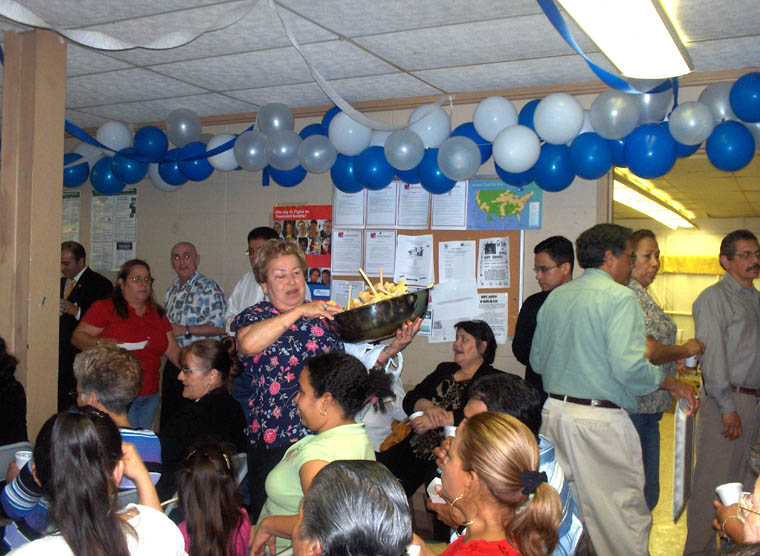
Although planning begins months earlier and food preparation takes several days, the few hours before the event are frenzied. The organizers, along with their older children, decorate the room with blue and white streamers, set up the altar, and hang blue and white curtains as a back drop. Blue and white balloons are blown up, twisted together and hung to line the walls above head level. Blue and white are selected for the decorations because they are the colors of Nicaragua as well as the colors associated with Mary. Rows of chairs are placed to face the altar. In the kitchen, drinks are mixed, food plates prepared, and boxes of gifts are delivered. The excitement is obvious as the organizers and volunteers create meals and assemble the traditional gift items to be distributed later. Some of the young adult children depart after helping their parents with preparations. To the observer, it is obvious that they respect the tradition, but they are young and they are living lives of young Louisianians. One son stated that he normally stays, but this year it was a Friday night and other things were happening.

Prior to La Purisima and La Griteria, a Spanish Mass incorporating Nicaraguan heritage is held. Juan Gutierrez explains that in Nicaragua, "the churches are empty" because the celebration occurs in the community. The Church is necessary for the event in Louisiana. Martha Narvaez tells how the church welcomed them when they arrived in Louisiana as refugees from the revolution. The Church played a vital role in helping them establish a new home and connect with other Nicaraguan immigrants, but December 7 was just a regular day on the church calendar. The priest at the time was supportive of the celebration but "we had to compete to reserve the church. Now they know and save it for us each year." At St. Jerome, La Purisima is always held on December 7 regardless of the day of the week. Other churches will hold it in conjunction with the Saturday Spanish Mass closest to the 7th.
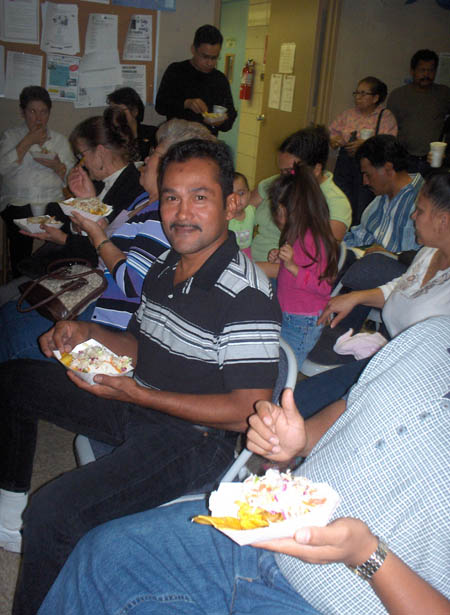
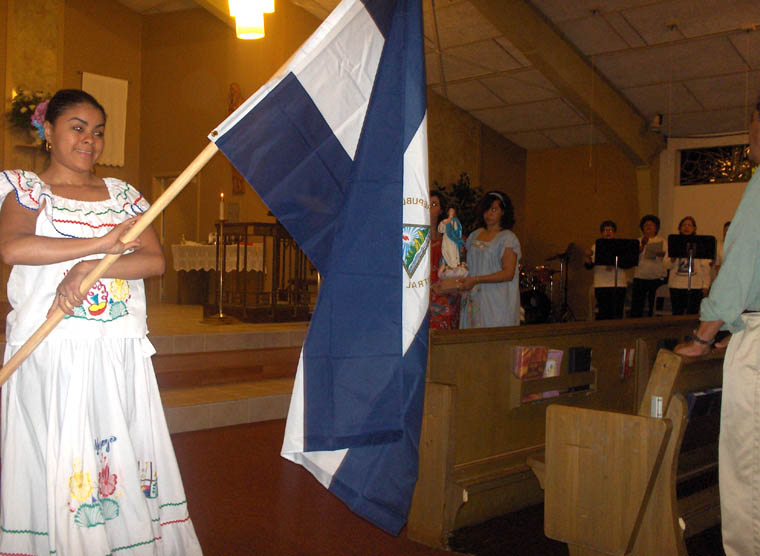
Catholic Mass begins with a procession; for La Purisma, this procession includes symbols of Nicaragua. Young women in traditional dresses carry the Nicaraguan flag and a statue of the Blessed Virgin. The dresses, imported from Nicaragua, are bright with hand-embroidered images depicting the flora and fauna of Nicaragua. The items carried by the young women are placed at the front of the church to be blessed by the priest. To help pass La Purisima to younger generations, the story is told as part of the Mass. At the end of Mass, the procession leads the celebrants to the hall where they will face the altar assembled by the organizers. Some celebrants sneak through side doors and scuttle before the procession in order to grab one of the coveted seats. The hall is not large enough for the estimated 250 people who attend. After the chairs are filled, a few more find their way into spaces along the wall. Reverend Alberto, who presided over Mass, is given a chair near the altar. He is one of the first to shout "Quién causa tanta alegría?" He is not Nicaraguan, but serves the Central American community. Reverend Alberto shared that the gifts are symbolic of Mary's gifts of love and message that people must help each other. The celebrants continue to push their way in and stand along the walls, in the aisles, and then fill up the back. No one seemed to leave discouraged. The Nicaraguans (and other Latin Americans) who came to celebrate represented a cross-section of the community. Men and women of all ages were present, many with young children in tow and still in work clothes.
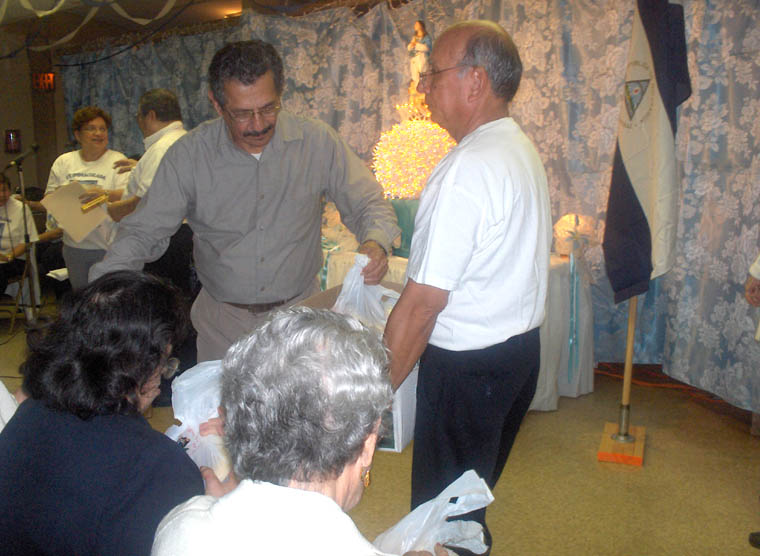
Because the people cannot travel to a variety of altars as is tradition, one altar serves as the focal point. Alfredo Narvaez is responsible for its creation. When asked how he plans the altars, he explains that everyone is welcome to share their ideas and visions. Some people have come to him with images from their dreams. He explains that each year the altar is different but certain ornamental traditions, such as lights and flowers, are always present. The altar in 2007, simple and beautiful, had the blue and white colors of Nicaragua and a statue of Mary placed atop a ball of blue and white lights. Flowers adorned the table and arrangements sent as gifts were placed on the floor along the front. Descriptions of previous year's altars indicate that these can become quite elaborate and have included backdrops depicting the Nicaraguan landscape of volcanoes and banana trees. One year, a flag read "Nicaragua es [is] Maria; Maria es Nicaragua" symbolizing the cultural role of the Virgin Mary and her connection with the identity of the country. Among the few churches where La Purisima is celebrated in Southeast Louisiana, the artistry of the altars has become an informal competition. Several years ago, this was formalized with an altar competition held at Kenner's Rivertown. It was not repeated because the organizers felt that the religious component was lost.
Canticles are the most important part of La Purisima. In Southeast Louisiana, the choir plays a significant role in the celebration. Unable to go from altar to altar to sing, the choir stands beside the altar and sings while celebrants join in with those songs they know. In many ways, it is similar to a large Christmas caroling event but is much more festiveand sacred. The songs are passed from generation to generation, and some are obviously more well-known than others based on the celebrants' participation. The organizers explain that the easier songs are more common because of the children and say, "They have to learn them and sing them for the gifts." Unlike festivals where people are moving around and engaged in different activities, the celebrants all sit or stand facing the altar. The choir assembles to start the celebration. As the first song concludes, the organizers emerge from the kitchen and begin distributing the first gift. It is a delicious cacao drink; a traditional gift of cold spiced chocolate milk. The songs and gifts continue for the next hour. The shout "Quién causa tanta alegría?" is frequently heard and answered by the crowd "La Concepcion de Maria!" during song breaks. The songs are nearly continuous except for a few resting periods during which the raffle drawings are done. These breaks appear to be much appreciated rests for the choir members and give them an opportunity to enjoy the gifts they have received as well. There are no speeches; no one addresses the audience except with festivity.
The organizers carefully select the gifts and stay as close to tradition as possible. Alfredo Narvaez states that they have difficulties importing certain items from Nicaragua and must adapt. Martha Narvaez later shares that because they have been fairly successful with locating and importing items from home, other immigrant groups have asked them for assistance so that they too can maintain traditions. Elizabeth Gutierrez, a dietician, leads the effort of providing the traditional foods associated with La Purisima and Nicaragua. Some foods are specific to La Purisima and others are simply traditional Nicaraguan items. In addition to making them for La Purisima at St. Jerome's, she has begun writing the recipes at home to pass onto her children.
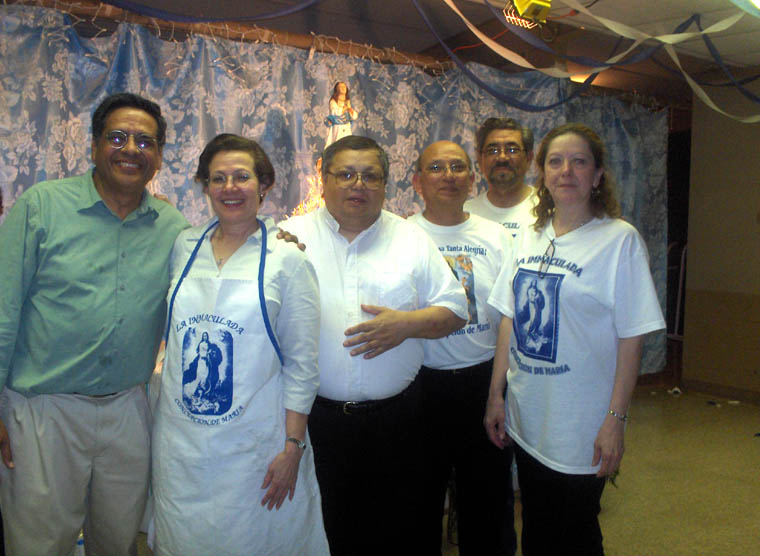
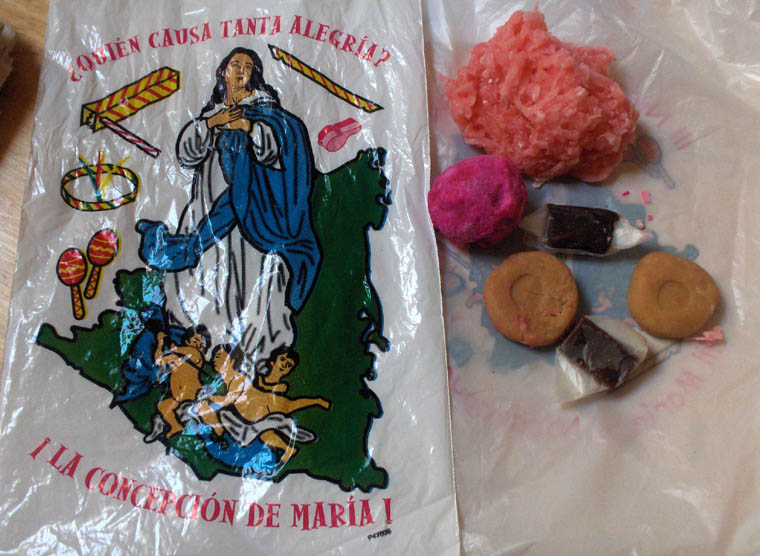
As the songs are performed, the gifts come out one at a time. The crowd is patient but excited to see what is next. A meat pie followed the cacao. Then a food that is as important to La Purisima as the songs is served. It is ajote en miel, pumpkin in molasses and honey. The room quiets a bit as people relish the taste. More songs bring more gifts for nearly an hour. Bags imported from Nicaragua are imprinted with the image of the Virgin Mary and the shouting "Quién causa tanta alegría? La Concepcion de Maria!" Each celebrant receives three bags. One held American candies like those given at Halloween; another contained a variety of homemade Nicaraguan candies: caramels, fudge, and coconut. These obviously took great care and time to make. The last bag distributed contained a triad of fruits: orange, apple, and banana. Fruit is also a traditional La Purisima gift. In addition to the smaller food items and gift bags, each celebrant received a plate of food. Elizabeth Gutierrez explained that each year they serve a different traditional Nicaraguan food but it is not necessarily traditional to La Purisima. In 2007, the dish was simple but delicious, and a few celebrants shared that it was comforting. The meal consisted of plantain chips, a slice of Nicaraguan cheese, and a cabbage and tomato salad. In between the food items, children were given coloring books and crayons, and noisemakers were passed around to those sitting in the middle of the hall. The noisemakers, called matracas, are handmade and imported from Masaya, Nicaragua. Many adults smiled when they saw them seemingly enjoying memories associated with them. As the music wore down, the last gift was distributed: a La Purisima car plate. The plate had the shouting and the image of Mary. José Arrechevala hoped that they would help other Nicaraguans remember their heritage and attend the event next year. Many of the celebrants, as well as the organizers, wore La Purisima gifts from previous years. These included t-shirts and Elizabeth Gutierrez proudly modeled the Purisima cooking apron. The organizers explain that they want to keep the traditional items as much as possible but also make it different each year to encourage people to keep coming.
Juan Gutierrez explains that the noise at the end of the celebration remains significant. He is regretful that the fireworks are not allowed and would disturb the neighborhood. As a substitution, blue and white balloons are inflated and then strung along the walls. People bring pins to pop them when given the sign. In unison, they reached up to create the noise. A position near the balloons is as coveted as a chair. Martha Narvaez describes the significance of the popping of the balloons, "The pops are wonderful. You remember the fireworks from when you were a child. It sounds wonderful. You see in the faces the happiness from their memories." Some stories of La Purisima describe the fireworks and say that unaware tourists would think a war had started for the noise is so loud. The Nicaraguan immigrants would rather have firecrackers but know that it would be a liability to the Church and put people at unnecessary risk.
Nicaraguan Immigrants in Southeast Louisiana
According to the most recent census in 2000, 3685 Nicaraguan immigrants live in Louisiana. Approximately 80% resided in Southeast Louisiana and nearly 2300 in Jefferson Parish. Jefferson Parish is the largely suburban area that is a substantial geographical and population portion of the New Orleans metropolitan area. Before Hurricane Katrina, the metro area's population was estimated to be 1.2 million. Comparatively, this made the Nicaraguan population quite small and the compiled Latino population of the area was only around 6%. As a major port city, New Orleans and Central America had close ties for many years. One of the significant links was the United Fruit Company, which imported tropical fruits to the United States. Many of the Central American workers sent their children to boarding school in New Orleans to provide them with an American education. Even so, the area did not draw Nicaraguans in large numbers, other than those who came in three distinct waves. The initial group was during the 1950s and 1960s. These were mostly from the Atlantic Coast region and many of them were associated with trade companies. The second wave was mostly comprised of urban populations leaving Nicaragua to escape the Revolution and Civil War that began in 1979. The majority of refugees went to California and Miami. Those who had ties to the New Orleans area more easily immigrated there. The last wave was in 1998 when people left Nicaragua and Honduras to escape the ravages of Hurricane Mitch. Again, those with connections to others already living in the area helped draw them to Southeast Louisiana.
For the most part, Nicaraguan immigrants have assimilated to American and Southeast Louisiana culture. Unlike other immigrant groups that established village-like enclaves in the region, the Nicaraguans dispersed and made their home among the general population. The organizers of La Purisma share that they believe the area is very accepting which made it easier for them to make it their home as well as stay connected to their roots but that they needed to be connected to the people from their country. This was their motivation for starting the La Purisima and La Griteria event at St. Jerome Catholic Church. Martha explains, "We would go to the church and see others. It is important to who you are. It is important to be together." Anyone familiar with the vibrancy of New Orleans also knows that it is a place where colorful culture and celebrations are welcome and thrive. The city is Creole: it is a place where white is not necessarily European and black is not necessarily African. The native people of the city are more diverse than the U.S. Census classification measures. Many people of color are the mixing of race and ethnicity, including French, Spanish, Native Americans, and Africans (slave and free people of color from the Caribbean). As mentioned earlier, La Purisima is unique to the Nicaraguan culture, but it is easy to understand how its celebration is welcome in Southeast Louisiana. Although the area had a relatively low rate of Latinos before Hurricane Katrina, Nicaragua and Southeast Louisiana share similarities between the Creole and Catholic populations. In many ways, the Nicaraguan immigrants blend well into this area as they too also come from the merging of European settlers, indigenous people, and enslaved Africans. They are also predominantly Catholic which helped make the transition to their new home.
New Orleans is one of the few predominantly Catholic cities in the United States and statuary of Mary is prevalent throughout the region making it easy for Nicaraguan immigrants to demonstrate the faith that is so central to their culture. After the destruction of Hurricane Katrina, many photographs were taken of the Virgin still standing among the debris or in front of an empty slab where a home once stood. After sharing a traditional Nicaraguan meal prepared for the interview, Mina Lanzaz discussed the veneration of Mary as culture in great detail. She explained that their lives, as Nicaraguans, as New Orleanians, are entirely intertwined with faith. As the only child of two Nicaraguan immigrants, she was raised with the customs but never participated in a La Purisima that was organized for the public. Berta Lanzaz, Mina's mother, explains that they pray the novena that is the reason for La Purisima. They do not feel the need for the event to worship Mary. Dispersion and a busy lifestyle are also factors for not attending the event.
When Berta Lanzaz listened to the songs recorded at La Purisima, it was apparent how deeply her native culture remains rooted within her. She became energized and went to retrieve an old songbook given to her by her mother. These were the songs of her home, and she was soon singing along with the La Purisima recording. Mina told her stories of memories of La Purisima and the December celebrations as a child. When asked how she learned her culture, she stated through observation and her parents. Raised bilingually, she translated the Spanish version of Historia de La Purisima, la Lavada de la Plata y La Gritera. Upon completion, she laughs and says, "I didn't know the specifics, but I remember the candy!" She shared stories of when family from Nicaragua came to visit, especially during the December celebrations, they would open their suitcases and the distinct smells of gifts emerged.
The Nicaraguan heritage remained in their home practices even as they embraced the culture of New Orleans. Her father, Nilo Lanzaz, merged his cultures in his paintings. One such painting depicts the Nicaraguan countryside with a volcano looming in the background. In the foreground, a New Orleans-style brass band leads the Nicaraguans in a second line parade. This was Niloville, an imaginary place where all the beauty of Nicaragua meets the cultural elements he loved of his adopted home. When asked if he had ever done pieces depicting La Purisima y La Griteria, Berta responds that he never did those in particular. His paintings all depict the church, and religious themes and festivals are common.
As the conversation continues about the Nicaraguan heritage of faith and their art, these two women share their piety and explain further why they no longer engage in any of the formal practices of La Purisima (that is: creating altars, traveling to visit altars, and attending the organized event). "Mary is the patron saint of Nicaragua. The presence of Mary is central to our heritage. We don't need to set up an altar. We are surrounded by Mary." This statement was made while we sat and spoke in the parlor area of their art gallery. Mary is indeed everywhere in the art and among the art. There are sections of the gallery that have the appearance of an altar, intended or not.
When one first thinks or hears of altars in Southeast Louisiana, one might think of St. Joseph's Day. Every year, Italians celebrate their heritage and honor their patron saint with elaborate food altars. Those altars consist of abundant food offerings that are then shared with those who come to worship on March 19. Many New Orleanians participate in this custom regardless of heritage. It is another tradition stemming from a particular heritage that has become part of the area's culture. The long history of altars in the New Orleans culture has made it easy for Nicaraguans to maintain their tradition. The long history of religious celebrations becoming a public event makes it possible that a version of the La Purisima and Griteria tradition could grow into the common culture of the place. How this might happen remains to be seen, but places are organic and change with time and people. As more and more Latinos migrate to the area for rebuilding work, they will likely influence the area's culture as other groups have helped create a unique American city.
In Nicaragua, the altars are competitions between neighbors, streets, neighborhoods, and cities. In Southeast Louisiana, the tradition of competition within LaPurisma was seen through the area churches that host the event. Several years ago, the organizers held an altar competition outside of the churches. It did not transfer well because they felt it lost much of the sacred purpose. People came to look but did not perform the songs, as they should. It was an exhibit rather than the religious festival it was intended to be. As the Latino population grows, the community altars may take hold and become more common. It is not a far leap to believe that many non-Latino residents would embrace and adopt the custom, especially after facing so many challenges of post-disaster living. Faith has given many area residents the strength to stay. The Nicaraguan immigrants demonstrate this faith and commitment through their celebrations.
Impact Of Hurricane Katrina On The Nicaraguan Community And Conclusion
The long-term impact of Hurricane Katrina is still unknown. Cities are organic places that change over time, but disaster changes them instantly. It is safe to say that no one living in Southeast Louisiana emerged from the destruction and aftermath an unchanged person. Throughout the region, families found themselves scattered while neighborhood groups formed cohesive tribes for rebuilding. As Louisianans sought higher ground, to take a breath, and assess the damage to their world, Latino immigrant workers arrived en-masse to fill the recovery labor needs. It is assumed that many of them will move on when the work subsides but many have already found Southeast Louisiana to be a welcoming place where they can freely celebrate their heritage within an already rich culture.
Celebration of La Purisima with altars to the Blessed Mother remains a vital and significant tradition in New Orleans' Nicaraguan community. The St. Jerome La Purisima organizers tell of immigrants who first settled in other American cities but came to Southeast Louisiana for hurricane recovery work. When they arrived and discovered the La Purisima celebration, they were excited to once again be celebrating an event so closely linked to their identity. Juan Gutierrez talked about how carefully they try to make the La Purisima event a tradition to be maintained. It is "so people can identify and say 'that is our country, our culture'." José Arrechevalla expands by saying, "We try because not every day we can do that." Regardless of nationality, the first generation is the most involved with customs from their native country. In years past, younger generations were encouraged to Americanize but in recent times, the value of heritage has increased. The organizers know that they need to bring younger generations into the planning and decision-making so that the tradition may carry forward. Elizabeth Narvaez tells how the recipes have adapted over the years but her children have asked her for more authentic recipes.
During these times, it is impossible to discuss Southeast Louisiana populations without acknowledging those displaced by Hurricane Katrina and those who are choosing to make new homes elsewhere. One wonders how they will practice their culture and heritage as they assimilate in their new geography. The Narvaez' share that because they were forced to leave their home, they held more tightly to their traditions as they settled into their new life. They explain that the people most involved with the organized La Purisima are those who left Nicaragua due to the revolution. Martha says it simply, "When you have to flee, you need something to hang onto." They can now easily travel to Nicaragua to connect to their roots but have come to consider New Orleans home. They love the culture of the place but they have not lost their heritage among it. Much of this is due to La Purisima and the opportunity it presents to immerse themselves in Nicaraguan traditions if even for a few hours.
The influx of Latinos to Southeast Louisiana may drive a renewed interest in heritage among those who have entirely assimilated and for the second and third generations. Because the Central American countries share cultural elements, which are celebrated through different festivals and sacred observances, their customs may merge. Alfredo Narvaez comments that the Nicaraguan people do not feel threatened by these new people and have helped them transition as best they can. He believes that the other Central American immigrants will likely blend together to help each other practice their individual cultural identities and that the Latino influence will become another chapter of the area's creolization.
