


Table of Contents
Introduction
Profiles of Masters and Apprentices



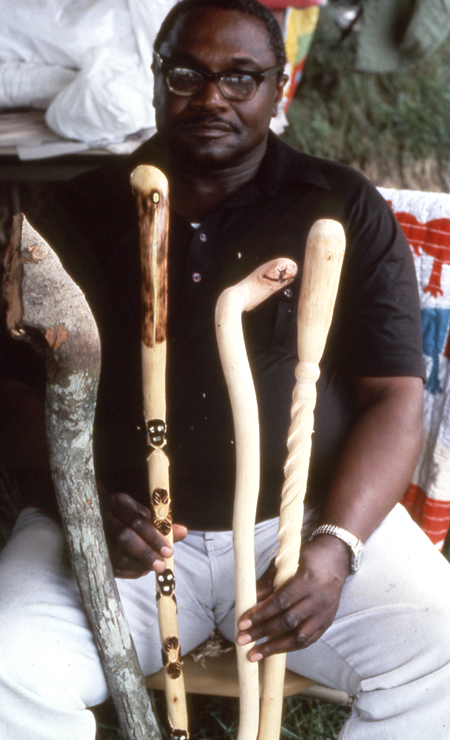
David Allen's craft of walking stick carving grew out of whittling--a traditional Southern pastime. Allen does not remember seeing carved walking sticks although walking sticks were commonly used in his community. Nevertheless, his carved sticks have remarkable similarities to walking sticks made by other African-American carvers.
Born in 1925, Allen has attained a reputation for his hickory sapling canes. He has been whittling and carving since he was about ten years old, when he found a pocket knife under the house. He first carved sling shots, other toys, and shoe shine boxes. One day, at about age fifteen, the idea for these fancy sticks came to him. Walking down the road, Allen stopped to cut a little gum stick to use as a cane. When he sat down to rest under a shade tree, he began carving. "The more I trimmed, the more I liked it," he says.
For many years, David Allen busied himself with a variety of occupations which included plumbing, logging, and carpentry. Meanwhile, he and his wife raised a family of six boys. In the late 1960s when various health problems caused him to retire, Allen found time for carving again.
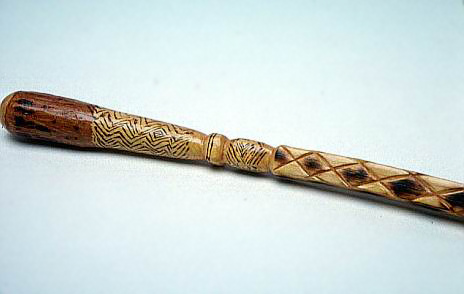
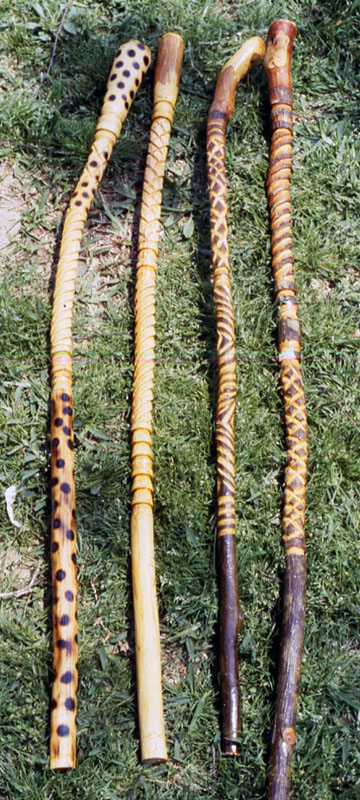
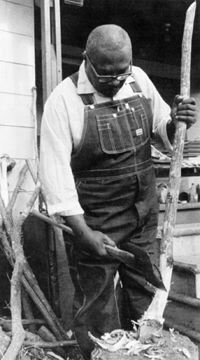
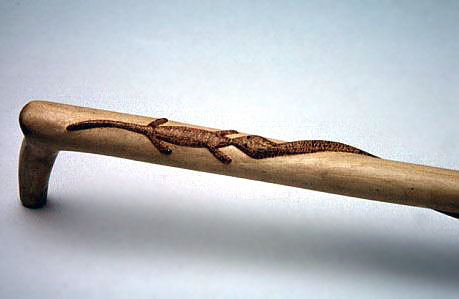
Since that time, Allen has developed his techniques and motifs. For Allen, the wood itself may determine the shape of the creation. Each of Allen's creations is unique, as no two saplings are exactly alike. The root of the sapling is used to shape elaborate handles for the canes. These may take the form of snakes, other animals, or faces of people. Sometimes he uses rhinestones for the eyes. Allen often smooths the length of the stick with a piece of broken glass or sandpaper before working it with his pocket knife; however, knots in the wood are woven into the design, and at times, pieces of bark are included as well. The end result is various patterns of complex swirls, stripes, diamonds and spirals. Other accent figures such as four-leaf clovers are often burned a black color to make them stand out on the pale hickory, which is Allen's preferred wood. These black and white designs, as well as the serpent motifs so frequently found in Allen's work are also common in African art. The finishing touch on Allen's fancy sticks is a coat of high gloss sealer. The sticks are hung with a piece of wire, bottom side up, from a clothesline. Then Allen applies the sealer as they hang freely.
Gradually, Allen's work has become known throughout Louisiana and nationally. The first festival he participated in was in his home town in 1979. The next year he demonstrated his craft at the Natchitoches Folk Festival. David Allen's work was also featured in an exhibit and accompanying booklet produced by the Alexandria Museum in central Louisiana, where one of his sticks remains on exhibit. After this event, Allen's popularity began to grow rapidly and he was invited to participate in many other festivals. In 1981 and 1985, Allen and his wife, Rosie Lee, who is a quilter, were invited to participate in the Festival of American Folklife sponsored by the Smithsonian Institution in Washington, D.C. Allen considers his trips to Washington, D.C. to be the high points of his career. One of his fancy sticks is on display at the Smithsonian and more are in The Creole State: An Exhibition of Louisiana Folklife located in the Louisiana State Capitol. Other festivals which have provided opportunities for David Allen to demonstrate his craft and sell his sticks include the Red River Revel, the New Orleans Jazz and Heritage Festival, as well as the Louisiana Folklife Festival.

He is pleased with the recognition he has received and admits that he never dreamed that people would care that much about his sticks. "That was just something I could do," he says, and he considers his talent to be God-given.
Prior to David Allen's first visit to the Smithsonian, he was not aware of the similarity of his work to certain African traditions. Some of the festival workers in Washington showed him African carvings and inquired if he had ever been to Africa to see this type of work. Some of the parallels between Allen's work and African carvings include: geometric incisions, serpentine fluting, coiled snakes, symmetrical positioning of sculpted figures, improvisation, and highly polished finishes. All of these items were found in Allen's carvings prior to his exposure to them in Washington. Along with his new awareness of the connections of his work with his ancestral Africa, the trips to the Smithsonian also helped David realize the significance and the value of his work as art.
In the early 1980s, Bennie Holyfield, Allen's next door neighbor, expressed an interest in learning to carve fancy sticks. From the time he was a small child, Holyfield, like Allen, had been a whittler, carving airplanes, spinning tops, whistles, and cane flutes. Recognizing his neighbor's talent and genuine interest, David Allen took Holyfield as an apprentice.
In 1984, the Folklife Apprenticeship Program awarded a grant to Allen so that the master/apprentice relationship could continue to grow. For a period of time, David Allen had a companion who would go with him to cut wood for canes and with whom he could converse about his carving from an artist-to-artist standpoint. However, the relationship was cut short when in late 1984, Bennie Holyfield died suddenly of a heart attack. This unexpected event left David Allen depressed for a period of time; however, throughout it all, he has never lost his enthusiasm for his work and he continues to find new ideas and continued recognition.
In the late 1980s, the people of Homer acknowledged David Allen's talents by adding a permanent exhibit of his work in the Ford Museum, which includes a mural of the artist. David Allen deeply appreciates the interest that his own people have shown in his work and proudly relates that he plans to contribute additional pieces of his craftsmanship to the museum.
