


VIRTUAL BOOKS
Introduction to Delta Pieces: Northeast Louisiana Folklife
Map: Cultural Micro-Regions of the Delta, Northeast Louisiana

The Louisiana Delta: Land of Rivers
Ethnic Groups
Working in the Delta
Homemaking in the Delta
Worshiping in the Delta
Making Music in the Delta
Playing in the Delta
Telling Stories in the Delta
Delta Archival Materials
Bibliography



Noms de Bayou: French Place Names in North Louisiana
By Kelby Ouchley
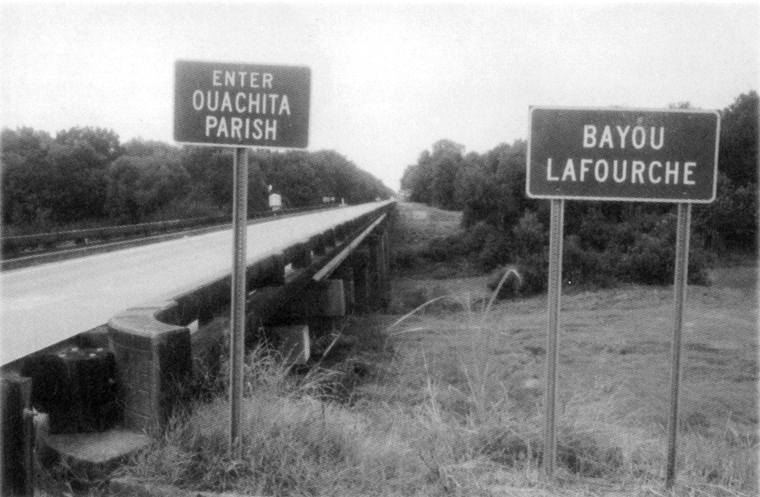
A sign for Bayou LaFourche marks the eastern boundary of Ouachita Parish. Photo: Mike Luster.
Lest you think French influence on our state is restricted to the southern half, consider the sinuous streams of northeast Louisiana. They flow through our geography with Franco-laden labels both pure and bastardized. And with good reason. Spaniards were the first Europeans to pass through this area. They were transient and too busy searching for gold and incidentally destroying endemic cultures to bother with naming wilderness features. If they did, they did not stick. Frenchmen were the first to establish a lasting presence. They were not Acadians. Throughout the eighteenth century free spirits floated down from central Canada to trap furbearers and render pots of oil from oleaginous bear carcasses. A handful of "pure" French dragged oxcarts up from the Point Coupee region. Most were not interested in settlement much to the chagrin of colonial authorities who yearned for the stability of domesticated farmers with pedigreed wives and water tight roofs. The Frenchmen were not on the landscape but of it, like the native women with whom they produced a generation of dark-eyed children. Home was wherever they needed to be to reap the seasonal harvests. Game for the table was available all year. Wild fruits began with mayhaws and dewberries and ended with muscadines and hickory nuts. Fishing was best during the spring overflows and later in the summer when the bayous slowed to wading trickles. Then V-shaped barriers of wooden stakes set across a stream would herd catfish and buffalo into willow basket traps. Autumn and winter were the times to gather prime pelts from deer, beavers and otter. Canebrakes were fired to expose bears, and waterfowl borne on Arctic winds were plucked from the cornucopia of natural resources. All of these activities had a common thread. They were on or near waterways. One does not efficiently transport burdens overland through virgin swamps. As had been the case for thousands of years here, dugout canoes of red-heart cypress were the conveyance of the day. Frenchmen paddled the eddies and drifted the currents with thousand pound bundles of furs, with Indian wives and half-breed children, with apprehension of losing these freedoms. They plied every major stream in northeast Louisiana. They put their names on nearly all of them.
Most names fall in one of two categories: a French surname, or reference to a natural feature associated with the stream. Surname examples include Bayou D'Arbonne believed to be derived from the common French-Canadian surname "Derbanne." A Gaspard Derbanne was known to be a companion of St. Denis in his early eighteenth century exploration of the Ouachita Valley. Galion Bayou in Morehouse Parish was named for a prominent hunter/trader in that area. Chauvin was a surname that yielded Chauvin Bayou and Chauvin Swamp in Ouachita Parish. Bayou Macon comes from the Maconce family. Others in this category may include Bayou Desiard, Bayou Bartholomew, and Choudrant Bayou.
The second category is descriptive. Bayou Lafourche is interpreted as "Forked Bayou", Bayou Coulee becomes "Flowing Bayou", and Bayou de Glaize "Cold Bayou" or "Ice Bayou." Bayou de Butte was named for Indian mounds long since vanished from its shores. Chemin-A-Haut Bayou translates to "High Road Bayou", a reference to the north/south Indian trace that once ran along its flood free high bank. Plants and animals are represented also. Cheniere Creek refers to the adjacent oak forests. Lapine Bayou is "Rabbit Bayou" and Bayou de l'Outre is "Bayou of the Otter." Imagine bison thundering across the shallows of Boeuf, i.e. "Buffalo River."
Then there are mystery names with veiled hints of an instant of humanity which flowed away with time. What was the "good idea" of Bayou Bonne Idee? Even the two large streams in northeast Louisiana with native American names, the Ouachita and Tensas Rivers, likely have French spellings.
Other geographic features have French names (e.g. the Prairies des Canot, Mer Rouge and Chattlerault) but none embellish our maps like bayous, creeks and rivers. When eighteenth century Frenchmen plied these streams they could not comprehend that, within two hundred years, dams, dredges, and levees would make the water bodies unrecognizable to them or that relics of their culture would linger with names first spoken from the bow of a pirogue.
