


VIRTUAL BOOKS

Introduction to Delta Pieces: Northeast Louisiana Folklife
Map: Cultural Micro-Regions of the Delta, Northeast Louisiana

The Louisiana Delta: Land of Rivers
Ethnic Groups
Working in the Delta
Homemaking in the Delta
Worshiping in the Delta
Making Music in the Delta
Playing in the Delta
Telling Stories in the Delta
Delta Archival Materials
Bibliography



"Willing to Take a Risk:" The Folklore of Cropdusting
By Susan Roach and Janet Ryland
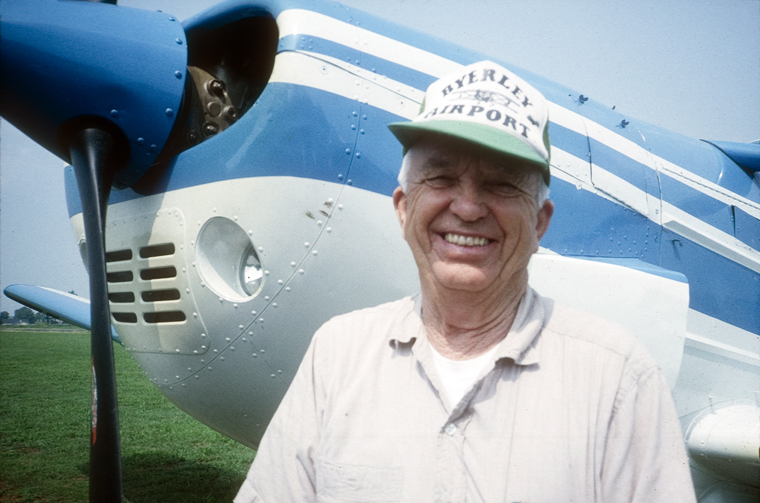
Steve Guenard. Photo: Janet Ryland.
Since the early 1900s, low-flying planes have swooped over the Delta farm landscape, leaving behind a swath of chemical cloud to kill pests or to fertilize crops. The extensive acreage of the Delta plantations calls for this efficient technique of dispersing chemicals over the crops. Called cropdusting, or "aerial application"--the technical term preferred by professionals today--this important Delta occupation has enticed many pilots, who have generated a wealth of occupational folklore. Actually, cropdusting was the foundation for another major industry: Delta Airlines. According to Lake Providence cropduster Steve Guenard, Delta cropdusting had its beginnings around 1920 "in Tallulah in Scott field by the people who ultimately formed Delta Dusters, which became Delta Airlines," originally centered in Monroe. Like other occupations, crop dusting has its own folklore ranging from the learning process of the job and its specialized technical language to jokes and stories about cropdusting, and to the perceived role of the cropduster.
The crop duster's role is a professional one with tremendous pressures, requiring courage, caution, and safety. Lake Providence pilots, Steve Guenard and Charlie Davis, emphasize the pilot's need for common sense and safety-mindedness. Owen Dale Holland, owner of Holland's Agricultural Aerial Service specifies his view of the job requirements:
"This game is a game dealing with stress. If an aerial applicator came here looking for a job, I am not really interested in him telling me what type of aircraft he has flown or how much time [flight hours] he has got or who he has flown for. . . . Can he perform under pressure? Or is he going to upset loading crews because he is fatigued and tired? How far can he go? Can he recognize fatigue? How does he deal with others? Is he sarcastic? Quick to draw a gun more or less? Or is he under control at all times? It takes a good deal when you are working. We have worked here forty-two days straight without a day off. . . . He has to love to fly. It has to be a part of his life; it has to be something he is not comfortable without. Secondly, he is going to have to learn to work with people. He is going to have to consider that other people's problems are great, and they are."

Crop dusters Owen Dale Holland and Arthur Woolsen. Photo: Janet Ryland.
Asked why they became cropdusters, most pilots reply, as Steve Guenard does, "I just like to fly airplanes." These pilots were attracted to flying in their youth. Grady "Bubba" Brown, who later became a military pilot and owner of Panola Plantation, learned flying basics with only minimal one-to-one instruction. After high school, he and his brother made enough money from farming rice on thirty-five acres their father had given to them, that they decided to buy a plane: "We bought an airplane for eight hundred dollars with the condition that the man teach us how to fly. And he gave us both six hours, and he said, 'Okay, you can solo with six hours.' And we brought the airplane home and told Mama and Daddy we bought an airplane. Well, they like to have killed us. But we kept our airplane and we been flying every since." Thus some pilots learned flying informally from other pilots or more formally in the military or commercial flight school. Likewise, many of the skills of cropdusting were and still are learned informally on the job from other cropdusters as well as in commercial flight schools. Art Woolson, who learned to fly as a military pilot in World War II, picked up cropdusting basics in about a month around 1950 in California cotton fields. He explains how he learned: "just got in and did it. A guy watched me and corrected me and told me what I was doing wrong and what I doing right, and I'd just dust the field, and he'd watch me and say, 'Well, you're a little bit high; put it down about three or four feet.' I'd get down to where, say wheels were touching the tops of the cotton, and he was happy." The teacher required the low flying to minimize "chemical drift." The lower the plane flies, the less chance the chemicals will fall on the wrong crop.
Having been fascinated by flying in his childhood, Owen Dale Holland and his older brother started dusting their own crops, and their family business grew out of that: "We started together with farm usage aircrafts. Local farmers saw our work and wanted us to do their flying. We looked at it and considered it. We purchased another commercial aerial airplane. . . . Then our younger brother voiced his wanting to get in there and learn it the rough way like my oldest brother and I did. Being able to work together as a family has been a very joyful thing. You learn your place, and you get there, and you stay there. You make it work." Holland's description illustrates the folk learning process at work: one family member teaching another. It also shows the bonding which occurs in such a situation.
Cropdusters also learn the specialized language of their trade in a traditional manner on the job. This language deals with the equipment, techniques, and names for the different jobs for the cropdusting crew. For example, many of the older two seater planes used were called "two-holers," no doubt a play on the term used for a double outdoor toilet. Much of the language is the special jargon of planes and their mechanics, ranging from names of planes to ways of outfitting old military planes for cropdusting. Cropdusting was dangerous in the past because planes were not made specifically for the job. They were light training planes with poor visibility or weak frames, which sometimes proved fatal. Today's more sophisticated, safer planes are constructed specifically for spraying crops.
In the past, the cropdusting crew included "flagmen" on the ground who marked the area just sprayed with a white flag so the pilot would know where he had sprayed that area or miss another area. Art Woolson, a pilot who dusted crops in the 1950s, describes the flagman's job: "When we were spraying, we used to use a man on each end [of the field], and they'd pace twenty paces over and hold the flag up. See, you just line on them, and they would move over again. Once they got pretty good, I used a couple of high school students for doing that. They would put on a face mask to protect themselves, but the spray we were using was reasonably safe." Actually if the flagman did not stay out of the way of the plane, his life was endangered by the low-flying plane. Holland remembers hearing about flagmen who were killed on the job. Today's crop-spraying planes have an automatic flagging system on the plane to prevent overspraying which can damage the plant or even kill it. Woolson notes the special term, "dump artists," given to disputable pilots, who would quickly empty a full load of chemical dust on a field without worrying about what is termed "even distribution" or a "smooth swath." The pilots were also called "fly by night" con artists because they got paid, leaving the farmer to cope with damage and unsprayed crops.
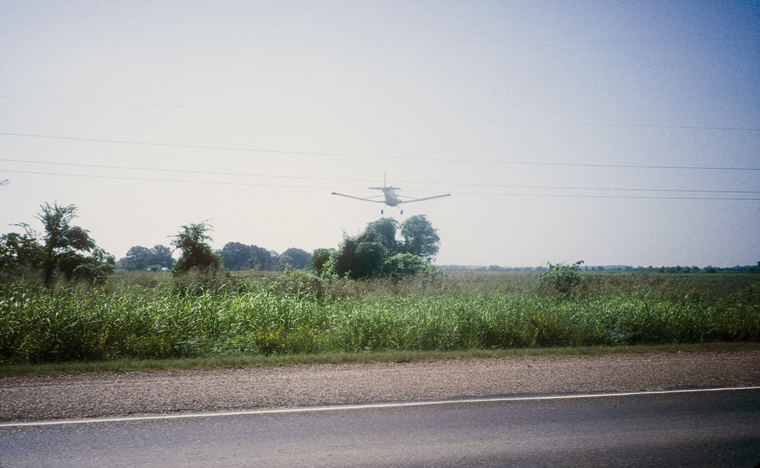
Cropdusting. Photo: Don Hatley.
Another specialized job belonged to the "loaders," who loaded the chemicals into the plane. In earlier days these laborers did not seem concerned with the poisonous nature of their work; in fact, they often ate their lunch spread out on the bags containing dust. Steve Guenard tells a story about one loader's exposure to the dust: "I thought we lost one one time to methyl parathion dust. We had a big stack [of dust] in the hangar with a tarp over it to go out the next morning. One of our loaders had a little night life and he'd be late. I said you have to be there before daylight in the morning--I said once, be there bright and early; he thought that was after the sun was up, so I changed my expression to dark and early. We got to the airport and it was black dark, and moved the airplane up there to load the dust. I said Willie is not here. . . . Well, many times you start loading yourself, so I flipped the tarpaulin back off the stuff, and there was Willie under there asleep, laying up there amongst the bags of methyl parathion dust. I said, "My gosh, he'd dead." I kinda poked at him and he grunted. I said, "Willie?" And he got up, hopped right up, and went to loading the airplane. I don't know how long he had been sleeping in that nest of dust."
Surprisingly, the pilots interviewed had seen little adverse effects from the chemicals, either in the earlier dust form or later in sprays. In fact, they joke that after they put out the chemicals, mosquitos won't bother them. Until the mid-1950s, large amounts of relatively weak chemical dust was needed to injure someone. But after about 1955, stronger chemicals began to be used, including parathion, an extremely toxic insecticide: a quarter-sized amount of the stronger liquid concentrate would absorb into one's system in about twenty minutes and kill them. Fatalities did occur when the stronger chemicals began to be used because people were used to the weaker chemicals. The workers who loaded chemicals into planes used to spread the old chemicals onto their chests to keep mosquitoes away; however, they soon realized that they would have to handle the new chemicals differently. But while chemicals have become much more potent since the 1950s, the industry is actually safer because people know how to use the chemicals now. The chemicals are handled very carefully and can be sprayed more accurately in a liquid form than in the dust form. Also a smaller amount of the chemicals is needed to successfully spray a crop. Chemicals are now sprayed in ounces rather than pounds per acre.
In addition to the threat of poisons, the pilot's safety is threatened by obstacles he encounters on his route. Art Woolson describes the problems: "Dusting crops in those days to me was very close to combat. I mean you had the same fear; all you had to do was hit the standpipe, or hit a fencepost, or pull up and not see a wire and hit a wire. You had bad luck waiting for you at every turn. You had to be extremely careful. I used to look at every field from the ground before I dusted it from the air to get acquainted with the obstacles that were confronting you." While he never had a serious accident, some of his employees did. One man, for example, snagged an electrical wire with his trail wheel and pulled up about 800 feet of wire as he flew off. The accident caused the town of Jonesville to lose power for several hours.
To help cope with intense job pressures, cropduster pilots often hang out at airport hangars to "bull," or share jokes or funny stories about the dangers of the job--lore which may be passed on to other community members. For instance Monroe resident Doyle Jeter recalled asking Leslie Deshotels, an Opelousas pilot who contracts in the Delta, what would happen if one of the engines of a double propeller plane quit; Deshotels replied, "That other engine would take us directly to the scene of the accident." Thus a twin-engine plan affords little more security than a single-engine one. And every pilot interviewed has "gone down," as they term the forced landings in the field brought on by engine or other mechanical failure. Their detailed personal narratives about their near-death experiences indicate their acknowledgment of the risk they take and their luck of survival.
A cropduster for forty-two years, Charlie Davis recalls being teased about his survival chances at his wedding: "When we got married, the preacher asked me what did I do. I said I was in cropdusting. He told my wife that the lifespan of a cropduster was two years. She wasn't but seventeen. She said, 'Well, I don't have a long time to spend with.' I have been doing it forty-two years now." Davis and other Delta pilots emphasize that their health has been good, and that cropdusting is safe if one handles it with common sense and care.
Yet as the preacher's remark indicates, the public regards cropdusters with some ambivalence. On one hand, these "crazy nuts" taking risk have much in common with the early stunt flying of barnstorming days; also they are putting poisonous chemicals into the environment. On the other hand, as Mr. Woolson puts it, "You're almost next to God to those farmers when you're dusting those crops because your efforts depend his success. If you fail, he fails. If you win, he wins."
Thus the cropduster's relationship to the farmer is symbiotic and intensely important. "Most of the people don't understand to begin with why you are aerial applicating or applying chemicals by air. It is simply because they have no background knowledge of farming. They still want to see a farmer in overalls and a pitch fork and a straw hat. We have long passed that image. Today, with finances, economics, you do now or you don't get it done. Farmers are working under a lot of pressure themselves these days.
Offering his skills to the farmer, the serious cropduster mediates between life and death. His service can literally "save" a crop attacked by boll weevils, fungus or weeds. "Willing to take a risk," the cropduster carries the power of life and death on the plane, and he faces death everyday on the job if he is careless. Anthropological analysis of cultural roles which deal so intensely with life and death reveals that these roles are normally regarded ambivalently, with fear and respect, with humor and awe. Certainly, these pilots who live much of their lives suspended between sky and ground--heaven and earth--bringing death to pests and life to the Delta crops still are a vital part of the region and its folklore.
