





About Quilts: An Overview
By Susan Roach

Quilts are wonderfully complex textiles with techniques that have a long history in many different countries. As a result, the process of making a quilt is a complex one with its own language, terms, and standards. As artifacts, whether made for decorative or utilitarian functions, quilts are worthy treasures that deserve care and preservation.
A Brief History of Quilting
A brief overview of quilting origins, terms, and documented survivals will help to place quiltmaking in its historical perspective. The word quilt originates from the Latin culcita, meaning stuffed sack, mattress, or cushion, and comes to English from the French cuilte. Various spellings have occurred since the 13th century: cowltes, qwhiltez, quildes, and twilts (Orlofsky xiii). Although the individual quiltmaker as artist was long ignored in most art history treatments of quilting, the long history of quilting and patchwork spanning many centuries and cultures has received considerable attention. Much of the popular quilting literature touches only briefly on this long history. Detailed examinations of the history of quilting and the quilt are Colby's Quilting, and Patchwork Quilts, Orlofsky's Quilts in America, and Finley's Old Patchwork Quilts and the Women Who Made Them. Another essential resource is Uncoverings: Research Papers of the American Quilt Study Group, published periodically.
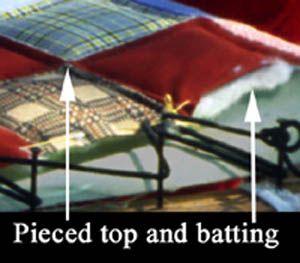
Actually, three separate techniques, each having a long history, characterize the typical American quilt. Quilts typically consist of three layers—a cloth sandwich: 1) a top of either solid fabric or patchwork, 2) a filler or batting of cotton, polyester, wool, or blanket; and 3) a lining (or backing or bottom) usually of a solid fabric (for illustrations, see Quilt Terms below).
Quilting itself is the process of sewing together the layers by hand or machine with a running stitch. An alternate method of securing the layers is tacking (or tufting).
Patchwork is the term generally applied to needlework which uses scraps of fabric either as pieces in a mosaic joined edge-to-edge by stitching (also called piecing) or as decoration applied to the surface of a plain background fabric (usually called appliqué). Colby suggests that appliqué arose from the necessity for repair, rather than for decoration, to strengthen worn places in fabric or to cover a hole. Likewise, quilting was also probably used for protection rather than decoration (3-4).
Quilting, appliqué and piecework are techniques with precedents in many different cultures. Quilting origins can be traced to China, north Africa, and the near East. Quilted clothing, for example, was used in China, where it was worn for warmth as well as protection in battle. Frequently noted as one of the earliest evidences of quilting is an Egyptian small, carved ivory figure of a king from the first dynasty of 3400 B. C. The king's cloak or mantle exhibits diamond-shaped motifs, which many have interpreted as quilting (Colby 4). One of the earliest surviving examples of quilted work is that of a rug, dated 100 B. C. to 200 A. D., found in a Scythian Siberian tomb. The rug is elaborately quilted and appliquéd with animals (Colby 5-6). The earliest surviving example of appliqué, dated 980 B. C., is an Egyptian ceremonial funerary canopy of a gazelle hide appliquéd with symbolic Egyptian motifs (Colby 20). Appliquéd designs have been reported from the West African tribes of the Fon of Benin and the Ewe, Fanti and Ashanti of Ghana since the 17th century (Vlach 48). Survivals of pieced work from 6th and 9th century India in the form of large banners show that patchwork today is little altered from its ancient precedents (Colby 21; Orlofsky 6). In fact, India, where quilted items are still made today, also has a long tradition of bed quilts as evidenced by a 1516 report from a Portuguese traveler in India, who noted the "beautiful quilts and testors of beds" as well as the quilted articles of dress (Orlofsky 6).
Patchwork and quilting techniques were probably brought to Europe during the crusades. Military use of quilted garments under armor was probably the chief function of quilting during the Middle Ages (Colby 11). Colby and Orlofsky both discuss the first noted reference to an early patchwork bed cover that occurs in a 12th century French poem Les Lais del Desire Groelent et Melion, which refers to the preparation of a nuptial bed which was covered with a "checkerboard" silk quilt. The earliest surviving bed quilt, from 14th century Sicily, is made from linen with wool batting and quilted with narrative scenes from the legend of Tristan (Orlofsky 3). Colby cites the earliest surviving English pieced quilting is a set of bed furnishings from Levens Hall, dated by family history as having been made in 1708 (6-7). The quilt and bed curtains use 17th century Indian chintzes. According to Holstein, the availability of the Indian chintzes in England stimulated the further development of pieced quilts in the 18th century (23).
In 1620, almost 100 years before the Levens Hall quilt, English settlers arrived in America. Although there is no record that they brought quilts with them, most scholars feel sure that quilts would have been brought along on the first ships (Holstein 25). The first evidence of quilts in New England is given in household inventories from 1642 and 1685 (Orlofsky 10). In addition to the English settlers who brought quilting traditions to the colonies, the Dutch brought their tradition of quilted clothing to New Amsterdam (Orlofsky 16). The earliest surviving American quilt, the Saltonstall Quilt from Massachusetts, is dated 1704, by the paper filler, which included pieces of the 1701 Harvard College catalog (Orlofsky 19). Pieced from small pieces of silk, velvet, and brocade, and put together in two-and four-patch patterns, this quilt evidences the necessity to use even the smallest fabric remnants because of the scarcity of fabric. Although many of the early surviving American quilts are created in the central medallion-style popular in England, Holstein notes that these American quilts are often marked in general by a simplification of imported forms, less detailed embellishment, and often more open surfaces (30-31).
America's distinctive pieced quilt tradition, using the "block style," was developed in utilitarian rather than decorative quilts. Holstein theorizes that this block-style piecing technique, in which pieces are cut into geometric, straight-edged forms, was the most efficient way to use surplus fabric (49-50). Finley (48), also theorizing on the development of quilt designs, suggests that although originally untrimmed scraps were fitted together in no particular pattern, soon scraps were trimmed to uniform size and sewed together end-to-end without an attempt to form a pattern. Finley develops a typology of quilt patterns and suggests that many possible variations were developed from one-patch, two-patch, four-patch, and nine-patch patterns. Contemporary quilt researcher Barbara Brackman has developed the most complete source on quilt patterns and has catalogued both pieced and appliqué quilts, as well as provided guides on dating fabrics.
Although these theories are plausible, actually there is no documentation available to support them. Since decorative quilts, no doubt, received special care and have been reported in estate inventories and since utilitarian quilts were used until they fell apart, it is not surprising that the few surviving quilts represent the decorative tradition rather than the utilitarian tradition. Thus, there is little historically to document the utilitarian tradition in quiltmaking. At any rate, a number of patchwork and quilting patterns were developed and popularized in America and migrated and changed with the settlers as they spread along the East coast, to the West, and South. Pattern names reflected religion, politics, and nature, as well as geometric designs. These pattern names were often changed from region to region of the United States, which means that some of our Louisiana quilts may have very different names from those in the various quilt pattern sources.
Quiltmaking in Louisiana today remains strong with many practitioners, ranging from traditional quilters who learned from their families and community members, to contemporary revivalist quilters who employ new quilting techniques learned in guilds and workshops, to academically trained fiber artists who create original works using quilting techniques. Regardless of how the craft was learned, these artists all share a love of fabric and handwork in an expressive art that has spanned the ages.
References:
Brackman, Barbara. Clues in the Calico: A Guide to Identifying and Dating Antique Quilts. Charlottesville, Va., 1989.
_____. America's Printed Fabrics: 1770-1890. Lafayette, Ca.: C & T Publishing, 2004.
_____. Encyclopedia of Applique: An Illustrated, Numerical Index to Traditional and Modern Patterns. McLean, Va.: EPM Publications, Inc. 1993.
_____. Encyclopedia of Pieced Quilt Patterns. Paducah, Ky.: American Quilter's Society, 1993.
Colby, Averil. Quilting. New York: Charles Scribner's Sons. 1971.
Finley, Ruth E. Old Patchwork Quilts and the Women Who Made Them. Philadelphia: J. B. Lippincott Co., 1929.
Holstein, Jonathan. American Pieced Quilts. New York: Viking Press, 1972.
Orlofsky, Patsy and Myron. Quilts in America. New York: McGraw Hill Book Co., 1974.
Uncoverings: Research Papers of the American Quilt Study Group, (Quilt journal) Lincoln, Nebraska.
Vlach, John Michael. "Quilting." In The Afro-American Tradition in Decorative Arts. Cleveland, Ohio: The Cleveland Museum of Art, 1978. 45-75.
Quilt Terms and Techniques: Some Definitions
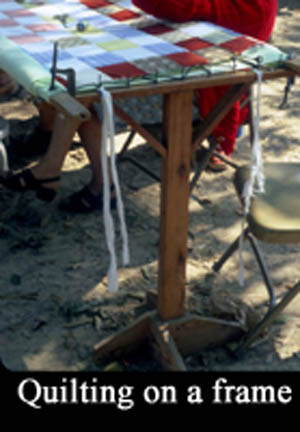
Quilt terms and techniques are part of the special quilting language frequently used by quilters. Some of the terms vary from region to region, but they are the basic information used in documenting the details of a quilt. The process of making a quilt is quite complex and may vary. Typically, the quilt maker makes a top, selects a batting and backing for the top, and quilts the layers together using a frame, hoop (or even a bed) to hold the three layers when spread out for quilting by hand (Figures 1A and B). Quilting may also be done on the sewing machine. These terms below used to describe quilts will aid in understanding the special qualities of quilts and in completing the Louisiana Quilt Documentation Form (page 2). In documenting a quilt, it is important to record the following information as accurately as possible:
Type of Item
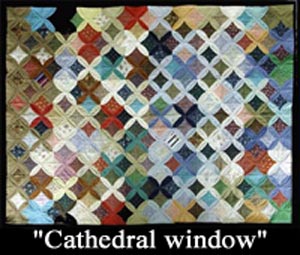
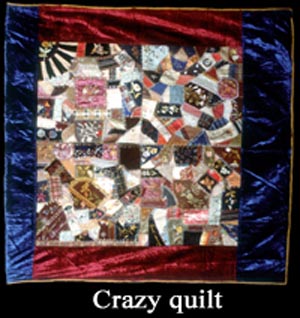
Quilts are called quilts even though they might not be quilted or even completed, so it is important to examine the quilt to see if it is a cloth sandwich, with a top, a back (or backing or lining), and batting (stuffing or filling) inside the two layers. If it has all three, it is a typical quilt. If it is one layer and the stitching appears on the other side, it is a quilt top. Some textiles also called quilts may actually have only one or two layers. The "Cathedral Window" (Figure 2), Victorian "Crazy Quilt" (see above), and even some older examples of the "Log Cabin" typically do not have a batting since the top and lining are so heavy
Sizes
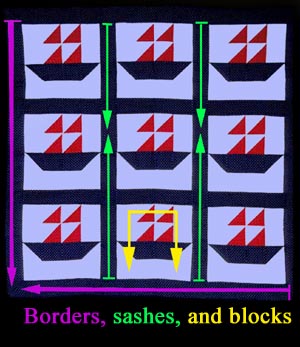
Basic units of the quilt (Figure 3) should be measured in inches using a steel tape or ruler or a stable fabric measuring tape:
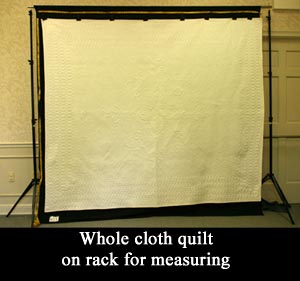
- Overall: Measure the length (usually from head to foot of bed) and width of the whole quilt (Figure 4). The following measures should be taken if applicable:
- Block: If the basic construction unit is a "block," measure one of these (Figure 5).
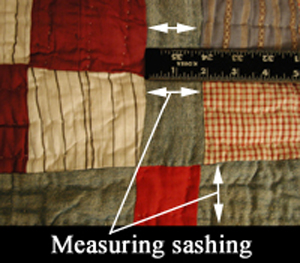
- Sashing: If it has "sashing" (one or more strips of fabric connecting separate blocks), measure the width of the sashes (Figure 6).
- Borders: If the quilt has borders (one or more strips around the outside of the quilt that frame it), measure the width of the border. In some cases, the borders on different sides may vary; this can be noted also.

Quilt type
This categorizes the quilt top. An experienced quilter may be needed for this section, but definitions and illustrations may help:
- Pieced: Also known as patchwork, pieced tops are made with fabric pieces sewn edge to edge, as in a mosaic (see Figure 3 above).
- Appliqué: Decoration is applied (with stitching or glue) to the surface of a plain background fabric.
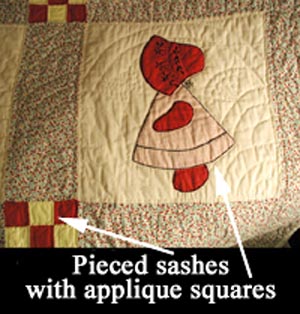
- Combination: The quilt has both piecing and appliqué (Figure 7).
- "Whole Cloth": The whole top is one fabric, with no piecing or appliqué (see Figure 4 above).
- Crazy: Made of seemingly random shapes and sizes of fabric, the quilt has no pattern. This type of quilt was popular in the Victorian period (Figure 8).
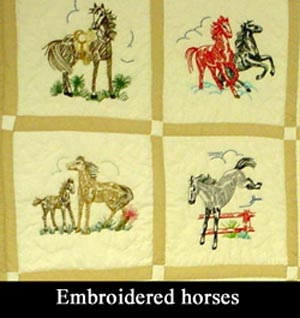
- Embroidery: Designs stamped on the fabric are embroidered on the top of the quilt. Many quilts which have embroidery will also be pieced or appliquéd (Figure 9).
- Cross Stitched: Cross-stitched quilt kits have been popular for many years and generally come stamped with the design to be embroidered using cross-stitching.
Construction of top: Look carefully at the top to determine if the piecing was done by hand, machine, or both. Usually hand-stitching is loose and more irregular than machine piecing. This does not include the quilting.
Pieced quilt type: If the quilt is pieced, the design units can be categorized according to how the design is constructed:
- Block: Pieces are sewn together to make a specific design that may be repeated in other blocks (see Figure 3 above).
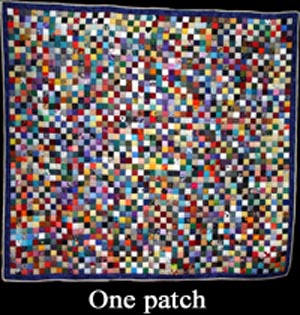
- One patch: The same unit is repeated with no other pattern discernible (Figure 10).
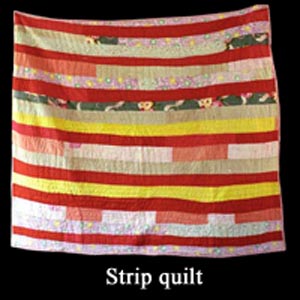
- Strip: Strips of fabric are sewn edge to edge (Figure 11).
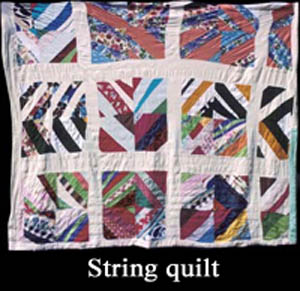
- String: Small bits of fabric are stitched together to form a square (sometimes on paper by machine) (Figure 12).
- All over pattern (Figure 13).
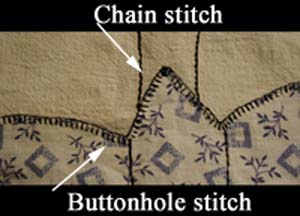
Appliqué stitching: These are the most common stitches used to apply the design to the fabric surface. The provided illustrations show the different basic stitches. Glue may also be used in newer quilts.
- Blind stitch: Barely visible since most of the stitch is under the fabric.
- Running stitch: A basic stitch sewn on top edge of the applied design.
- Buttonhole: Radiates out to the edge of the applied design (Figure 14).
- Machine appliqué: New machines make a variety of stitches, which can be identified by the regularity and close spacing of the stitching.
- Other: There are many other decorative embroidery stitches, such as "briar stitching" used especially in Victorian Crazy Quilts; if known, these can be noted here (see Figure 8 above).
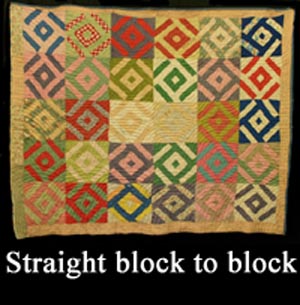
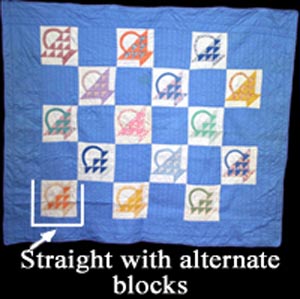
Setting: The construction of the top includes how the blocks are designed in relation to other blocks or parts of the design. The most common settings are illustrated below.
- Straight block to block (Figure 15).
- Straight with alternate blocks (Figure 16).
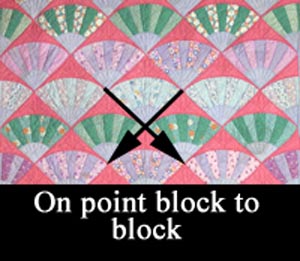
- On point block/block (Figure 17).
- On point with alternate blocks: Generally uses a solid color between pieced blocks.
- Sashed: Strips used to separate the blocks (Figures 3 and 18).
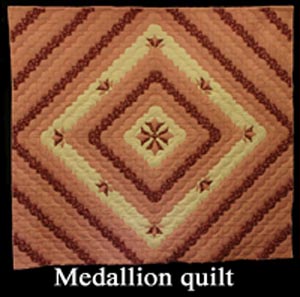
- Medallion: An all-over, large-scale design, rather than repeated designs (see Figure 13 above).

Binding: Binding is the method used to finish the edges of a quilt, enclosing the batting (if any) between the layers.
- Stitching: Check the stitching finishing the edges to see if it is done by hand or machine; it could be sewn on one side by hand, and the other by machine.
- Applied: An applied binding adds material to the edges to finish the quilt, which gives looks like a trim. If binding is used, it can made from straight grain fabric (cut parallel to the grain of the cloth) or bias grain fabric (cut diagonally across the grain of the cloth); using a bias strip of fabric is preferred, especially for curved edges such as the "Double Wedding Ring" (Figure 19).
If no new material has been added, then the binding is not applied. In this case, the edges may be bound in several ways:
- Top brought to back: The top of the quilt is turned over on the back (Figure 20).
- Back brought to front: The lining of the quilt is turned over on the top (Figure 21).
- Both turned in (also called knife edge): Both the top and back edges are folded inside so that the edges are even and stitched together either by hand (usually blind stitched) or by machine.


Borders: An optional unit on quilts, borders provide a nice frame when used. They may be utilitarian to make them bigger, and they may not even be on all four sides. Newer quilts frequently have multiple pieced borders on all four sides, and some borders may also use appliqué. Also check to see if the fabric matches the quilt or if it is a different fabric. Check all that apply.
Top fabric and Colors
- Fiber: If fabric fiber can be discerned by look or touch, check all that apply. If the quiltmaker is there, she will probably be able to tell you what material she used. Dates may give some clue as to fabric types. Polyester/cotton combinations have been common since the 1970s, but many contemporary quilters prefer 100% cotton, which was also the most common fiber in historic quilts.
- Design: Is the fabric a print or a solid color, or does it have both?
- Colors: Check the dominant colors; if various colors are used, check "multicolor/scrap, but also check the dominant color if there is one.
- Value: Check the overall effect of the quilt color: soft pastels or darker hues.
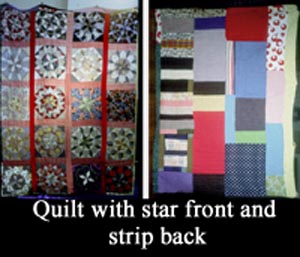
Backing/Lining: The back of the quilt (unless it's just a top) can be one solid piece of cloth (usually made from a sheet or wide cotton muslin) or it may be made from smaller bolt fabric; look for seams to determine the type. Some quilts have backing made of several different fabrics, and some quilts may even be pieced with strips (Figure 22).
- Fiber: Check for fiber type; quilts made before 1970 most frequently are cotton.
- Design: Is the fabric a print, solid color, or does it have both?
- Colors: Check to see if the color is the same as a dominant color in the top, a contrasting color, or a neutral (white, off-white muslin)
Quilting: Check to see what method (if any) is used to hold the layers together:
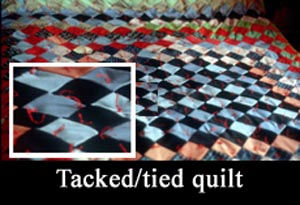
- Tacked/tied: Also called "Tufting," this technique of finishing a quilt relies on string or thread run through all the layers and tied in knots that can be on top or bottom and evenly spaced, usually about 4 inches apart. (Figure 23).
- Unquilted: Tops are often left unquilted and without binding; some tops do have a backing, but no quilting—a rarity.
- Machine quilted: Quilting by machine is more common among contemporary quilters because of the special quilting abilities of new sewing machines. The running stitches are precise, tight, and designs may be quite intricate.
- Hand quilted: Stitches can be tiny or large and may look somewhat irregular, but they will have a space between each stitch.
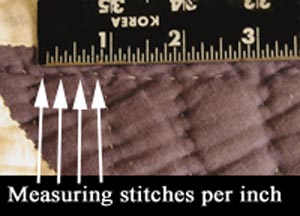
- Stitches per inch: On hand-quilted quilts, count the stitches per inch, putting the ruler at the start of one stitch and count the number of visible stitches for the inch (Figure 24).
- Design: The quilting stitches used to hold the layers together and prevent the batting from shifting can be done in a variety of designs:
By the piece: Stitches follow the edges of the pieces that make the block (Figure 25).
Shells: Stitches are done in descending concentric half circles (sea-shell like) usually one-half to one inch apart (see Figure 21 above).
Rows: Straight rows of stitches usually one-half to one inch apart; a variation is the square using descending half squares (Figure 26).
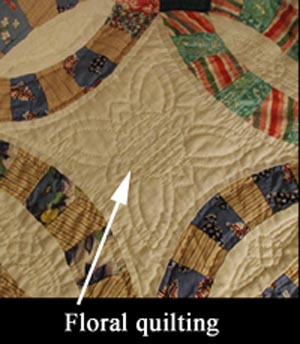
Floral/scroll motifs: Decorative designs such as fleur de lis, flowers, scrolls, etc. may be drawn on the fabric and quilted with running stitches (Figure 27).
Figure motifs: Any other type of figure can be drawn or done freehand on the top and quilted.
Other: Any other design used such as crosshatching, etc.


Batting: The batting (also stuffing, filling, or filler) may be a variety of materials; however, it may be difficult to determine the type used. If the quiltmaker is available, it is best to ask her. Otherwise, it may be possible to determine by date or by feel, weight, or depth or softness of the batting. If a quilt is torn, revealing the batting, the task will be easier. Some tips on identifying are as follows.
- Cotton: Quilts made before 1960 will usually have cotton; older quilts could even have some hard bits, which can be felt. Earlier quilts may have thick or thin cotton batts.
- Cotton/Polyester and polyester batting: Usually impossible to distinguish just by feeling. In general, polyester fibers may have a wirier feel between the top and back than cotton fibers.
- Wool batting: Rare in the south, but when it occurs, it is usually thicker than cotton batting and has a different weight.
- Blankets and old quilts: Sometimes used as batting, blankets will have a smoother feel inside the layers, while quilts may be lumpier. Occasionally, the pattern of the quilt inside may be visible under lighter color fabrics.
Condition: Inspect the quilt carefully front and back to determine its condition and note appropriately. Quilts which have been washed may be in relatively good condition, but may have some gaps in the batting where it has shifted.
Photos by Susan Roach
Graphics by Kerry Davis
Notes on Quilt Care
With the growing interest in American quilts, textile conservationists have been working to discover newer and better ways of caring for them. Given the amount of time, expense, and care put into making quilts, they certainly deserve the extra care, which will preserve them longer. Although they may seem sturdy, quilts are rather perishable; therefore, it is worthwhile to consider innovations in storage, cleaning, and use. While textile conservation standards may change, here are some basic guidelines and some good resources gathered from books, quilt and textile conservators, and online sources to help you preserve and appreciate your quilt heritage.
Storing Quilts
DO NOT store quilts in plastic bags. Fabric needs to breathe. Wrapping quilts loosely in clean, old cotton pillowcases or sheets is advised. Keep them out of direct sunlight and out of direct contact with wood and metal surfaces. This basically rules out storage in cedar chests, trunks, and quilt boxes, although cedar chests can protect wool and silk from insects. These enclosed chests do not allow adequate air circulation and may also cause rust (or age) spots, sometimes called "foxing," on the quilts if there is metal inside the chest. Refold the quilt periodically (every two months or so) to prevent permanent creasing, which breaks fibers. Air as often as possible out of direct sunlight. Do not stack more than four quilts, and do not put heavy items on top of quilts. It is best to rotate the order of the quilts in the stacks if they must be stacked. Old quilts may be folded with acid free paper in the folds. Most conservators recommend storing in large acid-free textile boxes, available from companies such as Light Impressions and Talas. Mothballs should not be used with cotton quilts, and most authorities advise against using mothballs to prevent insects even with silk or wool; however, some approve it as long as the mothballs do not touch the fabric.
Safe Use of Quilts
Quilts may actually be better off in use on beds than they would be in storage since they will not be subject to the problems caused by folding (as long as they are not sat on, are not in direct sun or strong florescent light, and are not kept between mattresses). A quilt may also be displayed on the wall as a work of art. To do so, attach the quilt to a wooden frame (similar to attaching canvas to a frame), using five-inch muslin strips (well-washed) sewn on the binding of the quilt. Easier to accomplish, yet more stressful on the quilt, is sewing a muslin sleeve (or casing) onto the top of the quilt so that a rod or dowel can be run through the casing.
Cleaning Quilts
Vacuuming quilts: Most textile experts agree that the best means of cleaning both sturdy and vintage quilts is to vacuum them regularly to keep them soil free. The safest method of removing soil from all quilts is to vacuum them clean, using a low suction on a standard machine or a hand-held vacuum cleaner. Cover the nozzle with a fiberglass or other screening material, such as nylon net, to protect the quilt. Do not touch a fragile, vintage quilt with the vacuum nozzle.
Hand-Washing Sturdy Cotton Quilts: Ideally, fabrics put into quilts should be washed and set before they are pieced; however, in older quilts or purchased quilts, one cannot be sure of initial treatment. Therefore, before washing, one must test the fabric to see if the colors are fast (will not run) by putting a few drops of water on different areas of the quilt and then blotting with a white blotter. If dyes do not come off on the blotter, repeat the test with detergents and water. If the colors are fast in a cotton quilt, the quilt may be washed in the bathtub or other large container, which will allow the quilt to be unfolded as much as possible. Some quilts can be cleaned with plain water without detergent. If a detergent is needed, the Alliance for the American quilt website recommends Orvus, a neutral detergent, Ivory Soap Flakes, or Fells Naptha. Do not use strong detergents with brighteners or bleaches. Place the quilt on top of an old cotton sheet or piece of fiberglass-coated screening and submerge it in plain water (preferable soft or distilled) about 90 degrees F. Soak the quilt in the tub without lifting it out of the water. Drain the soapy water and let new rinse water in. Repeat this step as many times as is necessary to remove all the detergent. When the final rinse water is drained, hand-squeeze excess water out of the material. To remove the quilt from the tub in a way that does not stress its fabric and stitching, lift it out on the sheet or screen (or place several rolled bath towels under it, then lift it out with the towels. Place it on towels or a mattress pad and press out excess water. Dry it flat (lining side up) on towels or a sheet spread on a frame or the ground away from direct sunlight. Do not hang it vertically on a clothesline since this puts great stress on the stitching. If drying indoors is necessary (although not recommended), fans blown across the surface will speed drying time. Although washing machines are not recommended, if you do use the washing machine, do NOT use the agitator. Do not use the dryer. Dry-cleaning quilts is NOT recommended.
Cleaning Fragile Quilts: If a soiled quilt is silk and wool, over 50 years old, or showing signs of wear even though it has extremely fine work on it, it may need special cleaning care. It is advisable to have a trained textile conservator do the cleaning of these special antique quilts (see below). Do not dry clean them since most dry cleaners do not have training in vintage fabrics.
References and More Information
Alliance for the American Quilt website
(answers questions on cleaning, displaying, storing, restoring quilts)
Care of Victorian Silk Quilts and Slumber Throws
Storing antique textiles at home
Ghiardi Thomsen, Fonda. "In Your Care We Trust."American Quilt Study Group Technical Guide, No. 3., 2002. Order from: American Quilt Study Group, 35th & Holdrege, East Campus Loop, P.O. Box 4737, Lincoln, NE 68504-0737 or call AQSG (402-472-5361
Orlofsky, Patsy and Myron. Quilts in America. New York: McGraw Hill, 1974. An older, but reliable book available in many parish libraries.
Online Essays on Quiltmaking in Louisiana
Roach, Susan. "Keep Your Mind and Your Hands Busy:" Expressive Dimensions of the Lone Quilter.
Roach, Susan. Traditional Quiltmaking in Louisiana.
Roach, Susan and Laura Westbrook Quilts as Women's Documents: The Louisiana Quilt Documentation Project.
Walker, Rosie A. Textile Uses in the Homes of Central Louisiana Czechs.
